
Most advice about white witch meaning is too shallow to be useful. It reduces the term to “good witch” and leaves people with a childlike moral label instead of a workable ethical standard. That sounds tidy, but it fails the moment you deal with protection, uncrossing, bindings, or any case where harm has already entered the situation.
A serious practitioner doesn’t start with aesthetics, robes, herbs, or social media identity. They start with ethics, diagnosis, and limits. White magic isn’t a theatre costume, and white witchcraft isn’t a promise that every action will look soft, passive, or pleasant. It’s a disciplined commitment to benevolent intent, restraint, and accountability, even when the work itself must be firm. Never dramatize magic in a Hollywood frame, and never make claims of guaranteed results. Nothing works instantly.
Navigating the Structure of White Witchcraft
- What Is a White Witch A Modern Definition
- The History of the White Witch Archetype
- The Guiding Ethics of White Witchcraft
- Typical Practices and Tools Used in White Magic
- White Witch vs Black and Grey Witchcraft
- How to Vet a Practitioner and Avoid Scams
- Frequently Asked Questions About White Witchcraft
What Is a White Witch A Modern Definition
“White witch” sounds clearer than it is. In actual practice, the term often gets flattened into a childish moral split: white equals good, black equals bad. That framing fails the moment a practitioner has to do real work for a real client, especially in cases involving crossed conditions, spiritual harassment, family interference, or the need to break an active curse.
A white witch, in modern use, is usually a practitioner who defines their work by ethics rather than by a single lineage, deity set, or ritual system. The core idea is benevolent intent, but that needs sharper language than “love and light.” It means the work is ordered toward healing, protection, blessing, restoration, and justified defense. It does not mean weakness. It does not mean refusing hard measures when hard measures are the remedy.

The label points to ethics, not aesthetics
Plenty of newcomers assume the term describes a look, a mood, or a fixed kit of harmless rituals. Experienced workers know better. White witchcraft is not defined by white robes, pale candles, soft speech, or social media language about “high vibrations.” Those are presentation choices.
What matters is method under restraint. A practitioner may use herbs, psalms, charms, divination, spirit work, cleansing rites, uncrossing, or household folk practices and still fall under this label if they keep clear limits around harm, coercion, and exploitation. Anyone trying to understand why ritual works at all should start with a grounded explanation of how magical belief shapes ritual practice.
A label alone is never enough. Ask what the practitioner does, what they refuse to do, and how they decide the difference.
White witchcraft is not passive
This is the point popular summaries usually miss. Protective magic can be forceful. Curse-breaking can involve reversal, severing, binding, containment, or expulsion. None of that is automatically malicious. In many traditions, refusing to confront an attack is not moral purity. It is poor judgment.
That is why the good-versus-evil binary causes so much confusion. If a home is repeatedly afflicted, if a client is dealing with obsession work, or if a malicious attachment keeps returning, “gentle energy” may not solve the problem. The first task is diagnosis. You identify what is happening, what caused it, whether the condition is spiritual, psychological, social, or medical, and which response fits the case. Only then do ethics become meaningful in practice.
From that perspective, a white witch is best understood as a practitioner committed to beneficial outcomes and disciplined limits, not as someone who avoids conflict at all costs. Sometimes the right working is a blessing. Sometimes it is a cleansing. Sometimes it is a hard boundary backed by spiritual force.
The History of the White Witch Archetype
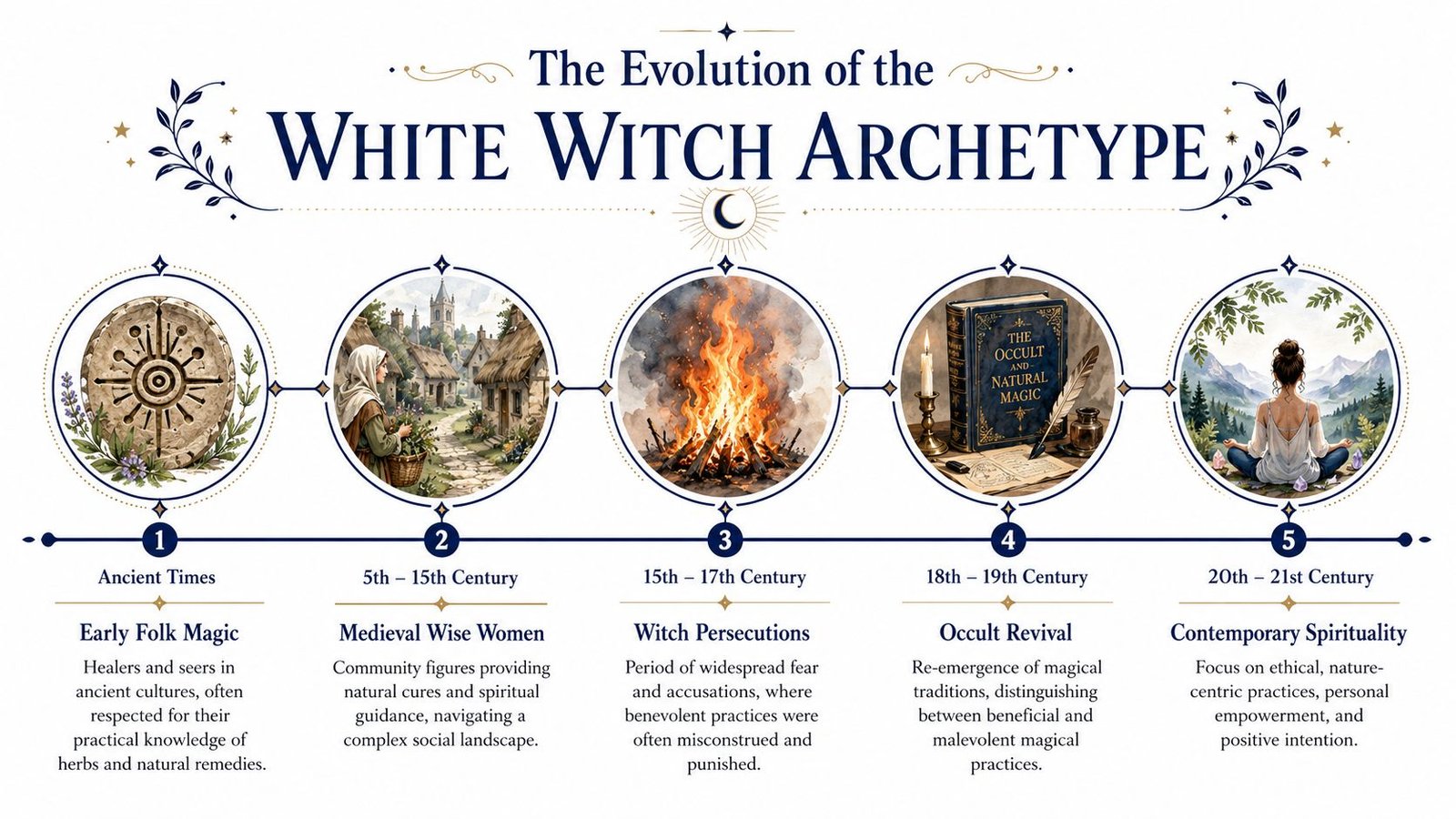
The phrase sounds ancient, but the wording is more recent than many people realise. Historian Owen Davies notes that the specific term “white witch” was rarely used before the 20th century, emerging from 19th-century folklorists who adopted it from 17th-century polemicists discussing benevolent “cunning folk,” as noted in this historical overview of magic terminology).
That older world matters more than the label itself. Across English-speaking folk history, the people who did benevolent magical work were more often called cunning-man, wise-man, or wise woman. They healed, blessed, diagnosed afflictions, and removed harmful workings. They weren’t usually living inside a clean “good witch” identity. They were filling a practical social role.
The older role was practical
In village and household settings, benevolent practitioners were often the people others turned to when ordinary remedies had failed. They might use herbs, spoken charms, prayers, songs, or ritual actions to calm illness, lift fear, bless livestock, or break hostile work. Their authority came from usefulness, lineage, reputation, or hard-earned trust.
That’s one reason modern fantasy imagery misses the point. The historical figure behind the white witch archetype was often closer to a healer and problem-solver than a theatrical occult celebrity. For broader context on how sacred authority and ritual knowledge developed in older societies, this discussion of ancient Mesopotamian pattern and sacred rule offers a helpful frame.
Canada’s legal shift matters
In Canada, the legal treatment of witchcraft also changed in a specific and important way. Section 365 of the Criminal Code, which prohibited “pretending to practise witchcraft,” was repealed on December 13, 2017 through Bill C-51 receiving Royal Assent, as reported by CBC’s coverage of the repeal. The offence had lingered as a “zombie” law long after its logic had rotted away.
This didn’t suddenly create witchcraft. It removed an obsolete legal mechanism that had treated certain claims around occult practice as criminal pretence.
The law had reached the absurd point where actually being a witch wasn’t the issue, but pretending to be one could still trigger a charge.
The archetype carries baggage
The term also carries cultural baggage beyond occult circles. In literature and popular imagination, “white witch” has at times been tied to a racialised archetype rather than an ethical one. Modern pagan and magical communities have largely moved away from that framing and re-centred the term around benevolent intent, nature reverence, and spiritual responsibility.
So when people ask about white witch meaning, the historical answer is layered. The phrase is relatively modern. The role behind it is much older. The stereotype is unreliable.
The Guiding Ethics of White Witchcraft
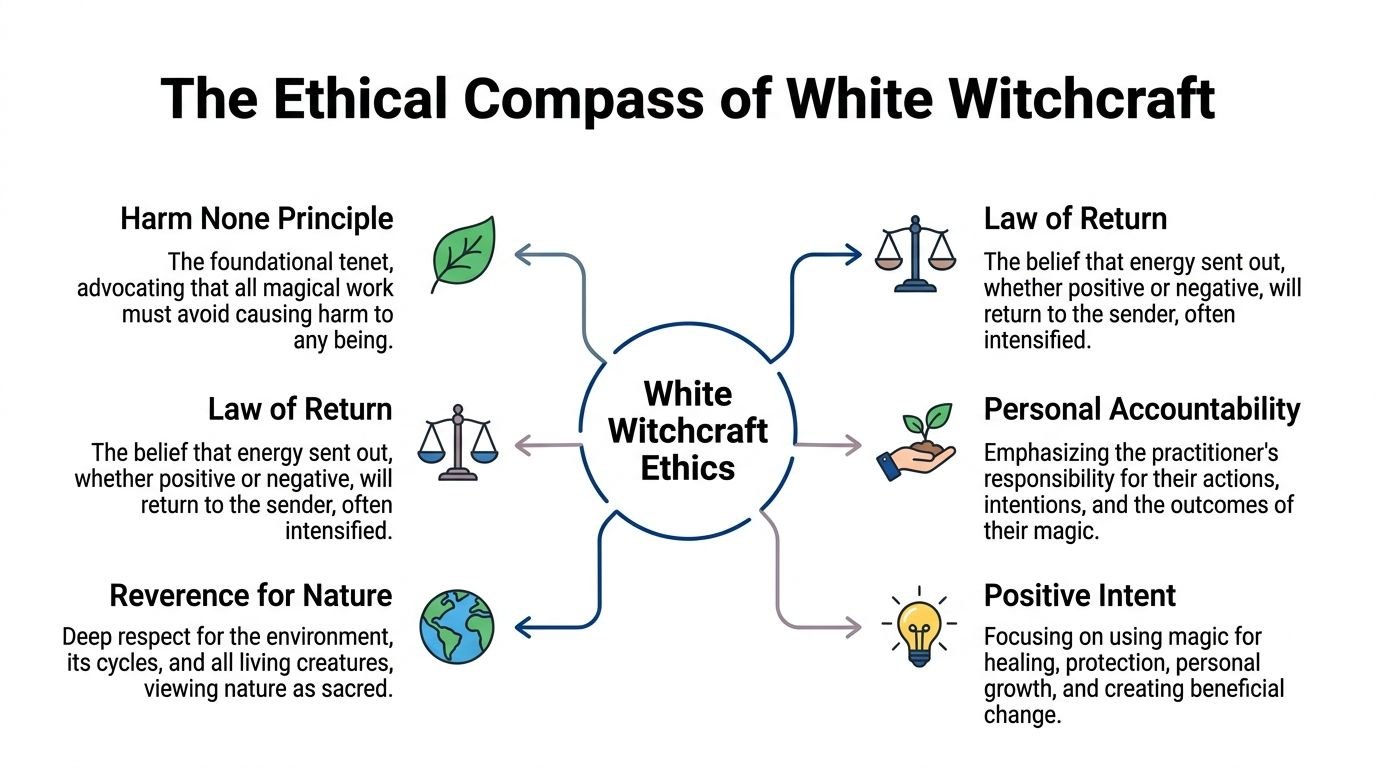
A modern white witch isn’t defined by one religion, one lineage, or one altar layout. In contemporary Western esotericism, the term functions as an ethical descriptor for practitioners who prioritise benevolent intent, often drawing on the Wiccan Rede’s principle of “An it harm none, do what ye will”, as discussed in this explanation of white witch ethics.
That line is easy to repeat and much harder to live by. Most beginners hear “harm none” and turn it into a sentimental ban on anything difficult. That’s not ethics. That’s avoidance.
Harm none is not moral laziness
Every act has consequences. Even a blessing changes conditions. Even a healing rite may expose truth that destabilises a situation before it improves. Serious white witchcraft asks the practitioner to think through intent, consent, foreseeable effects, and whether the action serves restoration or ego.
A few ethical tests are useful in practice:
- Check motive first. Are you trying to heal, protect, clarify, and restore, or are you trying to punish because you’re angry?
- Examine consent carefully. Work done with someone is different from work done on someone.
- Weigh side effects. A road-opening ritual for one person may close a door for another. That doesn’t always make it wrong, but it does make it your responsibility.
- Know when not to work. Some situations require mundane action, medical care, legal support, distance, or silence.
Intent is necessary, but not sufficient
People often say intention is everything. It isn’t. Intention matters, but method matters too. A benevolent goal pursued through reckless means can still create damage. That’s why mature practitioners pair compassion with discipline.
White witchcraft also tends to involve an ongoing relationship with nature, timing, and reciprocity. The practitioner is not meant to dominate every condition through force. They work in rhythm with cycles, limits, and consequences.
Field note: Good ethics don’t remove hard choices. They make you accountable for how you make them.
Benevolence includes boundaries
At this juncture, the public conversation usually collapses. If white magic is only allowed to be soothing, then it becomes useless in many real situations. Protection can require refusal. Uncrossing can require forceful removal. A binding may be the least harmful option in a dangerous case.
The point is not to stretch “white” until it means whatever you want. The point is to recognise that benevolent work sometimes takes firm forms. The ethical question is not whether the ritual feels severe. The ethical question is whether it is proportionate, necessary, and aimed at reducing harm rather than feeding appetite.
Typical Practices and Tools Used in White Magic
White magic tends to look ordinary from the outside. That’s one reason people underestimate it. The common tools are often humble: herbs, candles, blessed water, prayer, charms, crystals, oils, written petitions, and protective objects placed with intention.
Practices commonly align with natural elements and rhythms. White witchcraft often uses herbs, crystals, and essential oils, and many practitioners time work with lunar cycles and seasonal shifts. These methods require patience and do not produce instant results, as described in this overview of white witchcraft practices.
What the work usually includes
A white witch may perform several kinds of operations in regular practice:
- Blessing work. Home blessings, travel blessings, pregnancy blessings, or rites to settle a space after conflict.
- Protective work. Wards, boundary charms, cleansing baths, floor washes, protective candle rites, and guardian petitions.
- Healing support. Spiritual comfort, emotional steadiness, sleep work, or ritual reinforcement alongside practical care.
- Divinatory guidance. Tarot, scrying, pendulum work, or omen-reading to assess conditions before acting.
These are not instant-fix mechanisms. They work through repetition, timing, and congruence between the ritual act and the actual condition of the case.
Tools are supports, not substitutes
People also make too much of materia. Crystals, for instance, are not magical shortcuts. They are supports within a method. If you work with stone energy in protective or meditative contexts, a careful mineral reference like this amethyst stalactite guide can help you think more clearly about structure, formation, and selection instead of treating every crystal as interchangeable.
For beginners, candles and herbs are usually more instructive than ornate tools because they teach patience. A cleansing bundle, a dressed candle, a bowl of water, or a spoken prayer can reveal more about your discipline than an expensive shelf full of unused ritual objects.
If you need a grounded overview of method before aesthetics, this introduction to the basics of spellwork is the sort of foundation worth studying.
White magic usually looks less dramatic than people expect. Repetition, timing, and clear intent matter more than spectacle.
What doesn’t work
Template spells copied without diagnosis often fail. So do rituals performed in a panic, rituals overloaded with too many mismatched ingredients, and any working based on guaranteed outcomes. When people pile urgency onto poor method, they usually get confusion, not clarity.
Nothing works instantly. Anyone promising otherwise is selling emotion, not craft.
White Witch vs Black and Grey Witchcraft
The white, black, and grey labels are blunt tools. They describe ethical tendencies, not fixed species of practitioner, and they often obscure more than they clarify.
Popular discussion treats white witchcraft as harmless, black witchcraft as harmful, and grey witchcraft as the murky middle. That summary is serviceable at a distance. It becomes unreliable the moment an actual case involves coercion, stalking, spirit disturbance, chronic hostility, or the need to stop ongoing harm.
A Comparison of Witchcraft Ethics
| Identity | Core Ethos | Typical Goals | Stance on Harm |
|---|---|---|---|
| White witchcraft | Restorative, protective, disciplined | Healing, blessing, cleansing, protection, guidance | Seeks to reduce harm and avoid malice, but may use forceful defense |
| Grey witchcraft | Situational, pragmatic, case-led | Balance, justice, defense, reversal, targeted intervention | Accepts morally mixed actions if they are proportionate and justified |
| Black witchcraft | Dominating, coercive, injurious | Control, revenge, manipulation, punishment, spiritual pressure | Uses harm as a tool for gain, control, or deliberate injury |
Where the neat categories fail
Protection is the clearest example. A home uncrossing may be gentle. A binding against repeated attack is not gentle, but that does not make it malicious. Curse-breaking can require confrontation. Reversal work can carry force. The ethical question is not whether the rite feels soft. The question is what it is doing, why it is being done, and whether the response is proportionate to the condition.
That is why the good versus evil binary fails serious practice. It trains beginners to judge tone instead of function.
A practitioner who refuses every hard-edged operation in order to stay “white” may leave a client exposed. A practitioner who hides behind “grey” to justify any impulse usually lacks discipline. The label is less important than method, restraint, and diagnosis.
Intention alone is not enough
Many modern descriptions of white witch meaning stop at intent. Intent matters, but it is not the whole ethical frame. Sloppy cleansing can stir a condition without clearing it. Protection done without assessment can lock a problem in place. A justified defensive working can become vindictive if the practitioner stops measuring force and starts feeding anger.
Experienced workers learn to separate three things. What is happening. What response fits the case. What consequences follow if the response is too weak or too aggressive.
That diagnostic habit matters more than aesthetics or branding. It is the difference between a blessing, a boundary, and an act of coercion.
Grey is not a free pass
Grey witchcraft is often presented as balanced or realistic. Sometimes it is. Sometimes it is just a polite label for inconsistency. Real ethical flexibility requires judgment, record-keeping, and a willingness to refuse work that crosses into domination or vanity.
For that reason, I treat white witchcraft as an ethical center rather than a promise of perpetual softness. The aim is restoration, protection, and reduction of harm. In practice, that can include removals, bindings, reversals, and spirit boundary work when the case calls for them.
Readers who want a clearer standard for screening claims should review this guide to verifying a spellcaster’s credibility. Cleansing is a good example of why labels can mislead, especially when people confuse plant use, folk ritual, and protection claims without understanding sage cleansing practices.
How to Vet a Practitioner and Avoid Scams
Most spiritual fraud succeeds because the client is frightened, rushed, or exhausted. A scammer doesn’t need strong occult knowledge if they can push the right panic button. That’s why vetting matters more than branding.
The hardest truth is that “white witch” is not a safety certificate. Existing discussion often defines the term too narrowly as “good,” while ignoring the complex situations where protection or removal of harm may require confronting darker conditions. That gap leaves people unsure how to judge method and ethics, which is one reason a diagnostic-first approach matters, as argued in this critique of simplistic white witch definitions.
Green lights worth taking seriously
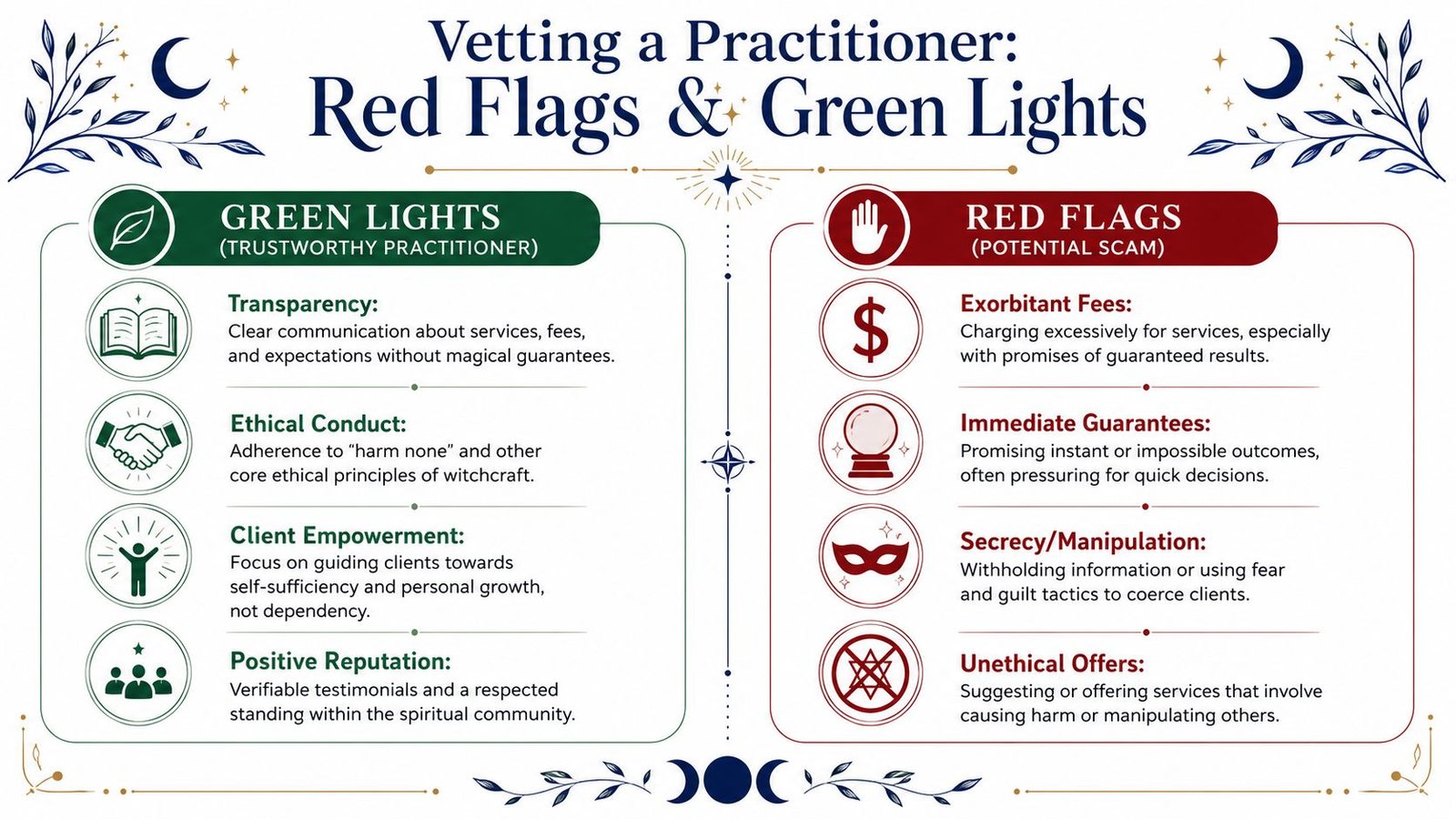
A credible practitioner usually shows their ethics in plain language, not mystical fog.
- Clear scope. They explain what they do, what they don’t do, and where ritual support ends.
- No instant promises. They don’t guarantee impossible outcomes or claim every issue is a curse.
- Assessment before action. They ask questions, review context, and may refuse work that isn’t appropriate.
- Documented policies. Fees, privacy terms, booking conditions, and boundaries are visible.
- Useful education. They help you understand process instead of cultivating dependency.
If you’re evaluating providers, a service focused on spellcaster verification and practitioner checks can be more useful than another generic review thread.
Red flags that show up fast
Scammers tend to use a repeating script:
- Fear first. “You’re cursed.” “Your partner is hexed.” “Your family line is blocked.”
- Urgency pressure. They insist you must pay immediately or the situation will worsen.
- Escalating charges. Every supposed obstacle requires another payment.
- Guaranteed success. They speak in certainty where no honest practitioner can.
- Isolation tactics. They tell you not to consult anyone else.
For people learning basic cleansing discernment, resources on understanding sage cleansing practices can help separate ordinary purification work from fear-based sales language.
A trustworthy practitioner can describe limits without sounding weak. A scammer usually can’t stop promising.
Why diagnosis matters
In serious work, diagnosis is not bureaucracy. It’s ethics in action. A good practitioner distinguishes grief from attachment, anxiety from attack, ordinary conflict from occult interference, and self-sabotage from external pressure. Without that step, ritual becomes guesswork dressed as certainty.
That diagnostic-first standard is especially important in cases involving curse removal, layered blockages, recurring relationship collapse, or protection after repeated breach. Those are the exact situations where simplistic “good witch” language stops being useful.
Frequently Asked Questions About White Witchcraft
Is white witchcraft a religion
Not necessarily. Some white witches are Wiccan, some are folk practitioners, some are eclectic, and some work within a private devotional system. The term usually points to ethics and method more than formal religious membership.
Can a white witch do protection or curse-breaking
Yes, if the work is aimed at protection, cleansing, or removing harm rather than indulging malice. Many people confuse softness with goodness. Benevolent work can still be firm.
Does white magic work instantly
No. It doesn’t. Ritual work may unfold gradually, and some operations require repetition, timing, and practical follow-through. Anyone offering immediate guaranteed results is giving you a sales line, not honest counsel.
Is white witchcraft always harmless
No practice that changes conditions is free of consequence. Ethical white witchcraft tries to reduce harm, foresee side effects, and act with proportion. That’s different from pretending every ritual is morally simple.
What tools does a white witch need first
Very few. A journal, a candle, clean water, a prayer or blessing practice, and one divination method are enough to begin serious study. One tends to buy too many objects and train too little attention.
What should a beginner study before trying spellwork
Study cleansing, protection, ethical boundaries, and divination before attempting heavy manifestation work. Learn how to tell the difference between emotion, intuition, projection, and panic. Those skills prevent far more mistakes than a cupboard full of supplies.
How do I know whether I need a ritual or a mundane solution
Often you need both, and sometimes you need only the mundane one. If the issue is legal, medical, financial, or psychological, handle that directly. Spiritual work can support clear action, but it shouldn’t replace real-world responsibility.
If you want a serious assessment before choosing any ritual path, SCG Witchery offers diagnostic consultations, structured divination, and custom ritual work built only after evaluating the actual mechanics of a case. That’s the standard people should expect more often.
Produced via Outrank app