
Ancient Mesopotamia. Pattern, Power, and Sacred Rule
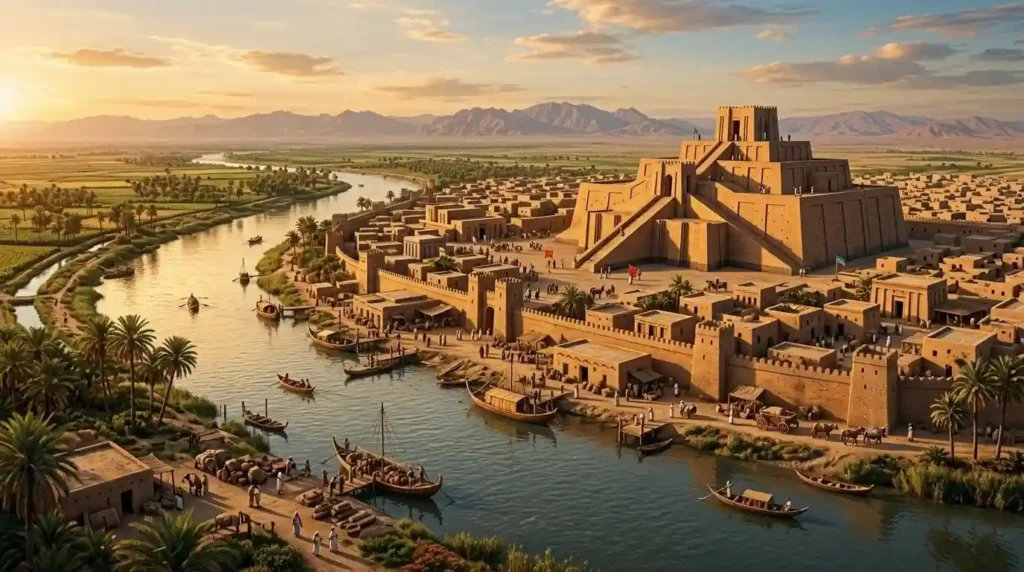
True human mastery begins not by chance, yet shaped through purposeful design In a place known today as Ancient Mesopotamia. Along the fertile banks of the Tigris and Euphrates five millennia past, societies arose – sharp, intentional – not meandering toward form. What appeared was less growth, more like awakening: cities built with precision, laws carved in stone, systems engineered with foresight. Evidence remains in countless tablets hardened by sun and time, revealing minds that saw patterns where others might see chaos.
Order came first, imposed not by nature but decision. Structure followed thought, long before labels were attached to power or rule. These people did not stumble forward; they projected meaning onto matter. Their worldview lacked our split between experiment and belief. Insight drove construction. Purpose preceded progress. Meaning led mechanism. Power, they saw, depends on organized systems. Beyond today’s rigid beliefs lies an older truth – early societies show how control worked, how secret teachings moved, and how reality was shaped through deliberate design.
Mathematics and the Structure of the Universe in Ancient Mesopotamia
Early scribes In Ancient Mesopotamia. showed sharp insight into efficient design through their math work. Not settling for basic counting methods, they built a refined base-60 structure called the sexagesimal system. Thought guided that choice, not chance. Since 60 is packed with factors – like 2, 3, 4, 5, 6, 10, 12, 15, 20, and 30 – it splits neatly many ways. That smooth division helped officials handle tricky ratios, share goods fairly, and lay out exact land plots without getting stuck in messy calculations.
Still shaping how we define moments and distances, this numerical method holds quiet power today. Each clock face built on sixties – hours, then smaller units – carries its imprint clearly. A full turn around a circle, marked in 360 parts, traces back to these early choices. From such roots, sky watchers long ago followed planets like Mars, Jupiter, Saturn, Venus, and Mercury through star patterns. Their work did not rely on guesses but precise methods meant to link daily life with celestial paths overhead.
Cuneiform: Knowledge Preservation in Ancient Mesopotamia
Across time, Ancient Mesopotamia memory fades – yet what lasts emerges when marks meet clay. By roughly 3200 BCE, writing appeared, shifting human record from guesswork to precision. Instead of relying on spoken lines passed mouth to ear, communities began pressing meaning into soft tablets. These early signs, shaped like wedges, evolved beyond counting grain or goats. Rather than mere letters, they formed a layered code where sounds and symbols merged. With each impression, scribes gave shape to law, lineage, wealth.
Reality itself became something that could be stored, referenced, controlled. Power followed the stylus. Through cuneiform, order rose where uncertainty once ruled. Over thousands of years, clay tablets held firm against erosion. Their endurance reveals something essential – lasting power depends on recording core ideas in forms that refuse to fade. What survives is not chance but structure carved deep.
Water Management and Mesopotamian Engineering
Out here, staying alive meant bringing nature to heel. Across Ancient Mesopotamia, heat baked the land each summer, dry spells dragged on, then sudden floods roared down from the Tigris and Euphrates every spring. Stability came only through large-scale human-made systems managing water flow. Using precise measurements, people built long channels, protective barriers, rock-lined storage pools, along with movable floodgates – each part working together. With these tools, untamed river energy got channeled where it was needed most.
Once-barren stretches slowly transformed under steady irrigation into rich fields capable of supporting entire communities. Behind strong defensive barriers, cities such as Ur, Uruk, and Eridu grew larger because surplus supplies made room for people who did not farm. Instead of growing food, some individuals became experts in law, construction, design, or ritual practice – free to shape societal systems more deeply. Because materials were managed with purpose, city life advanced beyond basic needs into structured complexity.
Ancient Law Codes and Organized Society in Ancient Mesopotamia
Managing large populations required ancient governments to shift from unpredictable rulings to fixed legal rules. Well before famous Middle Eastern law collections introduced punishment-based justice, primitive clay tablets outlined clear methods for trade oversight, community repair, and power distribution. The earliest known example, Ur-Nammu’s code, reveals strong attention to peaceful cities, transparent business practices, otherwise balanced communities. Such writings defined exact boundaries so daily life could remain orderly.
Fixed pay rates set by rule for workers using hands and tools in skilled trades
Valuation timelines grow tighter when dealing with key market goods, real estate holdings, livestock inventories – each governed by fixed review cycles. Timing shifts depending on asset type, though oversight remains consistent across sectors. Markets adapt, yet measurement intervals hold steady regardless of external changes
Definitive financial restitution fines for civil infractions and structural property damage
Justice became steady, visible, uniform – etched into clay so no one could claim ignorance. Vulnerable groups gained firm shields from financial exploitation through laws made unchangeable. The land adopted rules that did not bend, held fast in sun-baked tablets spread everywhere. Authority stood on substance, not shifting words. Each tablet acted as a public anchor against unfair money practices.
The Ziggurat and Centers of Authority in Ancient Mesopotamia
Each self-governing urban center turned around its towering centerpiece – the ziggurat – rising like an artificial hill made of packed earth. Not carved from rock but shaped through human coordination and precise planning, these forms stood despite limited access to timber or stone. Instead of relying on imported materials, architects used what the land provided: wet soil molded into blocks and hardened under open sky. Deep within, countless unfired bricks formed a heavy foundation, stacked beyond count.
Outer surfaces survived seasons thanks to baked brick armor, locked tight with sticky black pitch that repelled moisture. What emerged was neither temple nor fortress alone, yet something more – a statement raised grain by grain. Standing tall across the landscape, the ziggurat acted not just as a religious monument but as a hub for governance and record keeping. Reaching upward in tiered layers, it linked the depths below with celestial realms above through architectural form. Within its stone walls rested granaries holding grain supplies, chambers filled with clay tablets, and meeting halls where officials shaped policy.
Built with deliberate massiveness, it signaled control amid disorder, its silhouette visible far beyond city limits. Its presence on the horizon reminded all who saw it that structure now ruled where randomness once held sway.
Flood Traditions in Ancient Mesopotamia Literature
Long before modern records, ancient writers blended actual happenings with layers of meaning. Found in texts like the Atrahasis Epic, the Epic of Gilgamesh, and the Sumerian King List, this blend holds firm through time. Shifting power between city centers marks one thread in the Sumerian King List’s account. At first, it describes rulers who held sway for immense spans – often tens of millennia. Then comes a break – a great flood cuts through the narrative like a blade. After the disaster, documented rule periods suddenly match known historical dates.
Evidence from texts fits patterns found in physical surroundings. Beneath old city remains in today’s Iraq, soil digs show heavy stretches of empty silt. Such findings prove powerful floods – capable of reshaping societies – hit often. Survivors etched chaos, renewal, and control regained into lasting stories passed down by early writers.
Divine Authority and the Origins of Civilization
Understanding this heritage requires stepping away from rigid modern views along with unproven stories. Over the past few decades, widely-read dramatic authors have tried reshaping old writings, arguing that the sky-beings described in clay were actual off-world laborers arriving to mine tangible gold while altering human genetics. Yet the full collection of inscribed tablets directly opposes such a concrete, tech-based idea. Those named in the records – figures like Anu, Enlil, and Enki – are clearly framed through deep awareness of existence, supreme governance, and core principles.
In Ancient Mesopotamia the texts never called them engineers or pilots of celestial devices. Instead, they were seen as origins – of structure, strength, of existence. That view repeats patterns found in early spiritual systems around the globe. Take the forged Book of Enoch: there, divine watchers fall from high realms, bringing hidden arts down. Crossing such thresholds to teach metalwork, sky signs, magic – they tilt the foundation. Such rupture demands correction; water arrives, sweeps it clean. Clear patterns show up again and again: from clay tablets marked with wedge shapes to fragile papyrus rolls, people have long seen their major breakthroughs as coming straight from higher powers.
Not machines or trade items did those first sources deliver – instead, they gave ways of thinking that made society possible, like speech forms, symbols on surfaces, how days fit into cycles, and rules for fair judgment. Reaction back then took no form of mere task lists; it expressed itself through deep dedication to purposeful effort. Monuments meant to endure rose under such influence, sky-based time counts became exact, detailed knowledge passed down in order, solemn promises drew authority from exalted titles. From the start, makers of cities grasped one truth – intelligence and direction shape everything across space.
Out of ancient Mesopotamia rises a legacy showing how disciplined thought builds worlds. Not chance, but relentless purpose carved human progress into being. Where others saw chaos, builders imposed pattern – their minds fixed on unseen laws beneath things. Mastery here grew not from luck, but steady grasp of hidden currents shaping life. Willpower, structured and repeated, became the tool by which raw existence took form. Each act followed intention like river follows channel. Focus, unwavering, turned myth into measure.