
Seeking Practitioners to Field Test the Orientation Wheel
The Question the Hero’s Journey Doesn’t Answer
Joseph Campbell’s Hero’s Journey remains one of the most enduring frameworks for understanding
transformation. Across mythology, literature, film, and psychology, its structure — departure, initiation,
return — maps the shape of every meaningful human story.
But the Hero’s Journey begins at the Call to Adventure and leaves one foundational question completely
unanswered: what creates the internal pressure that makes someone answer the call in the first place?
The model assumes the hero moves. It does not explain why stillness breaks.
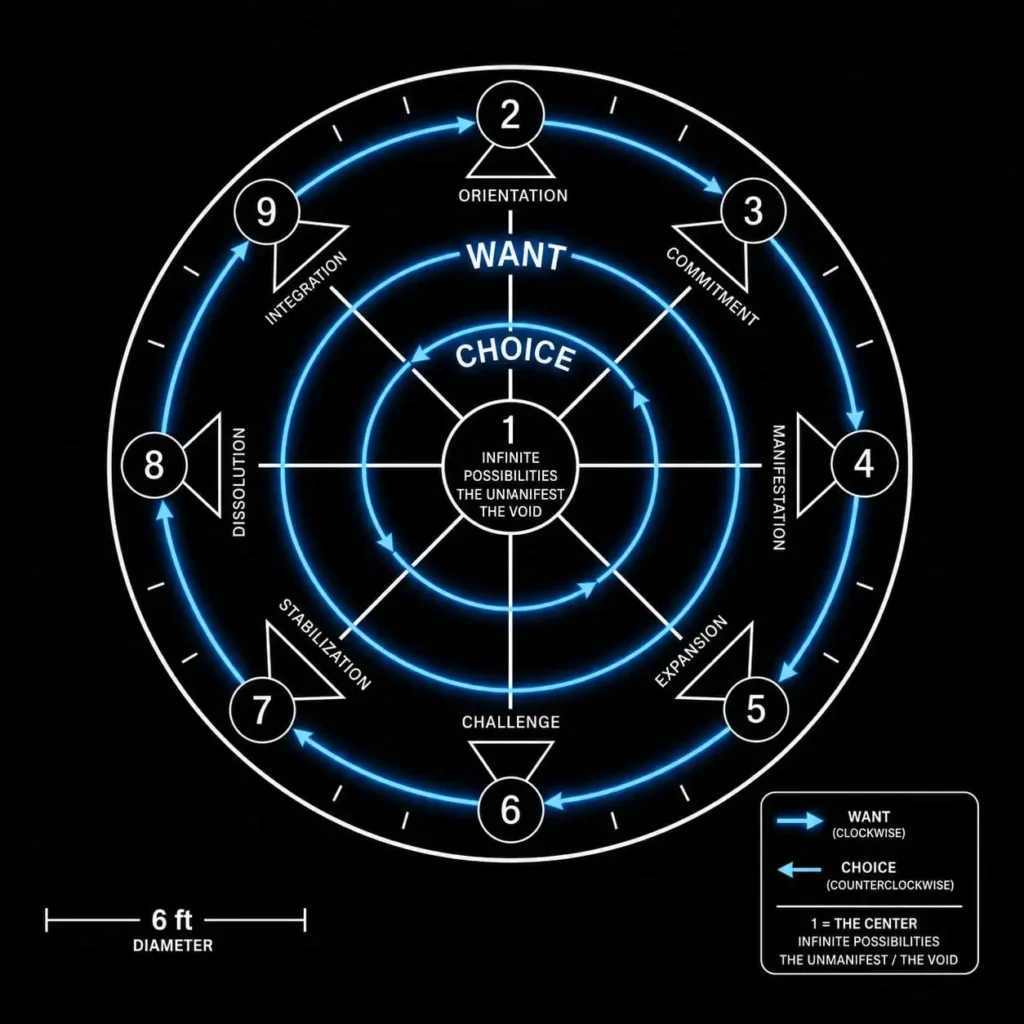
The 9 Pillars of Orientation Wheel addresses this gap directly. Before any outward movement, a sequence of internal forces must activate — Lack creates the asymmetry that disturbs equilibrium, Desire generates the initial pull toward resolution, Want sustains that pull around a specific possibility, and only when Choice converges with Want does Selection occur and Orientation begin. The Hero’s Journey names the threshold. The Orientation Wheel reveals the engine that forces you across it.
Most magical systems spend a great deal of time discussing manifestation, intention, energy, belief, correspondence,
or results.
Far fewer ask a simpler question:
Why do some possibilities become reality while countless others remain unrealized?
That question led me to develop the Orientation Wheel, a framework that attempts to map the process through which conscious participation moves from possibility into experience and then returns to possibility carrying the lessons, changes, and capacities gained along the way.
The system did not begin as a ritual.
It began as an observation.
Many practitioners can clearly identify what they desire. Many can visualize outcomes, perform rituals, construct servitors, petition spirits, or build elaborate magical operations. Yet despite possessing strong desire, they often find themselves moving in directions that contradict their stated objectives.
The Orientation Wheel attempts to explore that tension.
A Different Question
Rather than asking how manifestation works, the Orientation Wheel asks how direction emerges in the first place.
The framework proposes that before any meaningful movement can occur, a process of selection takes place.
Within the model, desire alone is not enough.
Choice alone is not enough.
The interaction between the two creates a point of convergence that eventually produces direction, commitment, action, challenge, adaptation, and integration.
Whether one views this through a magical, psychological, philosophical, or symbolic lens is entirely up to the practitioner.
The framework is intended to be adaptable rather than dogmatic.
Why Field Testing Matters
Every system sounds convincing when examined only by its creator.
The real test comes when other practitioners attempt to use it.
That is where assumptions break down, weaknesses become visible, and useful refinements emerge.
For that reason, I am currently inviting practitioners to participate in a structured field test of the Orientation Wheel.
The objective is not to recruit followers.
The objective is not to convince anyone that the framework is correct.
The objective is to gather honest observations from people willing to put the model into practice and report what they experience.
Positive results are useful.
Negative results are useful.
Confusion, contradictions, unexpected outcomes, and outright failures are equally valuable.
Who Might Be Interested in the Orientation Wheel?
This project may appeal to:
- Chaos magicians.
- Ceremonial magicians.
- Traditional witches.
- Occult researchers.
- Ritual practitioners.
- Individuals interested in process-oriented magical models.
- Practitioners who enjoy testing ideas rather than merely discussing them.
No specific tradition is required.
The framework was designed to be examined, questioned, modified, challenged, and tested.
Current Stage of Development
The Orientation Wheel is currently in its first practitioner testing phase.
Participants who are accepted into the project will receive access to testing materials, documentation, and feedback resources intended to help evaluate the model in practical application.
The goal is simple:
Discover what holds up under real-world use and identify what needs improvement.
Interested in Participating?
If you would like to learn more about the Orientation Wheel or apply to participate in the practitioner field test,
visit the project page below:
The 9 Pillars of Orientation Wheel
I look forward to hearing both the successes and the criticisms.
Systems improve when they are tested.