
Most advice about the alchemy of sex is too soft to be useful or too theatrical to be safe. One side turns it into a vague metaphor for intimacy. The other sells it like instant occult power. Both miss the point.
In practice, alchemy of sex is disciplined energy work. It has mechanics, limits, ethical consequences, and a failure rate when people treat arousal as wisdom. Never dramatize magic in a hollywood frame, never make claims of guaranteed results. Nothing works instantly.
Understanding The Alchemy of Sex: A Practitioner’s Overview
- Deconstructing the Alchemy of Sex
- The Historical Roots in Daoist Practice
- Core Principles of Energetic Exchange
- Practical Techniques and Safety Protocols
- Advanced Integration for Practitioners
- Risks and the Importance of Discernment
Deconstructing the Alchemy of Sex
A common assumption says the alchemy of sex is just a poetic way to talk about passion, bonding, or emotional intensity. That modern usage is too loose to guide actual occult work. It encourages people to confuse feelings, fantasies, therapy language, and ritual mechanics.
The confusion is real. The gap between sexual alchemy as a Western esoteric ritual and its clinical redefinition as the “erotic nature of affairs” has left clients mixing therapeutic metaphor with occult practice, especially where concrete spellwork is being sought and a diagnostic ritual approach is needed, as discussed in this discussion of Esther Perel’s usage and the confusion it creates.

What it is and what it isn’t
In occult practice, alchemy of sex is not shorthand for “good chemistry.” It is the deliberate raising, containing, directing, and assigning of sexual force toward a chosen end. That end might be personal transformation, spirit contact, ritual charging, bond work, or the exposure of hidden relational dynamics.
That also means plenty of things people call sexual alchemy are not alchemy at all. They may be valid in their own lane, but they aren’t the same operation.
| Often mistaken for alchemy of sex | What it actually is |
|---|---|
| Intense attraction | Emotional and biological response |
| Relationship counselling language | Therapeutic interpretation |
| Wellness sensuality content | Body awareness or intimacy coaching |
| Ritualised energy work | Actual occult method |
A grounded body-based perspective can still help. If someone needs help separating trauma response, tension patterns, and sensory awareness from mystical projection, Lake City PT’s approach to sexual wellness is a useful example of a non-occult framework that takes embodied experience seriously without pretending every sensation is magical.
Precision matters more than mystique
Arousal amplifies what is already present. It doesn’t automatically purify it. If resentment, obsession, coercion, grief, or fantasy contamination are sitting underneath the act, those things tend to intensify too.
Practical rule: If you can’t describe the intended function of the act in plain language, you aren’t ready to use it ritually.
That is why seasoned practitioners separate symbol from mechanism. A figure like Lilith, for example, may enter this discussion as an emblem of autonomy, desire, refusal, or sovereignty, but symbolism still needs interpretation within a larger working. This discussion of Lilith as an ancient demon and modern symbol of empowerment is useful because it shows how quickly sexual themes can become projected meaning rather than disciplined operation.
The serious approach is plain. Define the purpose. Check the emotional field. Establish consent. Decide whether the work belongs in the body, the psyche, or the ritual chamber. If those distinctions aren’t made first, the so-called alchemy usually collapses into confusion.
The Historical Roots in Daoist Practice
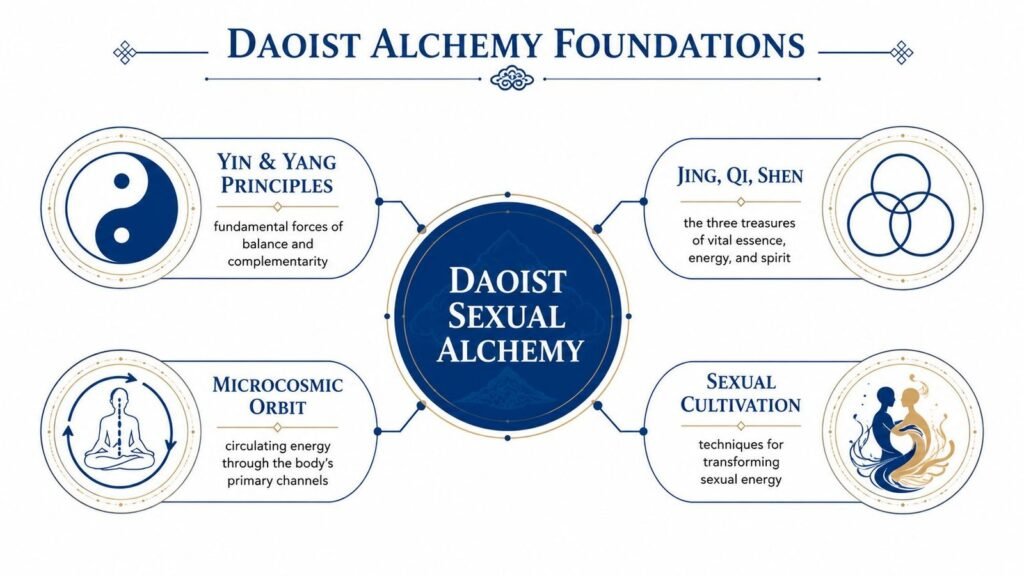
Sexual alchemy did not begin as a vague promise of better intimacy or a catch-all metaphor for transformation. Its clearest historical form appears in Daoist cultivation systems, where sex was placed inside a disciplined model of health, longevity, and internal refinement. The body was treated as an operative vessel. Desire had to be governed, timed, and directed.
The body as laboratory
That older framework matters because it was procedural. Daoist sexual practice was not built on the assumption that any intense erotic state was spiritually useful. It was built on sequence, restraint, and theories of energetic conservation. Classical Daoist thought linked sexual practice to the handling of jing, qi, and shen, the three treasures described in this overview of Daoist internal alchemy. In plain terms, sex was not automatically sacred. It became part of cultivation only when it served a defined method.
That is the first distinction modern readers need. Therapeutic language uses “sexual alchemy” as a metaphor for healing or integration. Historical Daoist practice refers to a specific body of cultivation methods with its own cosmology, assumptions, and risks. Modern occult application borrows selected principles from those systems, often without the full doctrinal structure. Confusing those three levels is how people end up romanticizing techniques they do not understand.
Several core ideas shaped the Daoist model:
- Yin and yang described complementary dynamics, not good versus evil.
- Sexual exchange was understood to affect vitality, not just mood.
- The body was trained as a refining vessel through breath, timing, and restraint.
- Results depended on method. Excitement alone did not count as practice.
If you work in Western occultism, this should sound familiar. Alchemy has always involved containment, transmutation, and controlled pressure. The same logic appears in other symbolic systems, including the correspondences found in an index of alchemical metals and their occult meanings. The point is not that Daoist practice and Western alchemy are identical. They are not. The point is that both treat transformation as a disciplined operation, not a burst of feeling.
What history clarifies, and what it does not excuse
Historical material is useful because it strips away modern sentimentalism. Many Daoist sexual texts assumed that emission, retention, polarity, and frequency had consequences. They did not treat every climax as equivalent. They also did not assume every sexual act was beneficial.
Some of that material becomes ethically troubling very quickly. Scholarship on Daoist sexuality notes the development of practices often called cai yin shu, or “harvesting yin,” in which men were instructed to draw vitality from women for health and longevity, as described in Livia Kohn’s discussion of Daoist sexual practice and its historical variations. That history should not be sanitized. It shows that spiritualized sexual systems can carry manipulation, hierarchy, and extraction inside the method itself.
That is why I do not treat antiquity as proof.
A practice can be old and still be predatory. A ritual can be symbolically elegant and still be unsafe. Historical lineage tells you where an idea came from. It does not settle whether the idea should be used now, or how it must be modified to meet present ethical standards.
What a modern practitioner should actually take from this
The value of the Daoist root is structural, not devotional. It teaches that sexual force changes quality when it is contained, directed, and integrated into a larger operation. It also teaches that method matters more than intensity.
Useful takeaways include:
- Arousal is treated as raw material. It must be shaped.
- Timing alters outcome. Peak, pause, circulation, and release are not interchangeable.
- Exchange has consequences. Partnered work affects both people, whether they name that in energetic terms or not.
- Technique sits inside ethics. Any system that treats one body as fuel for another needs hard scrutiny.
What should be left behind is just as clear.
- Exploitative partner models
- Literal immortality claims
- Authority based on age alone
- Mystification used to bypass consent or discernment
That diagnostic stance is the only sane way to adapt this material. Historical Daoist sexual alchemy gives modern practitioners a map of principles. It does not give blanket permission, and it does not remove the need for consent, screening, emotional stability, and clear ritual purpose.
Core Principles of Energetic Exchange
Sexual energy becomes useful in occult work when it is treated as raw force with direction, not as excitement for its own sake. Often, the first part is understood, while the second is ignored. That’s why they report intensity without stability.

One useful technical model comes from Taoist sexual alchemy. In the method described as Endowment’s Alchemy, the yang phase builds high arousal, then the immediate yin phase requires stopping and relaxing so energy can move through the body without ejaculation, allowing circulation to continue for hours, as described in this explanation of the yin-yang alternation.
Depletion versus cultivation
This difference is the centre of the matter. If arousal rises, peaks, and discharges without intention, many practitioners experience a drop in focus, collapse in ritual attention, and emotional flattening afterward. If arousal rises and is then contained, redirected, and circulated, the same force can become more coherent.
That does not mean orgasm is always “bad” or retention is always “advanced.” It means different outcomes follow different handling.
| Pattern | Likely occult effect |
|---|---|
| Escalation with no containment | Short burst, poor focus afterward |
| Suppression through tension | Frustration, rigidity, energetic congestion |
| Build, pause, circulate | Stronger internal charge and steadier attention |
| Build with partner attunement | Shared field, but only if both stay regulated |
Exchange is not always equal
In partnered work, people often talk as if energy exchange is naturally balanced. It isn’t. One partner may be more suggestible. One may be more dominant. One may be dissociated while appearing compliant. One may be carrying unresolved grief that floods the field.
That’s why I don’t treat “mutual desire” as sufficient evidence that the exchange is healthy. Desire can be genuine and still be badly timed, poorly structured, or contaminated by the wrong objective.
If the body says yes and the nervous system says no, your focus fractures, collapsing the conscious will that sustains the operation.
For practitioners who work with broader alchemical symbolism, this index of alchemical metals and gnosis can sharpen the distinction between raw substance and refined use. The same logic applies here. Base material isn’t the problem. Mishandling it is.
What transmutation actually means
Transmutation in this context is not a slogan. It means a biological impulse is given a higher assignment through deliberate handling. Breath changes the tempo. Pauses interrupt compulsion. Attention moves sensation through the body instead of forcing it toward one point of release. Eye contact, touch, and pacing can stabilise the shared current instead of scattering it.
A workable model looks like this:
- Generate charge through arousal, breath, attention, and consent.
- Contain the charge instead of rushing to discharge.
- Circulate it through the body, symbol, prayer, sigil, image, or intention.
- Ground afterward so the force doesn’t linger as agitation.
People fail here when they mistake intensity for completion. In sexual alchemy, intensity is usually just the beginning of the useful part.
Practical Techniques and Safety Protocols
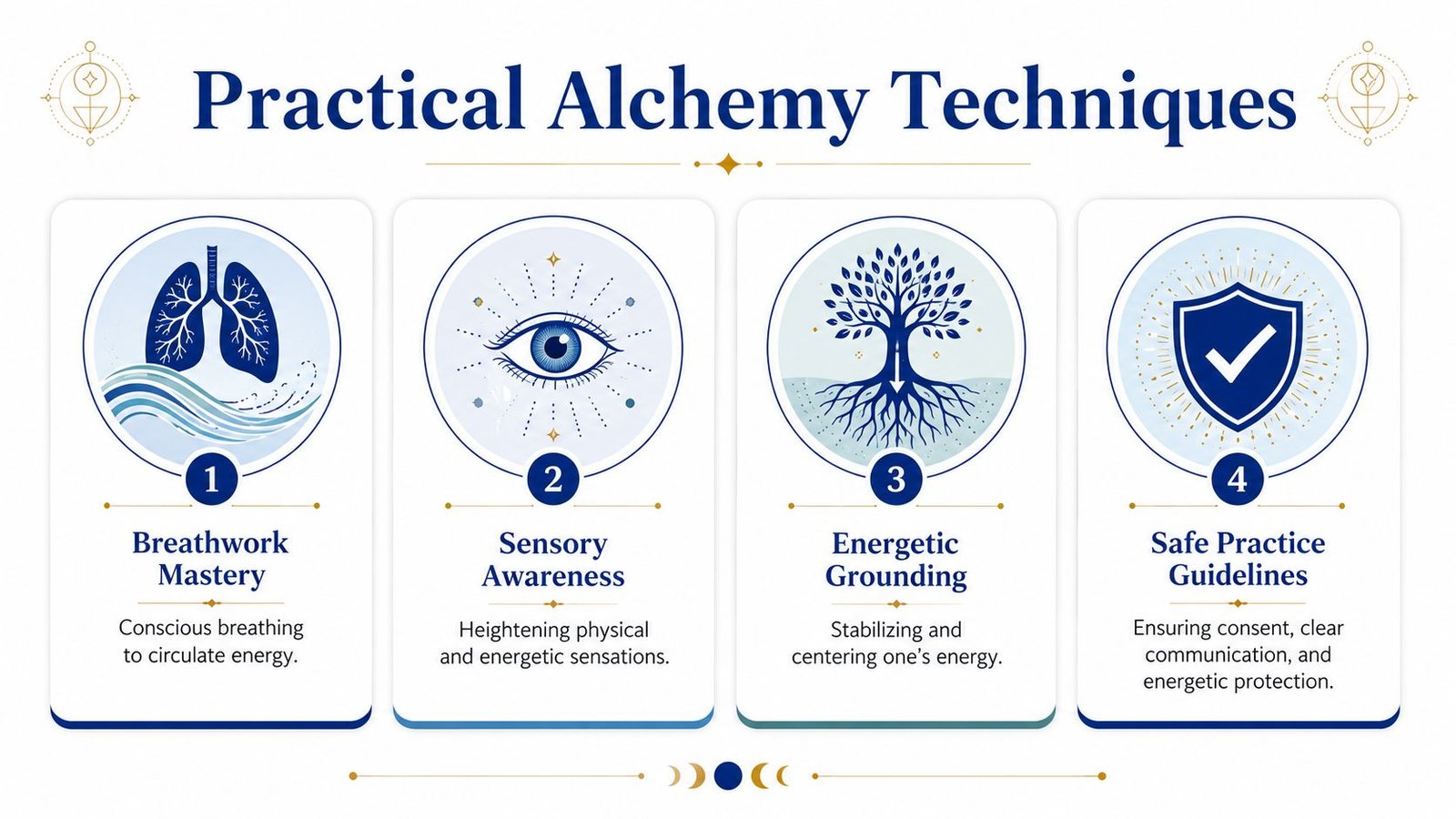
Technique without safety turns sexual alchemy into self-deception. Safety without technique turns it into vague discussion. Both pieces belong together.
A frequently cited retention technique is the Three Fingers Method, in which the midpoint between the anus and scrotum is pressed several seconds before ejaculation to retain sexual energy and separate ejaculation from orgasmic release, as described in this outline of the method in alchemical sex. That is a technical procedure, not a party trick. Used carelessly, it can produce strain, anxiety, or compulsive over-control.
Solo practice that actually builds skill
Beginners usually want a dramatic ritual. They need basic regulation first.
Start with simple drills:
Breath pacing
Slow the breath before arousal gets high. If the breath goes shallow, the body is already moving toward compulsion rather than control.Attention training
Move awareness from the genitals to the chest, spine, belly, throat, and hands. The point is not fantasy enhancement. The point is distribution.Timed pauses
Stop before the body insists on stopping. This develops authority over the process rather than dependence on the brink.Grounding
Stand, drink water, wash the hands, or place the palms on the floor after practice. End the circuit deliberately.
These exercises sound modest because they are. They work because they build reliability.
Partner work needs explicit agreements
Partnered sexual alchemy fails when people assume consent to intimacy is consent to energetic work. It isn’t. The conversation has to be clearer than that.
Use direct agreements such as:
- Purpose: Are you bonding, healing, charging, divining, or testing compatibility?
- Limits: What is not permitted, physically and ritually?
- Stop conditions: What signs end the work immediately?
- Aftercare: What happens when one person feels flooded, attached, ashamed, or abruptly empty?
For practical physical boundaries and recovery care, understanding safe sex practices is worth reading because occult framing never replaces body safety, communication, or aftercare.
Operational warning: Never use sexual ritual to bypass a conversation you don’t want to have.
When not to use retention methods
Retention isn’t suitable every time. Some people use it to avoid vulnerability, not to cultivate energy. Others create pelvic tension, frustration, or obsessive self-monitoring because they are chasing performance.
A poor sign is when the method makes the practitioner less present, less generous, and more fixated on “succeeding.” A good sign is steadier attention, less desperation around release, and cleaner intention before and after the act.
Broader ritual discipline is of great importance. These principles for effective spellwork and rituals apply directly here. Clear aim, proper containment, ethical handling, and closure matter more than trying to force a dramatic energetic event.
A short safety checklist
| Check | Why it matters |
|---|---|
| Consent is verbal and specific | Prevents spiritualised coercion |
| Physical health is respected | Avoids turning strain into “initiation” |
| Emotional state is stable enough | Reduces trauma reenactment |
| Intention is named before practice | Stops drift and projection |
| Grounding follows the work | Prevents lingering agitation and fixation |
People often ask for the strongest technique. The safer question is which technique they can perform consistently, ethically, and without distortion. That’s the one worth using.
Advanced Integration for Practitioners
For experienced occultists, the alchemy of sex is not a stand-alone identity. It is one power source inside a larger ritual system. Used properly, it can feed consecration, spirit offerings, image charging, talisman work, or divinatory opening. Used badly, it muddies all of them.
The first discipline is assignment. Raised force needs a container before the work begins. That may be a sigil, a spoken petition, a prepared talisman, a lamp lit for spirit contact, or a scrying objective written in plain language. If there is no container, the energy usually spills into fantasy, attachment, or interpersonal confusion.
Where it belongs in ritual work
Sexual force tends to function best in advanced work when the operator already knows how to hold trance, end trance, and distinguish symbol from projection. Without that foundation, the practitioner often mistakes erotic intensity for spirit confirmation.
Useful integrations include:
- Talisman charging when the symbol and purpose are already fixed.
- Spell ignition when the working requires momentum rather than broad emotionality.
- Scrying support when arousal is moderated and directed, not allowed to overrun perception.
- Devotional offerings where the act is structured, consensual, and not confused with compulsion.
Not every case benefits from this current. Work involving coercive obsession, unstable attachment, revenge contamination, or unclear consent often gets worse when sexual force is added.
Why diagnosis comes before ritual action
Many practitioners become reckless. They learn a potent method and try to use it everywhere. Serious work requires selection, not enthusiasm.
A diagnostic-first methodology solves that problem. A 40-minute diagnostic session as the required starting point before any ritual is commissioned creates a hard pause before action and allows either a concrete plan or a reasoned no-work recommendation, as described in this outline of the diagnostic-first process.
That structure matters because sexual alchemy magnifies what it touches. If the underlying situation is misread, more force means a larger mistake.
Strong current does not compensate for poor diagnosis. It amplifies it.
Trade-offs experienced operators should respect
Sexual current offers density, immediacy, and strong symbolic alignment in certain cases. It also introduces entanglement risk that other methods do not.
A calm candle rite may produce less charge but cleaner boundaries. A talisman consecrated without sexual force may take longer to build but remain easier to evaluate. A non-sexual offering may be less intoxicating and more precise.
Experienced practitioners know that the strongest current is not always the right one. The right current is the one that fits the mechanism of the case.
Risks and the Importance of Discernment
The biggest danger in the alchemy of sex isn’t that the practice is dark in itself. The danger is that people drop their standards because the subject feels intimate, taboo, or powerful. That is exactly when standards need to tighten.
The risks are practical. Emotional entanglement can be mistaken for spiritual destiny. Energetic dependency can be mistaken for devotion. Manipulation can hide inside language about polarity, surrender, sacred union, or divine timing.
Fraud thrives where people want certainty
Sexual topics attract practitioners who promise too much. They know clients feel urgency, shame, longing, and secrecy. That makes them more vulnerable to guarantees, panic-selling, and invented authority.
A live Spellcaster Verification Service exists specifically to help protect clients from fraudulent practitioners who claim guaranteed results or instant magic, while supporting a process-oriented approach instead, as described in this overview of the verification service.
No mature practitioner should be offended by vetting. Honest operators expect questions.
Discernment habits that protect you
Use a hard filter before working with anyone on sexual ritual:
- Check their claims: If they promise instant results, walk away.
- Check their process: If there is no assessment, they are guessing.
- Check their boundaries: If they sexualise the client-practitioner relationship, stop.
- Check their language: If every setback becomes “resistance” that requires more money, leave.
For people who need help spotting predatory behaviour in spiritual services, this guide to exposing spiritual scams is a practical place to start.
Trust the practitioner who narrows the scope, names the limits, and is willing to say no.
Sexual alchemy is potent. It can also be misused by the desperate, the arrogant, and the theatrical. Maturity in this field looks unglamorous. It looks like consent, diagnosis, restraint, plain speech, and careful review after the work is done.
If that sounds less exciting than the myths, good. It is also far more likely to keep your practice intact.
If you need structured guidance rather than vague promises, SCG Witchery offers a diagnostic-first approach to occult work, including private consultations, custom ritual planning, and verification support for people who want careful assessment before any spiritual action is taken.