
You’re probably here because the cedar is already on your table. Maybe it’s a bundle you bought months ago and never used because you weren’t sure how to do it properly. Maybe you’ve used sage before and want something steadier, less sharp, more rooted. Or maybe your home feels stale after conflict, illness, heavy visitors, or a long stretch of low mood, and you want a cleansing practice that feels deliberate rather than trendy.
Burning cedar has a distinct presence. The smoke is woodsy, dry, and grounding. It doesn’t feel decorative when done properly. It changes the room, but not in the fantasy-film way people like to project onto spiritual work. It’s a ritual action with a physical effect, a cultural history, and a method that matters.
That method is where many individuals go wrong. They rush the preparation, use poor ventilation, treat sacred plant material like scented décor, or copy a social media version of smudging with cedar wood that strips out both safety and respect. Then they wonder why the bundle burns badly, why the smoke feels harsh, or why the practice leaves them unsettled instead of clear.
Nothing works instantly. Cedar smudging isn’t a theatrical shortcut, and it isn’t a guaranteed fix for every spiritual or emotional problem. It’s a foundational purification rite. Done well, it can support blessing, clearing, grounding, and spiritual readiness. Done carelessly, it becomes smoke without discipline.
Guide to Cedar Smudging Rituals and Procedures
- An Introduction to Purification with Cedar
- The Ancient Roots and Spiritual Purpose of Cedar
- Sourcing and Preparing Cedar Responsibly
- A Step-by-Step Guide to Smudging a Space
- Critical Safety Protocols for Cedar Smudging
- Cedar Compared to Other Sacred Herbs for Cleansing
- When Smudging Is Not Enough
- Frequently Asked Questions About Cedar Smudging
An Introduction to Purification with Cedar
Cedar is one of those materials that tells you very quickly whether you’re paying attention. If the bundle is too damp, it spits and chars. If it’s over-dry or packed badly, it flares too fast and gives you heat without the slow, steady smoke you want. If your mind is scattered, the whole act becomes mechanical.
Used properly, cedar is a purifier with weight to it. The smell settles the body first. Then the room follows. Many people notice that cedar doesn’t feel as abrupt as harsher cleansing herbs. It tends to create a sense of steadiness, warmth, and order, which is why it’s often chosen when the goal isn’t just to clear a space, but to bless it and make it fit for prayer, rest, or ritual.
That’s the difference between ritual and performance. A serious cleansing isn’t about producing lots of smoke. It’s about selecting the right plant, preparing it correctly, knowing who should not be exposed to it, and working with a defined intention.
Smudging with cedar wood works best when the practitioner stops treating it like ambience and starts treating it like disciplined spiritual hygiene.
In practical terms, cedar is useful before meditation, after conflict in the home, before welcoming people into a new space, and before any rite where you want the atmosphere stabilised rather than aggressively stripped. It’s also a good teacher because it forces patience. You can’t fake the preparation and expect a clean result.
A good cedar working begins before the flame. It begins in how the material was gathered, how it was dried, what vessel you use, whether the room can handle smoke, and whether everyone present should even be there for the rite.
The Ancient Roots and Spiritual Purpose of Cedar
Cedar isn’t just “another cleansing herb.” It carries a specific role in Indigenous traditions, and that role should be understood before anyone starts burning it casually.
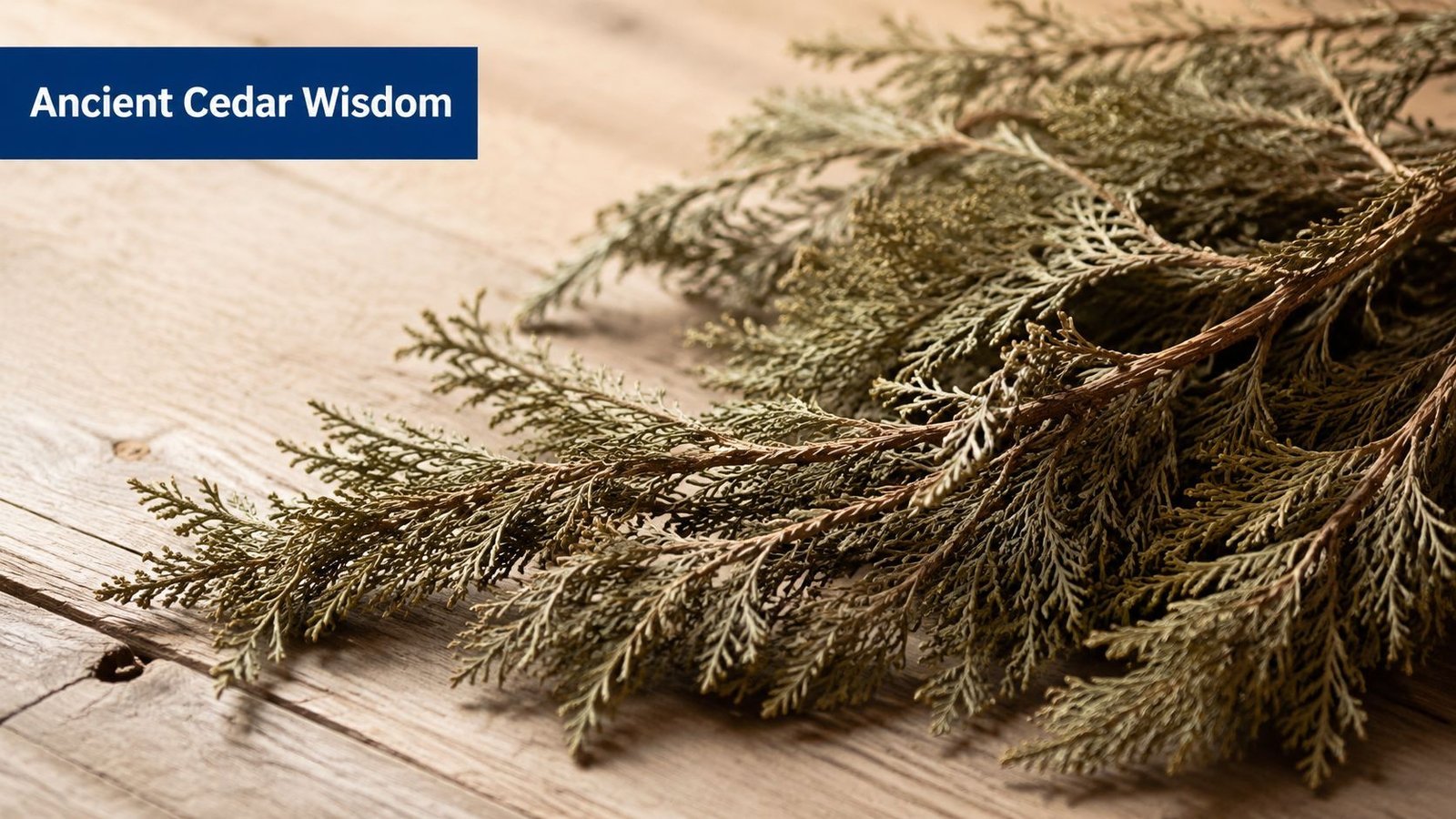
According to McGill University’s Office of Religious and Spiritual Life on smudging, cedar holds a foundational position in Indigenous smudging ceremonies across North America, is cited by nations like the Lakota as a medicine that purifies space by attracting good spirits, and is one of the three core medicinals used in smudging alongside sage and sweetgrass. That matters because it gives cedar a distinct ritual logic. It is not interchangeable with every other plant people burn for “energy cleansing.”
Why cedar is approached differently
A lot of modern spiritual content flattens sacred herbs into a single message. Cleanse bad vibes. Light bundle. Wave smoke. Done. That’s not how mature practice works.
Cedar is often approached as a purifier that also blesses. In teachings associated with smudging, the smoke may be directed over the heart, head, eyes, ears, and mouth as part of cleansing body, mind, and spirit. That orientation tells you something about cedar’s use. It’s not only about removal. It’s also about alignment and right relation.
If you’re trying to build a grounded spiritual routine around retreat, prayer, or ceremonial preparation, it helps to learn in spaces that value context instead of aesthetics. For readers interested in that broader environment, this guide to spiritual retreats in Colorado is a useful starting point for finding settings where practice is treated with seriousness.
What cedar is for in practice
When I teach foundational cleansing, I tell people to match the herb to the task. Cedar is well suited to these situations:
- Preparing a room for prayer or meditation because it supports a settled atmosphere rather than an abrasive reset.
- Blessing a new home or threshold when the intention is welcome, protection, and right order.
- Cleansing the self before ritual work when you want to arrive calm, focused, and spiritually composed.
- Maintaining an already decent space that feels heavy, stale, or emotionally cluttered.
Practical rule: Use cedar when the aim is purification with steadiness. Don’t reach for it as a dramatic cure-all.
Respect also means admitting limits. If you aren’t part of an Indigenous tradition, you shouldn’t pretend you are. You can still approach cedar with humility, careful language, and an understanding that sacred plant work has origins deeper than modern wellness branding.
Sourcing and Preparing Cedar Responsibly
The quality of the smudge starts with the quality of the relationship. That includes your relationship to the tree, the land, and the material in your hands.
Ethical gathering is part of the rite
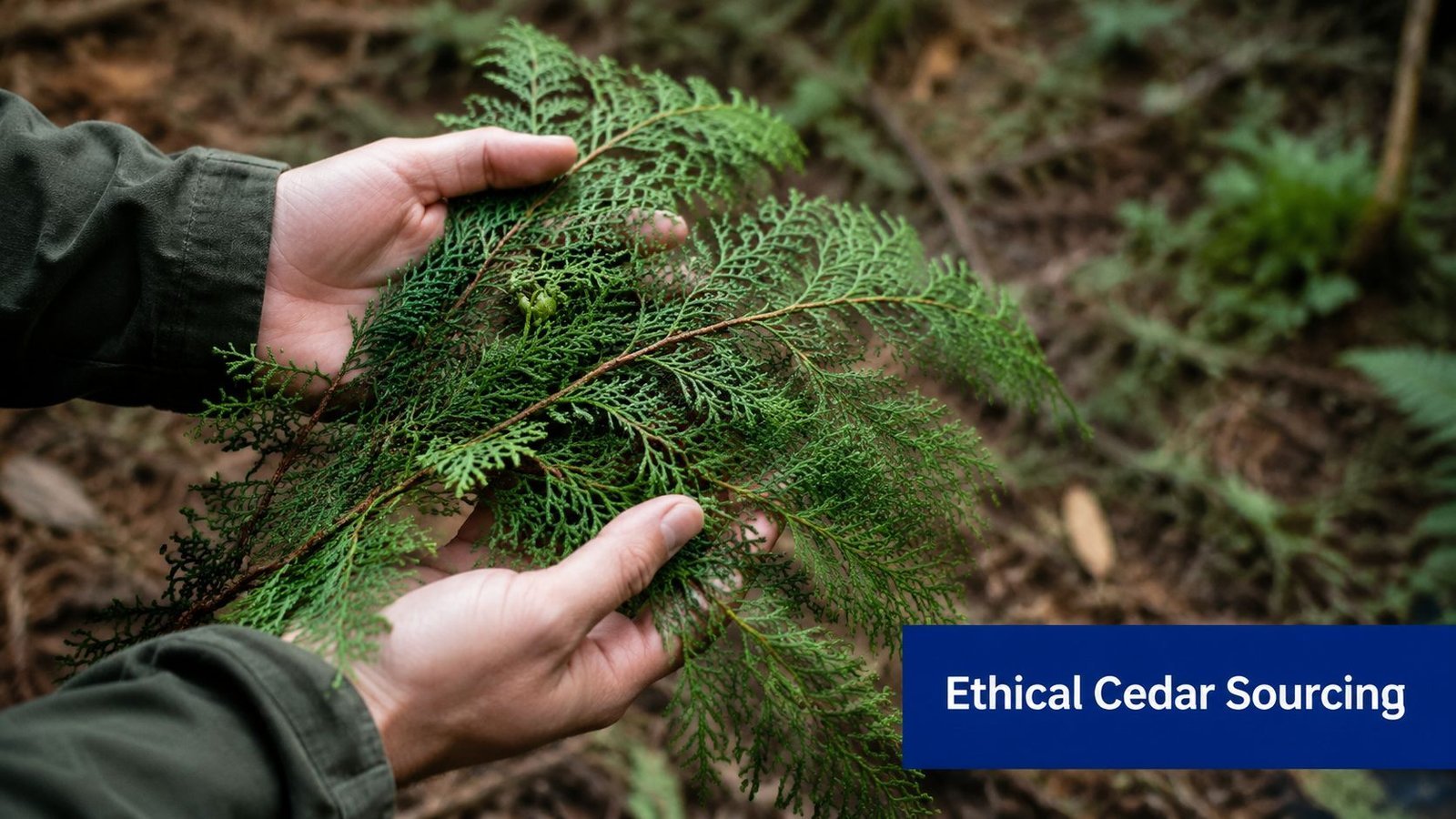
If you harvest cedar yourself, don’t approach it like foraging décor. A teaching shared in this discussion on harvesting cedar respectfully is direct and useful: practitioners should cut only small branches, leave the tree visually undisturbed so it appears as if “you were never there,” ask permission from the tree, and leave a tobacco offering as a reciprocal gesture.
That sequence matters because it turns harvesting into prayer rather than extraction.
If you don’t gather your own cedar, choose sellers who can explain where the material comes from and how it was handled. I avoid any supplier whose presentation treats sacred plant bundles like novelty stock. If they can’t speak clearly about sourcing, I don’t burn their materials in ritual.
A simple standard helps:
- Take little, not much. Small branch cuttings are enough.
- Leave the tree intact in appearance. If your harvest is obvious from a distance, you took too much.
- Ask first. Even if someone sees that as symbolic, it disciplines the mind away from entitlement.
- Offer something in return. Reciprocity belongs to the act.
Drying determines how the bundle behaves
Fresh cedar rarely behaves well in ritual. It needs time to become usable. Guidance on making a proper cedar bundle notes that the material should undergo an air-drying period of 7–10 days in a humidity-controlled environment away from direct sunlight to preserve the volatile aromatic oils needed for a slow, even smoulder, as described in this cedar smudge stick preparation guide.
That drying window is not a decorative detail. It changes everything about the burn.
If the cedar is still holding too much moisture, you’ll fight to keep it lit and end up scorching the outer layer. If it’s dried carelessly in harsh sun or stored badly, the aroma becomes flatter and the smoke quality suffers. What you want is a bundle that catches, then settles into a patient smoulder without repeated relighting every few moments.
Good cedar preparation feels quiet. The bundle shouldn’t demand constant correction once it’s lit.
For binding, keep the bundle firm but not strangled. Air still needs to move between the branchlets. Overpacked bundles smother themselves. Loose ones collapse ash everywhere. A medium hand works best.
A Step-by-Step Guide to Smudging a Space
There’s no need to make this elaborate. There does need to be order.
Before you light anything
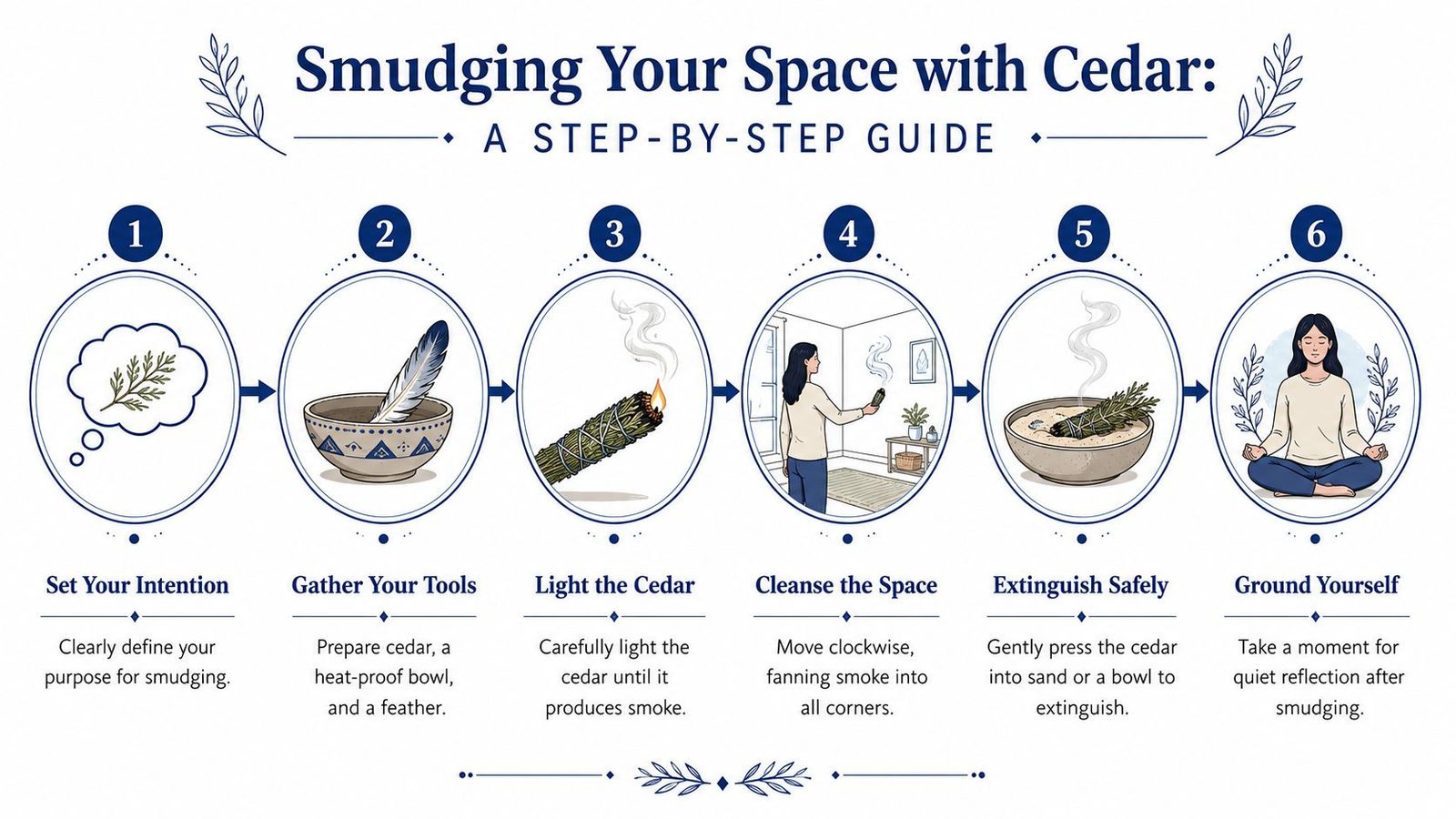
Gather the tools first. You need a cedar bundle, a heat-resistant vessel such as clay, metal, glass, or abalone shell, and something to guide the smoke if you use one, such as a feather or your free hand at a safe distance.
Then set the room. Open a window or door so the smoke has somewhere to move. Remove paper, loose cloth, or anything easily singed from your path. Decide what the work is for. Cleansing after an argument is not the same as blessing a new home altar.
If you’re new to ritual structure, a practical foundation in intention and method matters more than collecting exotic tools. A good primer on that mindset is this introduction to the basics of spellwork, especially if you tend to light things before you know what you’re trying to accomplish.
How to move the smoke through a room
Light the tip of the cedar until it catches. Then gently reduce the flame so the bundle smoulders. You want smoke, not active burning.
Move deliberately. Many practitioners work clockwise through the space, paying close attention to corners, thresholds, windows, mirrors, beds, and any area where people argue, grieve, or sleep poorly. If you’re cleansing yourself, bring the smoke toward the body carefully and with intention.
A straightforward sequence works well:
- Begin at the entrance and state your intention plainly, whether aloud or internally.
- Move the smoke into the corners because stagnant atmosphere tends to collect there.
- Trace doors and windows to mark the boundaries of the space.
- Pass over objects with purpose if they’re part of your spiritual practice.
- Return to the starting point so the work feels complete rather than abruptly abandoned.
I don’t recommend racing through a room while reciting memorised lines you don’t mean. Slow, attentive movement does more than ornate wording.
| Action | What to focus on |
|---|---|
| Entrance | Name the purpose of the cleansing |
| Corners | Lift heaviness and stagnation |
| Doorways | Mark protection and order |
| Personal body | Head, heart, and hands with care |
How to close the work properly
When the cleansing is finished, don’t just set the bundle down and walk away. Press the lit end into sand or a safe heatproof surface until it is fully extinguished. Sit with the room for a minute. Notice whether it feels calmer, clearer, or quieter.
Nothing works instantly, and cedar isn’t meant to solve every problem in one pass. But a correctly done cleansing usually leaves the space more workable. That alone has value.
Critical Safety Protocols for Cedar Smudging
Competent ritual practice includes smoke management, fire awareness, and basic duty of care. Cedar smudging is not exempt because the intention is spiritual.

Smoke is not symbolic
A Canadian government publication on indoor air quality and smudging found that burning 5 grams of sage for one hour in a 4000 ft³ room generated a maximum PM2.5 concentration of 76 µg/m³, slightly below Alberta’s one-hour PM2.5 guideline of 80 µg/m³, with five sage types averaging between 40.8 µg/m³ and 72.3 µg/m³ and a full observed range from 35 µg/m³ to 76 µg/m³, as detailed in this National Research Council publication on indoor air conditions during smudging. The same source also notes that in Quebec, occupational standards for western red cedar wood dust set a VEMP of 0.5 mg/m³ for inhalable particles and recognise respiratory and skin sensitisation risks.
That gives you the practical truth. Smudging with cedar wood is a real combustion event. The room air changes. Your lungs are involved. Ventilation is not optional.
In institutional settings, there may also be procedural requirements around smoke detectors, shared spaces, and advance notice. Those rules exist for good reason.
Practical fire and exposure rules
Use common sense, but make it specific.
- Ventilate the room. Open a window or door before you begin and keep air moving.
- Use a proper vessel. Clay, metal, glass, or abalone shell can manage heat better than improvised containers.
- Stay with the bundle. A smouldering cedar bundle should never be left unattended.
- Keep distance from combustibles. Curtains, paper, dry florals, books, and loose fabric all matter.
- Extinguish completely. Don’t trust a dim ember. Check it.
If the room can’t handle smoke safely, don’t smudge in that room. Intention doesn’t cancel particulate matter.
There’s also a people-based safety rule. If someone nearby has respiratory sensitivity, don’t make them absorb your ritual choices. That isn’t spiritual authority. It’s poor judgement.
Cedar Compared to Other Sacred Herbs for Cleansing
People often ask which herb is “best.” That’s the wrong question. The better question is which herb fits the spiritual task in front of you.
Choosing the right herb for the job
Here’s the simplest practical comparison.
| Herb | Primary Spiritual Use | Best For |
|---|---|---|
| Cedar | Purification, blessing, attracting supportive presence | Homes, thresholds, prayer space, steady maintenance |
| White Sage | Strong clearing and banishing | Heavy atmospheres, sharper resets, post-conflict cleansing |
| Sweetgrass | Inviting sweetness, beauty, and welcome | Calling in harmony after cleansing |
| Palo Santo | Gentle daily clearing and pleasant atmosphere | Light maintenance, brief personal use |
Cedar stands apart because it tends to cleanse without hollowing out the room. If white sage feels like stripping paint, cedar often feels like restoring order to a lived-in place. That’s why I prefer it for spaces where people need to sleep, recover, pray, or reconnect.
Sweetgrass is often chosen after cleansing, not instead of it. Palo Santo is used by many for everyday spiritual refreshment, though it occupies a different cultural and ritual context and shouldn’t be treated as a direct substitute for every tradition.
When to use cedar instead of something stronger
Choose cedar when the room is dull, emotionally crowded, or spiritually untidy, but not hostile. Choose it when the goal is to settle and bless. Choose it when you want continuity in the home rather than a scorched-earth reset.
I also reach for cedar when a person is already overstimulated. Some spaces don’t need force. They need composure.
For practitioners who like to work with plant correspondences in a broader divinatory frame, divination and the shadowed herbs offers a useful look at how materia can be read more precisely instead of being selected by trend.
Cedar is often the right choice when you want a room to feel inhabited well, not emptied aggressively.
That said, don’t turn herb selection into dogma. The same home might need cedar one month and a different approach the next. The work follows the condition.
When Smudging Is Not Enough
Cedar cleansing is foundational. It is not universal.
What cleansing can and cannot do
A proper smudging can shift the tone of a room, support prayer, mark a threshold, and help a person come back into themselves. It can create a cleaner starting point. That’s meaningful. But it won’t automatically resolve a repeating family pattern, a destructive attachment, an entrenched run of crossed conditions, or a life problem with multiple moving parts.
At this juncture, many people get disappointed. They perform one cleansing, expect a total reversal, and assume the method failed. Often the issue is diagnostic, not ceremonial. The cleansing may have done exactly what cleansing does. It just wasn’t the whole answer.
If the heaviness returns immediately, if the disturbances are patterned, or if several areas of life are deteriorating at once, broaden the response. Sometimes practical mundane action is needed. Sometimes boundary work is needed. Sometimes a more targeted spiritual method is needed.
When a deeper diagnosis is needed
A disciplined practitioner asks better questions before escalating the work.
- Is this a space issue or a person issue
- Is the condition recent or repeating
- Did something specific trigger the shift
- Is cleansing helping temporarily, or not at all
- Are there non-spiritual factors that must be addressed first
That diagnostic habit matters more than collecting stronger ritual tools. If you’re already working with cleansing and want a complementary home practice for heavier conditions, some readers also explore uncrossing bath work as part of a broader cleansing routine.
What matters is honesty. Nothing works instantly, and not every problem responds to smoke alone. Mature practice means recognising when a rite is appropriate, when it needs support, and when you need a clearer read on the mechanics of the situation.
Frequently Asked Questions About Cedar Smudging
Common practice questions
How often should I smudge with cedar?
Use need, not superstition, as your guide. Good times include after conflict, before spiritual work, when entering a new space, or when the home feels stale and unsettled. Some people keep a regular rhythm. Others use cedar only when the atmosphere clearly calls for it.
What do I do with the ashes?
Treat the remains respectfully. Let them cool fully first. Then dispose of them in a clean, deliberate way. Some practitioners return ashes to the earth when appropriate. Others wrap and discard them carefully. What matters is that you don’t scatter hot ash or treat ritual remains carelessly.
Do I need a spoken prayer?
No. Spoken words can help focus the mind, but they aren’t mandatory. Clear intention and composed action matter more than reciting language that feels borrowed or empty.
Safety and respect questions
Can I smudge around children, pregnant people, or someone with asthma?
No. Guidance on smudging safety states that cedar, like any herb used this way, must not be performed in rooms containing infants, pregnant persons, asthmatics, or allergy-prone individuals due to respiratory risks from smoke exposure, and the smouldering bundle must never be left unattended, as noted in this smudging safety overview.
What if the bundle keeps going out?
That usually points to preparation or packing. The cedar may still be too moist, too tightly bound, or not lit long enough at the start. Resist the urge to keep torching it. Check the material quality instead.
Is it disrespectful to use cedar if I’m not Indigenous?
That depends on how you approach it. Respect starts with acknowledging the practice’s origins, avoiding costume spirituality, not speaking over Indigenous teachings, and not presenting yourself as a tradition-bearer when you’re not. Humility goes further than performance.
How do I know if advice about smudging is trustworthy?
Look for guidance that includes method, limits, and safety. Be wary of anyone who promises instant transformation, claims every herb works the same way, or uses pressure tactics around spiritual fear. If you want a sharper eye for that problem, this piece on how spiritual scams operate is worth reading.
Cedar is a simple practice, but not a shallow one. If you prepare it carefully, use it safely, and keep your expectations grounded, it can become one of the most reliable rites in a serious household practice.
If you’re dealing with a situation that feels more complex than a basic cleansing can address, SCG Witchery offers a diagnostic-first approach to occult work. That matters when you need more than a generic ritual suggestion. A proper assessment can help you determine whether cedar cleansing is enough, whether another method fits better, or whether no ritual work should be done at all.