
For centuries, the symbols known as Viking Runes have captivated the imagination of historians, spiritual seekers, and fans of Norse mythology alike. More than just a practical alphabet, these characters were believed to hold deep cosmological significance, won by the All-Father, Odin, through profound sacrifice. Whether you are looking to understand the genuine historical context of the Norse writing system or seeking insight into runic philosophy, this guide provides a deep dive into the enigmatic world of authentic Viking Runes.
The Ancient Power of Viking Runes
What Are Viking Runes?
The word “rune” itself derives from the Old Norse word rún, which translates to “secret,” “mystery,” or “whisper.” Historically, runes served as the primary alphabet and writing system for the Norse people during the Viking Age, long before the widespread adoption of the Latin alphabet in Scandinavia.
While they functioned daily as a means of communication, carving memorials, and record-keeping, the Norse worldview did not separate the mundane from the sacred. Symbols carried inherent power. In the Hávamál, an Old Norse poem containing counsel from Odin, the god describes his nine-day sacrifice—hanging from the world tree, Yggdrasil, pierced by a spear—to seize the wisdom of the runes from the depths. This mythological origin demonstrates that runes were viewed not as human inventions, but as fundamental forces of reality.
The Younger Futhark: The True Alphabet of the Vikings
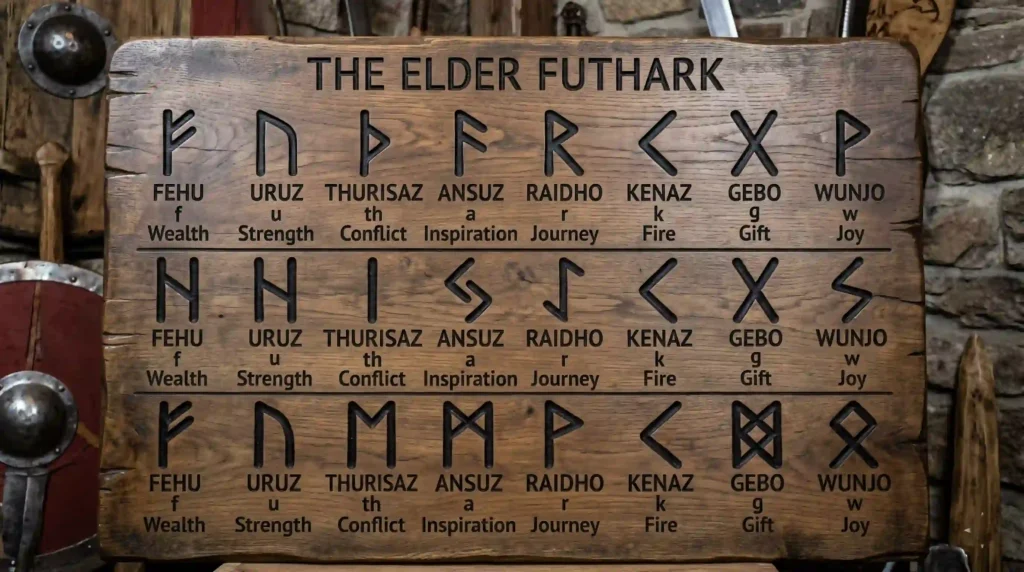
A common misconception is that the Vikings used the 24-character Elder Futhark. In reality, that older system was used by earlier Germanic tribes. By the dawn of the Viking Age around the late 8th century, the script evolved and condensed into the Younger Futhark.
This 16-character alphabet was the actual script carved onto Viking Age runestones, weapons, and personal items. It is split into three structural groups called ættir (singular ætt), which organize the symbols phonetically and conceptually.
The First Ætt (Freyr’s Ætt)
The first six runes lay the foundation of survival, physical reality, and elemental force.
- Fehu (F): Wealth and cattle. In Norse society, livestock was the primary measure of mobile wealth and required constant vigilance to maintain.
- Uruz (U/V): Slag or physical endurance. It represents raw strength, vital life force, and the power to overcome harsh environments.
- Thurisaz (Th): Giant or Thorn. A dual-natured symbol representing defensive protection, conflict, and the stubborn forces of nature.
- Ansuz (A): Source, mouth, or Estuary. Closely tied to divine inspiration, speech, leadership, and the breath of life given by the gods.
- Raidho (R): Riding or Journey. It signifies travel, the physical movement of wagons, and the cosmic order or rhythm of life.
- Kenaz (K): Ulcer or Torch. Historically associated with physical affliction or the controlled fire used for creation and warmth.
The Second Ætt (Hagal’s Ætt)
The next five runes address the internal trials of human existence, fate, and the constraints imposed by nature and destiny.
- Hagalaz (H): Hail. It represents sudden, unpreventable destruction, cosmic balance, and structural disruptions.
- Nauthiz (N): Need or Constraint. This rune speaks to hardship, deprivation, and the grim endurance required to survive adversity.
- Isa (I): Ice. It represents stagnation, freezing, stillness, and the temporary halting of progress.
- Jera (A/A): Good Year or Harvest. A rune of natural cycles, patience, and the rewards earned through steady labor.
- Sowilo (S): Sun. A powerful symbol of light, warmth, victory, and the life-sustaining force that counters the freezing cold.
The Third Ætt (Týr’s Ætt)
The final five runes focus on community structures, justice, leadership, and the overarching spiritual environment.
- Tiwaz (T): The God Týr. It represents law, cosmic justice, sacrifice for the collective good, and honor in battle.
- Berkano (B): Birch twig. A symbol of growth, regeneration, birth, and the nurturing matrix of nature.
- Ehwaz (M): Man or Human. It focuses on human nature, social structure, shared mortality, and the collective identity of a community.
- Laguz (L): Water or Ocean. It signifies the vast, dangerous northern seas, deep intuition, and the fluid nature of life.
- Yr (Z/R): Yew bow. Represents finality, defense, archery, and the enduring resilience of the yew tree.
Using Viking Runes in the Modern Day
The Viking Age concluded nearly a thousand years ago, yet interest in these symbols remains vital. Today, practitioners and scholars engage with the historical script to explore philosophy, artistic heritage, and esoteric work.
Runecasting and Philosophy
Modern runecasting uses these historic symbols as a tool for personal reflection. Similar to other traditional symbolic systems, runes are drawn to offer unique perspectives on current challenges, forcing the practitioner to analyze their situation through the lens of ancient Norse pragmatism and fate (ørlög).
Bindrunes and Sigils
A bindrune is created by combining two or more runic characters into a single integrated symbol. Historically used for practical mark-making, ownership indicators, or protective purposes on items like weapons and amulets, modern enthusiasts continue to design bindrunes as personal sigils representing specific intent, focus, or inner strength.
Integrating the Historical Significance of Viking Runes
Understanding Viking Runes requires moving past modern fantasy and looking at the actual script of the Norse people. The Younger Futhark reflects a worldview shaped by a harsh climate, profound respect for fate, and an unbreakable link between everyday life and the cosmic order. By exploring the true 16 meanings of the Viking Age script, you connect directly with an unyielding tradition that still echoes clearly today.
Great article!