
Ragnarök: The End and Rebirth of the Norse World
In the chilling whispers of Old Norse prophecy, one event stands above all others: Ragnarök. Often translated as the “Twilight of the Gods,” this cataclysmic series of events represents the ultimate destruction of the cosmos, the death of the great Aesir gods, and the eventual rebirth of the world. But what exactly happens during this Norse apocalypse, and why does it continue to fascinate us today?
Defining the Prophecy of Ragnarök
In Norse mythology, Ragnarök is not just a random disaster; it is a preordained destiny. Unlike many other ancient mythologies where the gods are immortal and invincible, the Norse gods—including Odin, Thor, and Loki—are well aware that their end is coming. This sense of “fated doom” gives the myth a unique weight and tragedy.
The prophecy of this event is primarily recorded in the Poetic Edda and the Prose Edda. It describes a cycle of violence, natural disasters, and a final battle that consumes the Nine Realms.
The Signs of the Coming Doom: Fimbulwinter
The countdown to Ragnarök begins with Fimbulwinter, the “Great Winter.” This is not a standard seasonal change but a three-year-long winter without a single summer in between. During this time, the world falls into chaos. Morality vanishes; brothers turn against brothers, and the social fabric of Midgard (the realm of humans) dissolves into bloodshed and greed.
Following the Great Winter, the celestial markers of the world fail. The wolves Sköll and Hati finally catch the sun and the moon, devouring them and plunging the realms into total darkness. The stars vanish from the sky, and the earth trembles so violently that all chains and bonds are snapped.
The Breaking of Bonds
As the earth shakes, the most dangerous enemies of the gods are freed. Loki, the trickster god who had been bound in a cave as punishment for the death of Baldur, breaks his chains. His monstrous son, the Great Wolf Fenrir, also escapes his magical bindings.
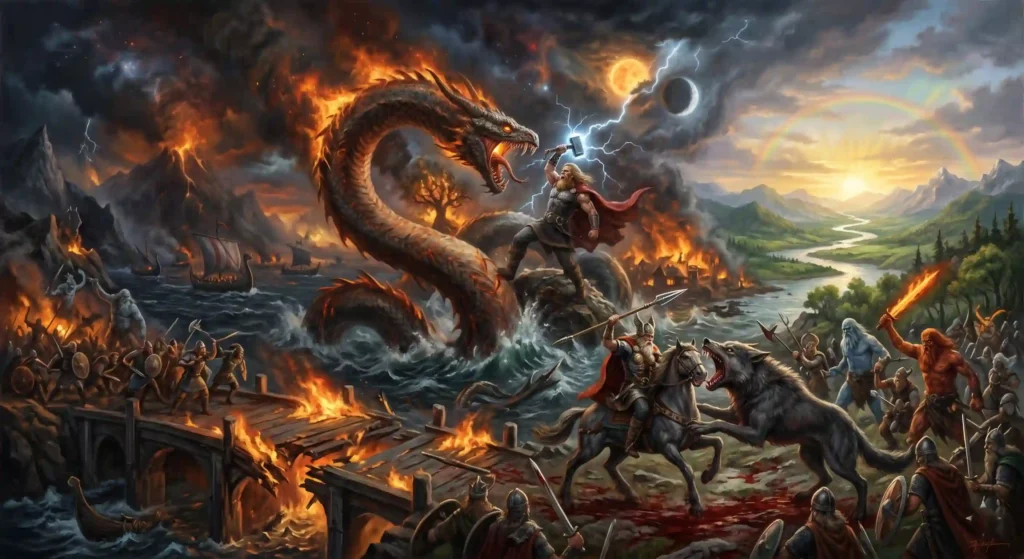
From the depths of the ocean, the Midgard Serpent, Jörmungandr, rises, causing the seas to flood the land. The ship Naglfar, made from the fingernails and toenails of the dead, sets sail across the rising waters, carrying an army of giants (Jotnar) led by the giant Hymir (or Loki, depending on the source).
The Battle of Vigrid
The forces of chaos gather on the vast plain of Vigrid, a field spanning a hundred leagues in every direction. On one side stands the army of the dead from Hel, the fire giants of Muspelheim led by Surtr, and the frost giants. On the other side, the gods of Asgard and the Einherjar (the heroic human warriors taken to Valhalla) prepare for their final stand.
The final battle of Ragnarök is defined by iconic, tragic duels:
- Odin vs. Fenrir: The All-Father fights the Great Wolf but is ultimately swallowed whole. He is later avenged by his son, Vidar, who tears the wolf’s jaws apart.
- Thor vs. Jörmungandr: Thor successfully slays the Midgard Serpent with his hammer, Mjölnir, but after taking nine steps, he collapses and dies from the serpent’s lethal venom.
- Heimdall vs. Loki: The watchman of the gods and the trickster engage in a duel where both inflict fatal wounds upon each other.
- Tyr vs. Garmr: The god of war and the hound of Hel slay each other in a final struggle.
The World Consumed by Fire
As the gods fall, the fire giant Surtr flings fire across the Nine Realms. The world-tree, Yggdrasil, trembles, and the earth sinks into the boiling sea. For a moment, it appears that the story of existence has reached a permanent, silent end.
The Rebirth: A New Beginning
However, Ragnarök is not a story of total extinction, but of cyclical renewal. From the ruins of the old world, a new, green earth rises from the waters. A few surviving gods—including Odin’s sons Vidar and Vali, and Thor’s sons Magni and Modi (who inherit Mjölnir)—gather at the field of Idavoll.
Two humans, Líf and Lífþrasir, who survived the destruction by hiding in the hollow of Yggdrasil (or Hoddmímis holt), emerge to repopulate the world. A new sun, the daughter of the previous sun, shines in the sky, marking the beginning of a peaceful new era.
Summary
The story of Ragnarök serves as a powerful reminder of the Norse worldview: that life is a cycle of struggle, death, and inevitable rebirth. While the gods meet a tragic end, their sacrifice paves the way for a world without the ancient blood feuds and chaos of the past. It is a tale of bravery in the face of certain defeat, a theme that remains timeless in our modern storytelling.