
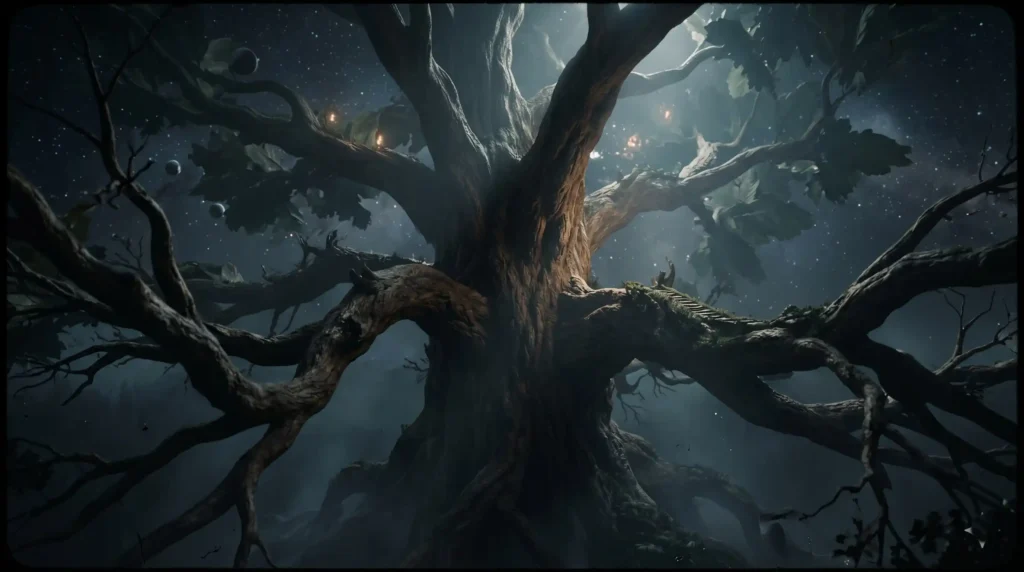
Understanding the Nine Realms of Yggdrasil
In the vast tapestry of Norse mythology, nothing is more central or foundational than the great World Tree. Known as Yggdrasil, this immense ash tree is the axis mundi that connects all existence. It is the framework upon which the universe is built, its branches reaching into the heavens and its roots anchoring the deepest corners of the cosmos. To understand the Vikings’ view of the world, one must first understand the structure of Yggdrasil and the nine distinct realms it supports.
In this guide, we will journey through the branches and roots of the World Tree to explore the diverse worlds that make up the Norse mythological landscape.
The Structure of the World Tree
Yggdrasil is often depicted as having three main levels, each hosting three realms. These levels are connected by the tree’s massive roots, which are gnawed upon by the dragon Nidhogg, and its high branches, where an unnamed eagle perches. Between them, the squirrel Ratatoskr runs up and down the trunk, carrying insults and messages. This living, breathing ecosystem represents the interconnectedness of all life and the balance between creation and destruction.
The Upper Realms: The Heavens
The highest branches of Yggdrasil house the realms of the gods and the light.
1. Asgard: Home of the Aesir
Asgard is the most famous of the nine realms. It is the fortified home of the Aesir tribe of gods, led by Odin. Here, you will find Valhalla, the hall of the slain, and the shimmering Bifrost bridge that connects the divine realm to the world of men.
2. Alfheim: Realm of the Light Elves
Alfheim is a world of immense beauty and ethereal light. It is inhabited by the Ljósálfar (Light Elves), beings described as “fairer than the sun.” Alfheim is ruled by the god Freyr and represents inspiration, art, and the luminous aspects of the spirit.
3. Vanaheim: Home of the Vanir
Vanaheim is the ancestral home of the Vanir, the second tribe of Norse gods associated with fertility, wisdom, and the ability to see the future. After an ancient war between the Aesir and Vanir, the two groups reached a peace that shaped the destiny of the cosmos.
The Middle Realms: The World of Men and Giants
The trunk of Yggdrasil supports the realms most often involved in the epic sagas of the gods.
4. Midgard: The World of Humans
Midgard (Middle Enclosure) is our world. It is situated right in the center of the nine realms, surrounded by an impassable ocean where the Great Serpent, Jörmungandr, resides. Midgard is the only realm visible to human eyes, though it is inextricably linked to the magic of the other eight.
5. Jotunheim: Realm of the Giants
Jotunheim is a wild, untamed land of massive mountains and dark forests. It is the home of the Jötnar (Giants), the ancient rivals of the Aesir. Jotunheim represents the chaotic forces of nature that the gods must constantly keep at bay to protect the order of Yggdrasil.
6. Nidavellir / Svartalfheim: Realm of the Dwarves
Located beneath the earth but still part of the central structure, this is the domain of the master craftsmen. The Dwarves (or Dark Elves) are renowned for forging the most powerful artifacts in Norse myth, including Thor’s hammer, Mjölnir, and Odin’s spear, Gungnir.
The Lower Realms: The Primordial Roots
The roots of Yggdrasil reach down into the ancient, elemental worlds of ice, fire, and death.
7. Muspelheim: The Realm of Fire
Muspelheim is a primordial world of fire, heat, and glowing embers. It is the home of the fire giants and their leader, Surtr. According to prophecy, the fires of Muspelheim will eventually consume Yggdrasil during the events of Ragnarok.
8. Niflheim: The Realm of Ice
Niflheim is the polar opposite of Muspelheim—a land of eternal frost, mist, and darkness. It is one of the two oldest realms, and it is from the meeting of Niflheim’s ice and Muspelheim’s fire that the first living being, Ymir, was born.
9. Helheim: The Realm of the Dead
Helheim is the final destination for those who do not die in battle. Ruled by the goddess Hel (the daughter of Loki), it is a cold, somber place. Unlike modern interpretations of “hell,” Helheim is not necessarily a place of punishment, but rather a continuation of existence for the majority of the dead.
The Significance of Yggdrasil Today
Understanding the Nine Realms is more than just an exercise in history; it is an exploration of a worldview that sees the universe as a singular, organic entity. Yggdrasil teaches us that every action in one realm—whether it be the world of men or the world of gods—vibrates through the entire tree.
Whether you are a fan of modern fantasy inspired by these myths or a student of ancient cultures, the symbol of Yggdrasil remains a powerful reminder of our connection to the world around us and the mysteries that lie just beyond our sight.