
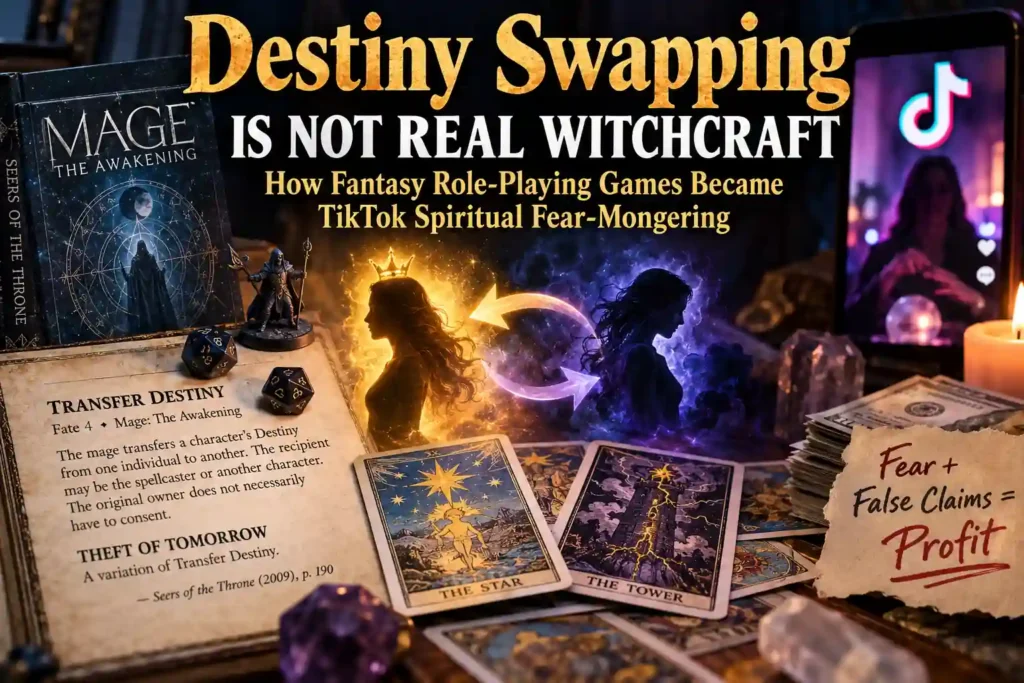
Destiny swapping is one of the most misleading supernatural claims circulating on social media.
The story is frighteningly simple: someone envies you, steals your destiny through witchcraft, and begins living the successful life that was supposed to belong to you. Meanwhile, you inherit their failures, misfortunes, and suffering.
TikTok Tarot readers, spiritual commentators, and self-proclaimed occult authorities have helped popularize variations of this narrative.
And what happens when someone becomes convinced that their destiny has been stolen?
They become frightened. They begin questioning their relationships, their failures, and even their own identities. Some seek spiritual assistance, and some are offered paid readings, cleansing rituals, protection services, or supposed destiny-restoration workings.
This creates two serious problems:
- Fear-mongering: Ordinary misfortunes and human relationships are presented as evidence of an invisible supernatural attack.
- Potential financial exploitation: The person frightening you may also offer to sell you the supposed solution.
Not everyone repeating these claims is necessarily dishonest. Some believe what they are saying. But sincere belief does not authenticate a supernatural operation, and anyone charging to remove an alleged destiny swap bears responsibility for substantiating what they claim to detect.
The most revealing discovery in our investigation is that an extraordinarily close version of destiny theft appears in published fantasy role-playing games.
In one case, the fictional operation is literally called Transfer Destiny.
It even comes with rules explaining how to perform it.
Those rules, however, are for a tabletop game.
The Smoking Gun: Mage: The Awakening and the Theft of Tomorrow
In 2009, White Wolf Publishing released Seers of the Throne, a sourcebook for the tabletop role-playing game Mage: The Awakening.
On page 190 is a fictional magical operation called Transfer Destiny, classified under Fate 4 magic.
It includes a variation called Theft of Tomorrow.
According to the game’s rules, a mage can transfer a character’s Destiny from one individual to another. The recipient can be the spellcaster or another character participating in the fictional scenario.
The original owner does not necessarily have to consent.
The rules describe the transfer of Destiny Merit points, a supernatural character attribute representing exceptional destiny. They also explain how the associated disadvantages move with the transferred Destiny.
This is astonishingly close to the claims made by contemporary social-media personalities.
A person with magical ability takes another person’s exceptional destiny and acquires its advantages.
The victim loses access to those advantages.
The perpetrator benefits from something that originally belonged to another individual.
Sound familiar?
The game describes the transfer of a particular character attribute, generally for a limited duration, rather than a permanent exchange of two complete human lives.
Nevertheless, the underlying fictional mechanism is unmistakable.
A fantasy game published in 2009 contains an explicit magical operation for stealing another person’s Destiny.
The similarities are striking. The language, the theft of supernatural advantages, and the supposed power to appropriate someone else’s destiny all resemble the modern social-media narrative.
But the sourcebook is fantasy literature, not an historical witchcraft grimoire.
Its magical instructions are game mechanics, not an authenticated occult ritual.
Fantasy role-playing rules do not become real-world witchcraft simply because someone describes similar supernatural powers on TikTok.
Tarot, Fateweavers, and the Illusion of Controlling Destiny
The connection becomes even more interesting when we examine tabletop games built around Tarot-style divination.
Consider Fateweavers, a storytelling game created by Mattea for the October 2019 Diceless Game Jam.
Players take on the roles of apprentice fate-weavers competing to influence the future. Through card divination, they attempt to determine what events will become part of the fictional world’s destiny.
The game’s premise explicitly involves manipulating fate through cartomancy.
Another game, Omar Aazam’s Fateweaver, uses Tarot cards as its central storytelling mechanism. Players explore a fictional world in which certain individuals can challenge predetermined destiny.
Then there is Wyrd Games’ Through the Breach.
Its characters, known as the Fated, receive glimpses of possible futures through a Tarot-style character-creation system. Their choices determine whether those destinies are followed, challenged, or altered.
The connections are important:
- Tarot reveals possible futures.
- Special individuals possess supernatural influence over destiny.
- Fate can be altered through extraordinary intervention.
- Other people’s futures can become part of a struggle for control.
These are established fantasy storytelling devices.
They are not evidence that Tarot readers can steal or exchange human destinies.
A Tarot reading and a magical destiny exchange are not the same operation.
Even if a divination accurately predicts a future event, that does not demonstrate that the diviner caused the event, transferred the event to someone else, or possesses the power to rewrite another person’s entire life.
That distinction is especially important when Tarot readers present speculation about destiny theft as a spiritual diagnosis.
Divination is not proof of supernatural causation.
The Religious Connection: Accusing Witches Does Not Make an Accusation True
The next significant historical connection leads to Nigerian Pentecostal Christianity.
Daniel Olukoya, founder of Mountain of Fire and Miracles Ministries, published Dealing with the Satanic Exchange, with a first printing listed in June 2005.
His teachings discuss the alleged transfer of spiritual blessings, curses, virtues, and undesirable influences.
Other deliverance literature describes destiny thieves, stolen blessings, spiritual attacks, and the supposed interference of demonic powers in people’s lives.
These publications predate the contemporary social-media trend.
But there is a fundamental problem with treating them as evidence of authentic witchcraft.
Just because a church claims that witches perform a particular act does not mean witches actually perform it.
A religious accusation is not an operational description supplied by a practicing witch.
A sermon condemning alleged demonic activity is not a historical ritual manual.
And a preacher warning that someone’s destiny can be stolen does not establish that anyone possesses the ability to steal it.
Christian authorities have attributed frightening supernatural powers to alleged witches for centuries.
During the European witch persecutions, theological authorities frequently connected witchcraft with the Devil, heresy, illness, destructive magic, and misfortune.
People accused of witchcraft were blamed for suffering and calamities that had no demonstrated connection to their actions.
In some historical settings, this fear contributed to accusations, trials, torture, and executions.
The Malleus Maleficarum, published in 1486 or 1487, became an influential example of Christian demonological writing portraying witches as agents of the Devil.
But this was a theological construction of witchcraft, not a neutral record of what every practitioner believed or performed.
The same distinction applies today.
A religious authority may believe that supernatural enemies threaten prosperity, families, health, or destiny.
That belief does not establish that the alleged enemy possesses the powers being described.
Christian demonology cannot be used as an unquestioned authority for defining what every witch believes or practices.
And it certainly cannot authenticate destiny swapping simply by alleging that witches do it.
Witchcraft Is Not Synonymous With Devil Worship
Another problem is the persistent tendency to define witchcraft through Christian theology.
The Devil, as portrayed in Christian demonology, is not a universal figure recognized or worshipped by all magical practitioners.
Many witches do not believe in the Christian Devil at all.
Some follow pagan or polytheistic traditions. Others are atheistic, animistic, ceremonial, folk-magical, or spiritually eclectic. Some practitioners work within Christian frameworks, while certain modern traditions do explicitly incorporate Satanic symbolism.
There is no universal witchcraft doctrine requiring belief in or worship of the Devil.
Consequently, the claim that witches automatically operate through Satanic forces reflects a particular religious interpretation, not a universal description of witchcraft.
Christian demonology cannot define an entire spectrum of occult traditions, and religious accusations do not establish the existence of a magical operation.
Traditional Yoruba Religion: Destiny Is Not Prosperity
The Nigerian connection also requires a distinction between Pentecostal deliverance teachings and traditional Yoruba religion.
In Yoruba philosophical and religious thought, Ori is associated with personal destiny and spiritual identity.
Rituals involving Ori may concern spiritual well-being, alignment, protection, and the fulfillment of one’s life course.
Some ethnographic accounts also document beliefs about interfering with another individual’s fortune or destiny.
A contemporary Nigerian study describes Aajo lilo-aisiki, an alleged practice concerning the exploitation of another person’s destiny for material prosperity.
But this is not equivalent to exchanging two complete destinies.
Prosperity and destiny are not interchangeable concepts.
A person could experience lifelong poverty under a particular interpretation of destiny. Another person could be wealthy while experiencing considerable suffering.
Acquiring someone’s prosperity would not necessarily mean acquiring their destiny.
Likewise, removing an obstacle from someone’s life would not mean rewriting their entire predetermined existence.
The fact that a tradition contains beliefs about destiny or stolen fortune does not establish a ritual for swapping entire lives.
Conflating these concepts is precisely how historical material becomes distorted.
The Ancient Mesopotamian Substitute King: A Genuine Historical Ritual
Unlike social-media destiny swapping, certain ancient fate-substitution ceremonies are supported by surviving primary documentation.
One of the clearest examples comes from the Neo-Assyrian Empire.
When an eclipse or another celestial omen threatened the king, ritual specialists could install a substitute ruler.
This substitute temporarily assumed the threatened royal role while the true king withdrew.
The ceremony was intended to redirect the predicted danger toward the substitute.
Surviving cuneiform records document the practice, commonly known as šar pûhi, or the substitute-king ritual.
This is authentic evidence of an ancient ritual intended to divert a particular predicted fate.
But the substitute did not inherit the king’s entire destiny.
He did not acquire the king’s relationships, future achievements, family history, spiritual identity, or complete life trajectory.
The operation concerned a specific threatened calamity.
Transferring a predicted misfortune is not the same thing as exchanging two complete destinies.
Other Traditions: Similar Ideas, Different Operations
Other religious, philosophical, and magical traditions contain concepts involving fate, misfortune, spiritual influence, and ritual transference.
In ancient Jewish ritual literature, the scapegoat ceremony symbolically places communal sins upon an animal that is subsequently sent away. This concerns the removal of sin, not the exchange of personal destinies.
Greco-Roman magical texts and surviving curse tablets document attempts to bind, obstruct, or harm other individuals. These practices were directed toward particular outcomes rather than the transfer of an entire life trajectory.
In Greek mythology, the story of Alcestis concerns a woman who agrees to die in place of her husband. This is a literary account of substituting one person’s death for another’s, not a documented destiny-swapping spell.
Some Chinese religious and folk traditions discuss manipulating fortune, extending life, or responding ritually to unfavorable fate. Such practices must be examined according to their own terminology rather than automatically classified as destiny swapping.
Traditional Western occultism also includes curses, blessings, planetary magic, spirit work, and operations intended to change personal circumstances.
None of these examples demonstrates the complete reciprocal exchange of two human destinies.
Resemblance does not establish equivalence.
How a Fantasy Concept Becomes a Spiritual Emergency
The contemporary destiny-swapping narrative combines several familiar themes.
It borrows the language of destiny, fortune, spiritual theft, hidden enemies, supernatural manipulation, and divination.
It resembles explicitly fictional game mechanics in which characters can appropriate another person’s fate.
It also echoes religious warnings about malicious spiritual forces stealing blessings or obstructing a God-given future.
These ingredients produce a compelling supernatural story.
But compelling stories are not necessarily accurate descriptions of occult practice.
The danger begins when the story is used to explain real people’s difficulties.
An acquaintance becomes more successful than you.
A relationship ends.
A business fails.
Someone imitates your clothing, language, hairstyle, or ambitions.
None of these circumstances demonstrates that your destiny has been stolen.
When someone claims otherwise, the next question should be straightforward:
Where is the evidence?
Not another Tarot reading purporting to confirm the first reading.
Not an anonymous testimony.
Not an interpretation of another person’s jealousy.
Not a sermon explaining what witches supposedly do.
Not a fantasy role-playing manual presented as a grimoire.
Actual evidence supporting the claimed operation.
Without it, the alleged spiritual diagnosis is unsupported.
And when that unsupported diagnosis becomes the justification for an expensive cleansing or reversal service, consumers have every reason to question what they are purchasing.
The SCG Witchery Verdict: Destiny Swapping Is Not an Authenticated Witchcraft Practice
The investigation identified explicit fictional mechanisms for transferring destiny, authentic historical rituals intended to redirect specific misfortunes, religious teachings about spiritual theft, and traditional beliefs involving destiny and prosperity.
These findings are not interchangeable.
The clearest written procedure for directly taking someone else’s Destiny appeared in a fantasy role-playing sourcebook.
The historical religious and magical material describes different operations.
The contemporary social-media claim that one person can steal another person’s entire predetermined life and replace it with their own has no authenticated historical foundation in the sources examined.
Destiny swapping, as sold through social-media fear narratives, is unsupported occult misinformation.
It is particularly objectionable when people are frightened into believing that an acquaintance has secretly stolen their future, then encouraged to pay for services to recover it.
Witchcraft does not require invented supernatural threats to have a history worth studying.
Tarot does not need sensational accusations about stolen destinies to have value as a divinatory tradition.
And practitioners do not need to frighten people into becoming clients.
At SCG Witchery, our position is straightforward:
A fantasy game is not an occult grimoire. A church accusation is not proof of witchcraft. A Tarot reading is not evidence that someone stole your destiny. And fear is not a legitimate substitute for research.
Before anyone tells you that your destiny has been stolen, demand the evidence.
If they cannot establish the operation they claim to identify, they have no credible basis for selling you its removal.
Witchcraft You Can Trust: Education Before Fear
At SCG Witchery, we believe that responsible occult practice begins with knowledge, investigation, and honesty, not fear.
For centuries, witchcraft has been misrepresented through religious accusations, superstition, sensationalism, and deliberate misinformation. Social media has simply provided a new platform for these old problems.
As professional practitioners, we have a responsibility to distinguish authentic occult traditions from fictional inventions, unsupported supernatural claims, and practices designed to exploit the vulnerable.
Not every misfortune is a curse. Not every coincidence is a spiritual attack. And not every person claiming occult authority possesses genuine knowledge.
Before accepting a supernatural explanation, examine the evidence, question its origins, and consider whether the alleged practice has any legitimate historical or occult foundation.
If you have concerns about a situation you believe may involve spiritual influences, a professional Spiritual Consultation provides an opportunity to discuss your circumstances, examine possible explanations, and determine whether any spiritual work is appropriate, without automatically assuming that a curse or supernatural attack is responsible.
Our commitment at SCG Witchery is to provide responsible occult education, transparent professional services, and honest assessments without manufacturing spiritual emergencies.
Witchcraft You Can Trust.
References and Historical Sources
- White Wolf Publishing. Mage: The Awakening, Seers of the Throne (2009), p. 190. Transfer Destiny and Theft of Tomorrow.
- Mattea. Fateweavers (2019). Creator’s game page.
- Aazam, Omar. Fateweaver (2023). Game page.
- Wyrd Games. Through the Breach. Publisher.
- Olukoya, Daniel K. Dealing with the Satanic Exchange. Battle Cry Christian Ministries, listed first printing June 2005.
- Adelakun, Adewale (2017). Understanding Sexuality from the Security Gospel Perspective: Mountain of Fire and Miracles Ministries as a Case Study. DOI.
- Broedel, Hans Peter (2003). The Malleus Maleficarum and the Construction of Witchcraft: Theology and Popular Belief. Manchester University Press.
- UNESCO. Ifá Divination System.
- Metropolitan Museum of Art. The Solar Eclipse and the Substitute King.
- State Archives of Assyria Online. SAA 10 221: The Substitute King Should Go to His Fate.