
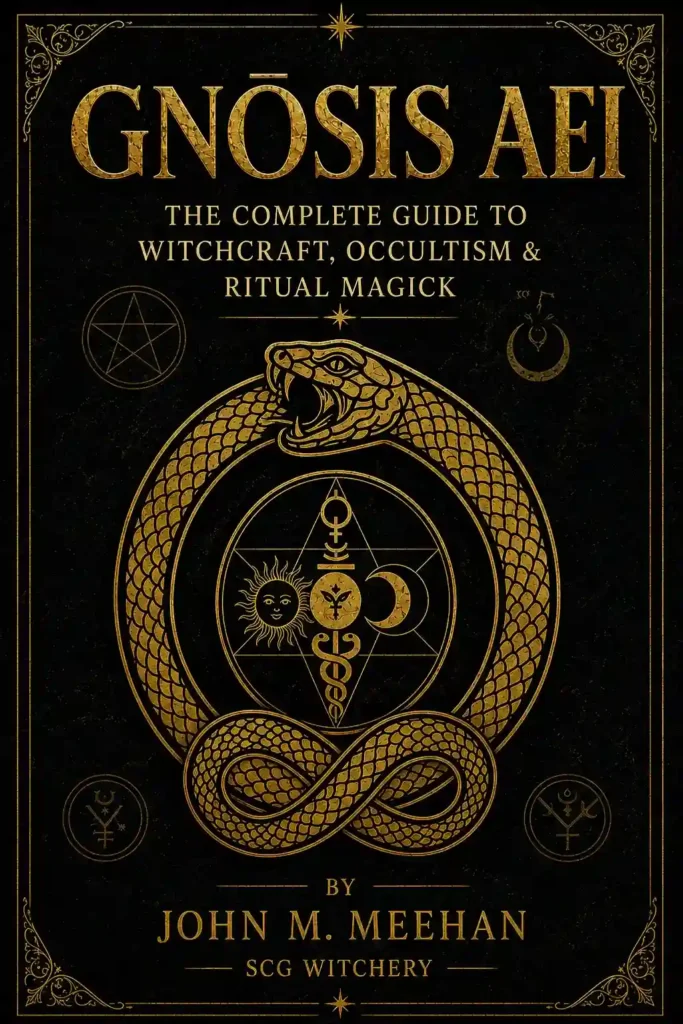
5 Mind-Bending Lessons from “Gnosis AEI”: Why Real Magick Is More Science Than Superstition
1. Introduction: Unveiling the Mechanics of Modern Esotericism
For centuries, popular culture has packaged magic into comfortable, digestible boxes. Mainstream perspectives often reduce real magick either to passive prayer, moralistic religious dogma, or superstitious folklore based on whim and divine supplication. Practitioners are frequently pictured begging external deities for favor or tiptoeing around cosmic taboos designed to keep the seeker timid, compliant, and subservient.
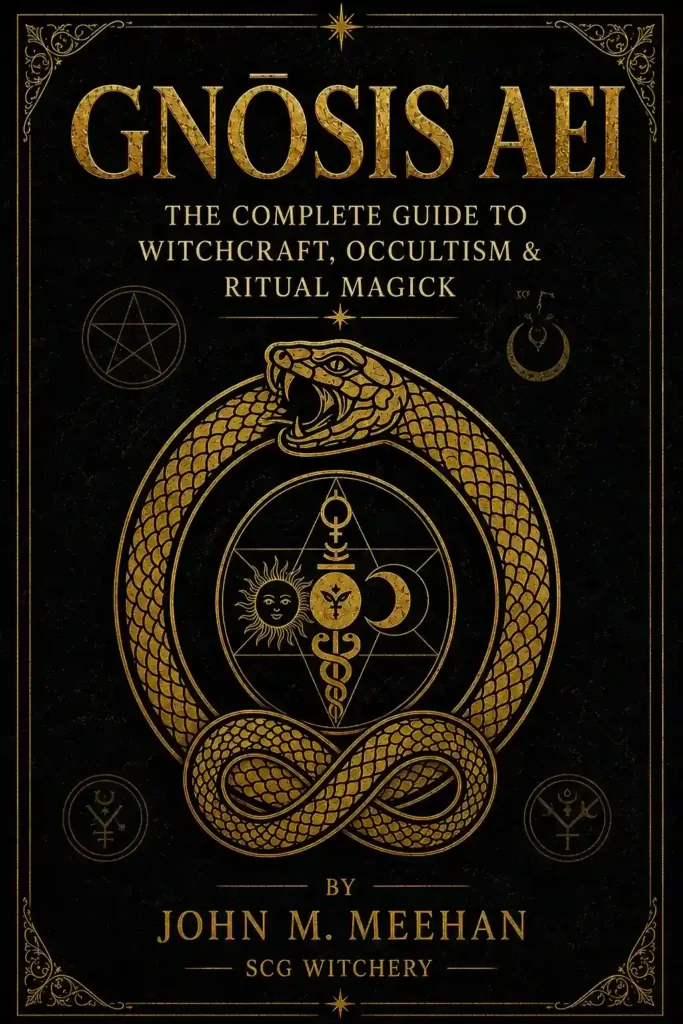
Enter Gnosis AEI (“Eternal Knowledge”) by John M. Meehan—a modern grimoire that violently strips away centuries of fluff, sentimentality, and spiritual dogma. Drawing from over three decades of practice spanning ceremonial magick, Luciferian philosophy, and the raw power of the Greek Magical Papyri (PGM), Meehan explicitly rejects the “sterile, moralistic structures of Wicca”—a system he now views with a cynical laugh—replacing religious submission with a cold, rigorous, and devastatingly practical framework.
At the heart of Gnosis AEI is the seamless synthesis of two core systems: The Leahcimich Theory (the overarching metaphysical soul) and The Hoci Method (the precise, structured physical and mental mechanics). Together, they put forward a single, revolutionary thesis: reality is not a fixed, immutable state governed by divine whim, but a fluid substance—like slowly cooling glass—that dynamically responds to a disciplined, sovereign Will operating within immutable spiritual laws.
2. Takeaway #1: Magick Is Cause and Effect, Not Divine Judgment
In the framework of The Leahcimich Theory, real magick does not operate on cosmic karma or moral judgment. The universe does not reward “good” intentions nor punish “bad” ones. Instead, the theory describes magick through metaphysical cause and effect, using the language of physics to explain a dynamic feedback loop between the practitioner, the ritual structure, and universal forces.
This principle, known as Dynamic Energy Flow, models a magical act not as a linear “fire-and-forget” command, but as a continuous exchange. The practitioner projects a wave of Will that alters the subtle fabric of reality; reality immediately sends back reacting ripples of force that an adept must perceive and navigate during the working itself.
To clarify this dynamic, Meehan introduces the Archer Metaphor:
- The Archer (The Vessel): The practitioner, whose strength, focus, and stability are paramount.
- The Bow (The Ritual Structure): The operational chassis, which must be crafted from sound materials with a taut string.
- The Arrow (The Intent): The targeted force, which must be razor-sharp, perfectly straight, and unblemished by doubt.
- The Release (The Climax): The conscious projection of gathered Will into the universe.
- Wind and Gravity (Universal Forces): The external metaphysical environment that the operator must calculate and respect.
To achieve consistent, predictable results, a working requires precise calibration across three distinct domains:
- Calibrating Intent: Ensuring the intent is sharp, clear, and free from contradictory desires or self-doubt.
- Calibrating the Vessel: Preparing the practitioner’s physical body, nervous system, and mind to act as a stable, focused firing platform.
- Calibrating the Structure: Aligning all ritual components—symbols, timing, and planetary correspondences—to resonate at the exact required frequency.
Meehan illustrates the danger of misalignment through the hypothetical scenario of The Flawed Prosperity Spell. A practitioner facing eviction performs a rite demanding “money to pay rent.” Their Vessel is compromised by desperate fear; their Structure is flawed, burning a green candle on a Saturday (the day of Saturn, associated with restriction and binding). The result? A chaotic blast of misaligned energy. The following day, a family member dies in a fatal car crash, yielding an inheritance of $2,000. The universe delivered the requested sum through the path of least resistance because the operator failed to build a properly calibrated channel.
Meehan dismantles popular misconceptions of cosmic justice with uncompromising clarity:
“Discard the comforting nursery tale of ‘karma.’ There is no cosmic judge weighing your good and bad deeds. The universe is not a courtroom; it is a firing range. Your ritual is the firearm. Your Will is the pressure on the trigger.”
Viewing real magick through energetic cause-and-effect radically empowers personal agency. It places responsibility on the operator for the design, execution and consequences of their own actions, without implying control over every external circumstance. As Meehan explains, we do not control the cosmos, but we are responsible for our actions within it.
3. Takeaway #2: Stop Groveling: Treat with Deities as a Sovereign, Not a Servant
One of the most radical departures in Gnōsis AEI is its stance on entity engagement. The text forcefully rejects the posture of worship, supplication, and emotional groveling before non-corporeal intelligences.
Meehan classifies spiritual practitioners into three distinct categories:
- The Solipsist: Believes all gods and spirits are mere mental projections of his own psyche. (A king with no kingdom or allies).
- The Supplicant: Believes he is nothing without his gods, begging on his knees for scraps of favor. (A servant submitter).
- The Sovereign: Recognizes spirits as ancient, objective forces, engaging with them from a position of absolute self-authority and mutual respect.
To establish this sovereign standing, the system distinguishes between Invocation (“calling in” an entity’s current into oneself for internal transformation) and Evocation (“calling forth” a spirit to an external space for communication or contract).
When engaging with deities, Gnōsis AEI mandates a strict Protocol for Sovereign Engagement:
- Research & Rapport: Studying an entity’s historical context, myths, and frequencies prior to contact to tune into their specific energetic key.
- The Altar as Embassy: Constructing a clean, respectful, and aesthetically aligned ritual space, treating the altar as a diplomatic sanctuary for a visiting dignitary.
- Vibrational Keys: Utilizing precise invocatory chants and sacred names as acoustic and energetic keys to tune into specific spiritual frequencies.
- Sovereign Humility: Respecting the vast age and power of the invoked force without diminishing one’s own internal authority.
“Your Will is absolute within your own sphere, and you engage with deities not as a servant begging a master, but as a king forging an alliance with another king for a common goal.”
This diplomatic reframing elevates real magick from religious obedience to cooperation between sovereign entities. The Leahcimich Theory treats personal Will and divine energies as complementary: Will directs the working, while divine invocation amplifies its potency. Personal Will is the rudder of the ship; divine invocation is the wind in its sails.
4. Takeaway #3: Physical Tools Are Merely “Training Wheels” for the Will
In traditional occultism, elaborate tools are frequently fetishized, yet real magick never depends on them. Gnōsis AEI demystifies physical apparatuses—the Athame, Wand, Chalice, and Pentacle—treating them not as independent sources of power, but as externalized symbolic technology engineered to focus specific faculties of human consciousness.
| Physical Tool | Internal Faculty |
| Athame (Ritual Blade) | Decisive Will & Intellect (Power to divide, command, and sever illusion) |
| Wand | Directed Imagination & Creative Intent (Laser-focused projection of force) |
| Chalice (Sacred Cup) | Receptive Heart, Emotion & Intuition (Vessel for spiritual communion) |
| Pentacle (Ritual Disk) | Material Manifestation & Grounded Spirit (Anchor for elemental integration) |
This evolution is clearly demonstrated in the system’s signature banishing rite: the Supreme Banishing and Sealing Ritual of Aethereal Dominion (SBRAD). Engineered specifically to supersede historical practices like the Lesser Banishing Ritual of the Pentagram (LBRP), the SBRAD discards the LBRP’s reliance on Abrahamic/angelic hierarchies and divine supplication. Where the LBRP tethers the operator to external religious authorities, the SBRAD operates on pure, self-delineated Aethereal dominion.
The SBRAD offers two distinct operational modalities:
- Version 1 (Full Ritual): Employs physical apparatuses—blade, colored candles, consecrated incense, and chalice—to build a multi-layered sensory anchor for formal temple work.
- Version 2 (Simplified Vocal Command): Dispenses with physical objects entirely. It relies strictly on disciplined imagination, breath, and the vocalized Will, executing a full metaphysical lockdown of the space purely through mental focus.
“Never grant your own power to an inanimate object… We learn with tools so that we may eventually become the tool itself.”
While physical tools are invaluable for training and stabilizing focus, ultimate mastery lies in internalizing the apparatus until your own consciousness becomes the primary ritual instrument.
5. Takeaway #4: The Double-Collared Chain: The Unspoken Cost of Coercive Magic
Societal moral codes often label love, lust, and domination workings as forbidden or “evil.” Gnosis AEI discards societal taboos, treating morality as a human social construct—a cage designed to keep individuals docile. Reality itself is non-moral and fluid. Mechanically, attempting to bind another person’s emotions is no different than altering any other fabric of existence.
Drawing historical precedent from ancient coercive attraction spells preserved in the Greek Magical Papyri (such as PGM XVI.1–75 and PGM XVIIa), the text acknowledges that direct influence and compulsion are fully within the practitioner’s reach. However, Gnosis AEI delivers a stark warning regarding the energetic physics of compulsion:
“When you cast a spell to bind another, you are forging a chain with two collars. One goes around their neck; the other goes around yours. You will feel what they feel.”
Understanding this warning requires examining the metaphysics of the Chaka—the irreducible, timeless spirit core that exists behind the mortal body and personality. The Chaka evolves through three distinct stages of development:
- The Ember: The unawakened or novice spirit core—small, easily buffeted by external emotions, and producing inconsistent magical power.
- The Flame: The steady, controlled core of a dedicated practitioner—resilient against stray psychic winds and capable of consistent projection.
- The Star: The radiant, self-sustaining state of a master—a gravitational force that actively projects its own reality onto the world.
In the context of personally directed love or lust bindings, Meehan warns that the emotional currents invoked in another may echo within the person who binds them. The double-collared chain illustrates the spiritual and emotional burden of such workings and the importance of mental fortitude. The Ember, Flame and Star illustrate the development of the Chaka, rather than a prescribed mechanism of regression caused by coercive magick.
6. Takeaway #5: Mastery Demands Brutal Scientific Reflection, Not Mindless Repetition
A core error of modern practitioners is the belief that repeating a ritual script over and over automatically builds expertise. Gnōsis AEI firmly rejects this: mindless repetition breeds complacency, turning dynamic spiritual operations into hollow, mechanical gestures.
True advancement in real magick requires disciplined observation, reflection and adjustment. The Hoci Method also emphasizes mental and practical health, energetic hygiene, and the management of stress and endurance. Within The Hoci Method, post-ritual analysis is mandatory. Practitioners are instructed to maintain a personal “Grimoire of Shadows” using a rigid, 6-step analytical framework for every working:
- Statement of Intent: A single, razor-sharp sentence stating the exact objective.
- Ritual Design & Correspondences: A complete catalog of tools, timing, planetary aspects, and invoked forces.
- Record of Execution: A purely factual account detailing the rite, noting any deviations, distractions, or sensory phenomena.
- Divined vs. Actual Outcome: Comparing pre-ritual divination against observable, tangible results in the physical world.
- Discrepancy Analysis: A cold, emotionless evaluation of any gap between intent and outcome. Was the intent clear? Was a correspondence weak? Was focus broken? Was the Vessel compromised?
- Mandate for Adjustment: A concrete, binding prescription written for the next attempt (e.g., altering timing, adjusting incense, or increasing vocal force).
By stripping away ego, wishful thinking, and emotional self-deception, this disciplined analytical feedback loop converts failed workings into valuable data, turning self-assessment into a reliable engine for genuine spiritual growth.
7. Conclusion: Real Magick Makes You the Architect of Your Own Destiny
Gnōsis AEI provides a clear framework for modern esotericism: real magical power is neither granted by divine grace nor requested through humble prayer. It is cultivated through rigorous discipline, personal accountability, and the intelligent application of sovereign Will in cooperation with spiritual forces.
By viewing real magick as an esoteric science rather than a superstitious belief system, the practitioner steps out of passive observation and into active creation.
Are you content to remain trapped within the conceptual cages of inherited societal beliefs, or will you discipline your Will and step forward to actively shape your own reality?