
Baphomet is frequently described as a demon, a Satanic deity, or an ancient supernatural being. Yet the historical evidence tells a more complicated story. Not established in historical demonology as an ancient demon. The figure most people recognize today is primarily an occult symbol of balance, transformation, and the relationship between opposing forces.
To understand Baphomet, we must separate medieval accusations, nineteenth-century occult philosophy, and modern religious interpretations. These are related chapters in the history of a symbol, not proof that a single entity has existed unchanged throughout history.
What Is Baphomet?
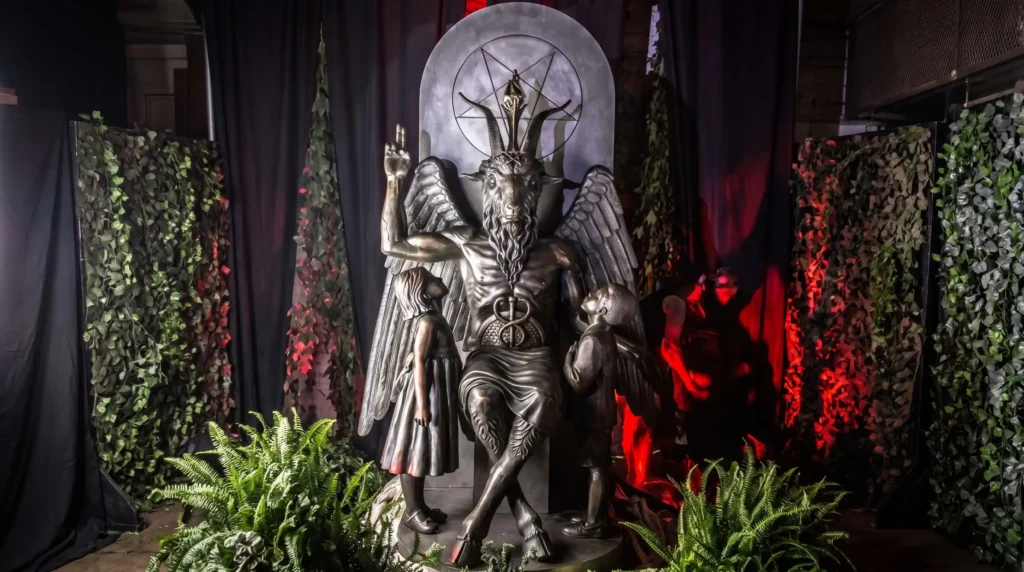
A name associated with accusations against the medieval Knights Templar and, centuries later, with the goat-headed, winged figure popularized by French occultist Éliphas Lévi. In Lévi’s work, Baphomet represents the equilibrium of opposites and his theory of the astral light, a proposed universal magical agent.
Some contemporary practitioners treat Baphomet as a deity, spirit, or devotional figure. Those are genuine modern religious interpretations, but they should not be confused with verified evidence of an ancient demon.
Where Did the Name Baphomet Come From?
The name predates Lévi’s illustration. Medieval forms of the word have appeared in contexts connected to the Crusades, and some historians interpret them as variations of “Mahomet,” a medieval European rendering of Muhammad. The precise history of the term remains debated.
Baphomet became notorious during the persecution of the Knights Templar, beginning in 1307 under King Philip IV of France. The Templars were accused of heresy and of venerating mysterious idols or heads. Some confessions were obtained under torture, making them unreliable evidence of what the order actually practiced.
There is no sound historical basis for asserting that the Templars worshipped Lévi’s familiar goat-headed figure. That image appeared more than five centuries later. The allegations against the order, the medieval word, and the modern icon must not be treated as interchangeable.
For historical context, see the History Channel’s discussion of the Templar accusations and the Llewellyn occult encyclopedia entry.
Éliphas Lévi and the Baphomet Image
The most recognizable Baphomet image originated with Éliphas Lévi in the 1850s. His androgynous, goat-headed figure, often called the Sabbatic Goat, appeared in Dogme de la haute magie and later editions of Dogme et rituel de la haute magie.
Lévi was not simply drawing a monster. He assembled a symbolic composition to express his theories of magical equilibrium, astral light, and the reconciliation of apparent opposites. Historian Julian Strube’s peer-reviewed study also shows that the figure belongs within Lévi’s wider intellectual, religious, and political project, rather than being reducible to the popular slogan “good versus evil.”
Read Julian Strube’s scholarly analysis of Lévi’s Baphomet for the historical context of this interpretation.
What Does Baphomet Symbolize?
As Above, So Below
One arm points upward while the other points downward, inviting an interpretation of correspondence between spiritual and material existence. The gesture is commonly understood through the Hermetic maxim “as above, so below.” It suggests a relationship between different levels of reality, not necessarily allegiance to a supernatural ruler.
Solve et Coagula: Dissolution and Reformation
In Lévi’s original illustration, the words Solve and Coagula appear on the arms. These alchemical concepts refer to dissolving and recombining. Esoterically, they can describe the breakdown of an existing condition followed by a new configuration. Transformation requires both processes.
Masculine and Feminine
The figure deliberately combines characteristics traditionally coded as masculine and feminine. In Lévi’s symbolism, this androgyny represents the union of complementary principles. It should not be mistaken for a literal biological description of a spirit.
Light, Darkness, and Knowledge
The flame above the head can be read as illumination or intelligence. Animal and human features coexist, expressing the meeting of instinct and reflective consciousness. The image is intentionally paradoxical: what appears contradictory may belong to one larger system.
This is also why occult symbolism should be studied within its historical setting. Related discussions of symbolic interpretation and inner transformation appear in our guide to shadow work and our broader divination resources.
Is Baphomet a Demon or Satan?
There is no reliable historical evidence establishing Baphomet as an ancient demon, and Lévi’s original symbolic figure was not simply a portrait of Satan. The association between Baphomet and Satanism developed through later reinterpretations, including nineteenth-century polemics and twentieth-century Satanic imagery.
That does not mean nobody worships or invokes Baphomet today. Some modern Satanic and esoteric groups adopt the image as a religious or philosophical emblem, while individual practitioners may regard Baphomet as a spiritual presence. Their beliefs should be described accurately without projecting them backward into medieval history.
Appearance alone does not establish demonic identity. Horns, wings, animal characteristics, and pentagrams have carried different meanings in different cultures and periods. Calling a figure demonic solely because it resembles later Christian devil imagery is not a historical argument.
Could Baphomet Be an Architect of Reality?
There is a useful distinction between an architect who literally creates the cosmos and a symbol that expresses the principles by which a cosmos is organized.
In an interpretive occult framework, Baphomet can represent the architecture of existence: polarity, correspondence, transformation, and the coexistence of apparently incompatible forces. That is a philosophical reading, not a documented ancient doctrine identifying Baphomet as the creator of reality.
Some Gnostic systems describe a Demiurge as the maker or organizer of the material world. Baphomet is not traditionally identified with that figure in the surviving ancient Gnostic sources. Equating the two would be a modern synthesis, and should be presented as such.
To explore the distinction between ritual action and symbolic cosmology, visit our witchcraft and ritual practice hub.
How to Identify Historical Claims About Baphomet
When evaluating an account of Baphomet, apply these four research questions:
- Identify the date. Is the claim medieval, nineteenth-century, or modern?
- Identify the source. Is it a trial accusation, a primary occult text, or a later interpretation?
- Separate symbols from beings. Does the author describe an allegory, a deity, or a literal demon?
- Check the evidence. Does the claim cite a surviving source, or merely repeat an association?
Why Is Baphomet So Often Misunderstood?
Three historical layers are repeatedly collapsed into one: medieval Templar accusations, Lévi’s nineteenth-century esoteric illustration, and modern Satanic or popular-culture usage. When these layers are mixed together, a symbol of equilibrium can be presented as if it were a named demon from antiquity.
The misunderstanding is intensified by the assumption that anything outside a particular religious tradition must belong to an opposing evil power. Historical research requires more than theological classification. It asks when a claim first appeared, who made it, what evidence survives, and how the meaning changed over time.
Frequently Asked Questions About Baphomet
Is Baphomet an actual demon?
Baphomet is not historically established as an ancient demon. The best-documented familiar figure is an occult symbolic construction popularized by Éliphas Lévi in the nineteenth century.
Did the Knights Templar worship Baphomet?
The Templars were accused of venerating mysterious idols, but the evidence is disputed and includes confessions obtained under torture. There is no credible basis for claiming they worshipped Lévi’s later goat-headed figure.
Is Baphomet the same as Satan?
No, not in origin or in Lévi’s primary symbolic intent. Some later movements associated the figure with Satanism, but that is part of its reception history.
What do Solve and Coagula mean?
They refer to dissolution and recombination, processes used in alchemical and esoteric explanations of transformation.
Is Baphomet a god, spirit, or symbol?
Historically, the best-supported answer is a name with medieval associations and a later occult symbol. Some modern practitioners additionally interpret Baphomet as a deity or spirit.
Conclusion: Understanding Baphomet Beyond the Demon Label
Baphomet is best approached through historical evidence and careful interpretation rather than fear-based assumptions. The familiar figure expresses a complex occult vocabulary of opposites, illumination, and transformation. Describing Baphomet as a symbolic representation of the architecture of existence is defensible as a modern esoteric interpretation. Describing Baphomet as an ancient demon or a proven cosmic creator is not supported by the same historical evidence.
At SCG Witchery, we believe serious occult study requires distinguishing documented origins from later religious claims, and symbolism from assertions of literal supernatural identity.