
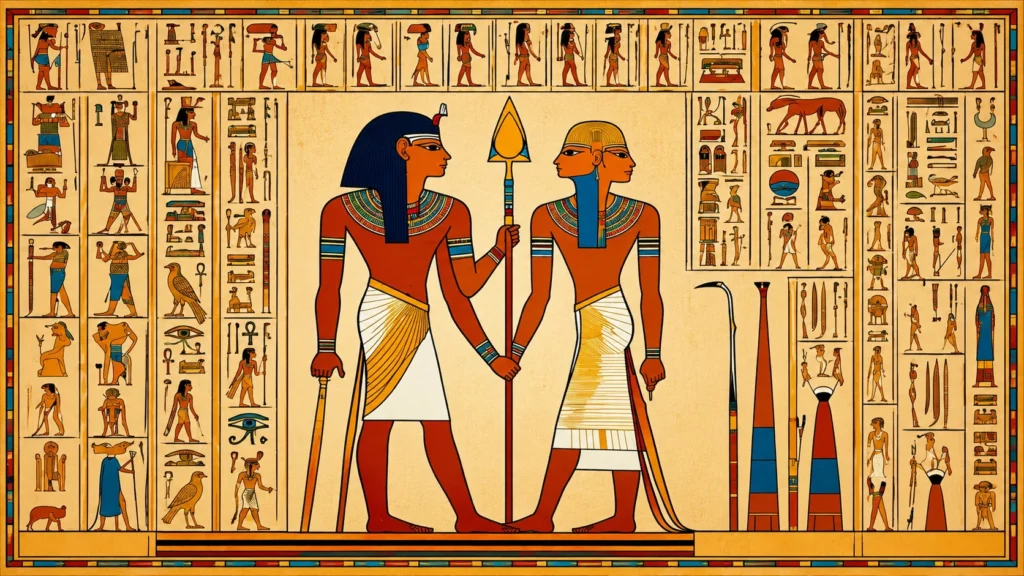
Ancient Egypt preserved some of the most influential traditions of ritual magick, and the Greek Magical Papyri (PGM) are among the most important surviving records of their later Greco-Egyptian development. These manuscripts preserve an extraordinary collection of spells, invocations, bindings, divination procedures, protective operations, and ceremonial instructions originating from the religious and magical traditions of the ancient Mediterranean.
What makes the PGM particularly significant is not simply their age. It is the remarkable detail with which many of these texts document the construction and execution of ritual workings.
These were not collections of vague spiritual affirmations. They were practical manuals containing instructions for accomplishing specific magical objectives through deliberately structured operations.
For contemporary witches, ceremonial magicians, and serious students of occultism, the Greek Magical Papyri provide direct access to historical methods of spell construction and ritual execution.
They also reveal something that is frequently overlooked in modern witchcraft: a magical objective and the ritual architecture used to pursue it are not the same thing.
Understanding that distinction is essential to understanding how ancient magicians approached their craft.
What Are the Greek Magical Papyri?
The Greek Magical Papyri, abbreviated PGM from the Latin Papyri Graecae Magicae, are a collection of magical manuscripts primarily associated with Greco-Roman Egypt.
The surviving material comes largely from the Roman period, particularly between the second and fifth centuries CE, although the religious traditions and magical techniques represented within these manuscripts possess considerably older roots.
Written principally in Greek, the PGM belong to a broader body of Egyptian magical literature that includes texts written in Demotic Egyptian and related traditions.
Their contents encompass numerous forms of ritual magick, including:
- Love, attraction, and erotic binding spells.
- Separation, coercion, and restrictive operations.
- Protective and defensive rituals.
- Healing and restorative workings.
- Divination, dream oracles, and scrying.
- Spirit invocation and divine communication.
- Consecration of objects and magical instruments.
- Rituals involving divine identification and spiritual empowerment.
The manuscripts do not represent a single, standardized magical tradition. Instead, they demonstrate the interaction of several religious and ritual systems within a shared cultural environment. This diversity is part of their importance.
Ancient Egypt: The Foundation of Greco-Egyptian Ritual Magick
Long before Greek rule, Egyptian civilization possessed a sophisticated tradition of ritual practice centered on heka.
Heka was both a divine personification and a fundamental concept of effective magical power within Egyptian religious thought.
Egyptian priests and ritual specialists employed spoken formulas, written inscriptions, symbolic objects, divine names, and ceremonial actions in their operations.
Magic was not treated as something inherently separate from religion. Ritual power was embedded within religious practice, healing, protection, funerary ceremonies, and the preservation of cosmic and social order.
When Alexander the Great conquered Egypt in 332 BCE, a new period of cultural interaction began.
Under the Ptolemaic dynasty, Greek political authority existed alongside established Egyptian priestly institutions and religious traditions. This interaction continued under Roman administration.
Greek and Egyptian religious concepts increasingly influenced one another, contributing to the development of the syncretic traditions preserved in the magical papyri.
One prominent example is Hermes Trismegistus, whose identity developed through the association of the Greek Hermes with the Egyptian Thoth.
Both deities were connected with knowledge, language, and sacred communication. Their identification became central to the wider development of Hermetic religious and philosophical traditions.
The PGM preserve a related environment in which Egyptian, Greek, Jewish, and other divine names and ritual elements could appear within the same magical operation.
This was not the abandonment of older traditions. It was the adaptation, combination, and continued development of ritual knowledge.
The Architecture of Ancient Spellwork
One of the most revealing characteristics of the Greek Magical Papyri is their procedural approach to magick.
Many instructions identify a specific magical objective and prescribe a corresponding sequence of ritual actions.
Although individual workings differ considerably, several structural elements recur throughout the manuscripts.
1. The Magical Objective
Every properly constructed ritual begins with a purpose.
Within the PGM, that purpose might involve attracting a particular individual, obtaining information, protecting a location, compelling communication, or restricting an adversary.
These are distinct objectives, not interchangeable expressions of the same desire.
A reconciliation operation, for example, differs fundamentally from an erotic attraction working. One seeks to restore a damaged relationship. The other seeks to generate or intensify desire.
Likewise, a protective binding differs from a coercive operation intended to control another person’s actions.
The materials and methods employed must correspond to the actual objective.
This is one of the central principles emphasized within the Hoci Method of GNŌSIS AEI: precision of intention requires precision of objective.
2. Materials and Magical Correspondences
The PGM contain instructions involving plants, resins, oils, minerals, lamps, writing materials, figurines, and other ritual objects.
These materials serve specific purposes within their respective operations. Their importance must be understood in relation to the ritual being performed.
A correspondence is not merely an ingredient selected because a modern reference chart associates it with love, protection, or prosperity. Its function must support the intended operation.
Ancient magical texts demonstrate how materials could be incorporated into a larger sequence of ritual actions, with different substances fulfilling different ceremonial functions.
For the contemporary practitioner, this reinforces the importance of constructing a ritual whose components work toward the same objective.
3. Divine Names, Invocations, and Spiritual Authority
The Greek Magical Papyri contain an extraordinary variety of divine names.
Among the figures and names encountered are Helios, Selene, Hekate, Hermes, Isis, Osiris, and various Egyptian and Jewish divine names and titles.
Individual texts may combine several religious traditions within a single invocation. These arrangements reveal a highly developed approach to ritual authority.
The magician does not always appear merely as a petitioner asking for divine assistance. Some operations employ declarations, commands, sacred identifications, and formulas intended to establish the practitioner’s authority within the ritual.
This distinction is important. Invocation, petition, identification, and command are different approaches to communicating with supernatural powers. They are not automatically equivalent.
The structure of an invocation must be understood according to its purpose and the particular ritual in which it appears.
4. Voces Magicae: The Power of Magical Speech
One of the most recognizable features of the PGM is the use of voces magicae, commonly translated as magical words or expressions.
These may consist of divine names, unusual combinations of syllables, repeated sounds, or extended phonetic sequences.
Some preserve recognizable linguistic or religious elements. Others have meanings that remain uncertain.
Within the ritual traditions that employed them, these expressions were treated as important components of magical speech.
Their function could involve invocation, the establishment of divine authority, or the activation of a particular ceremonial operation.
The voces magicae also demonstrate why ritual language cannot always be reduced to its ordinary dictionary meaning.
The context, repetition, pronunciation, and relationship of a formula to surrounding ritual actions all matter.
For serious practitioners studying historical magick, faithfully examining the original formula is preferable to inventing a convenient modern translation.
5. Ritual Timing, Gesture, and Execution
Some PGM workings include instructions concerning ritual timing, bodily positioning, gestures, preparation, repetition, and the handling of particular objects. Others are relatively simple.
This variation is important because it demonstrates that ancient magick did not follow one universal procedural template.
Nevertheless, where specific actions are prescribed, those actions belong to the architecture of the working.
An invocation spoken during the preparation of an object may serve a different function from one delivered at the culmination of a ritual.
Similarly, the preparation, consecration, activation, and completion of an operation are distinct stages when the text establishes them as such.
The precise arrangement depends on the individual working.
Binding Magic in the Greek Magical Papyri
Binding magic is one of the better-documented categories of ritual activity in the ancient Mediterranean.
The broader historical tradition includes the use of inscribed tablets, figurines, written names, and formulas intended to restrict or influence a particular person.
Within the PGM, binding techniques appear in operations involving attraction, compulsion, restraint, and other objectives.
These workings offer an important lesson in magical terminology.
A binding does not automatically constitute a love spell, a curse, or a protective operation.
Binding describes a class of magical action. The intended result determines its specific purpose.
A binding designed to restrain harmful behavior is structurally and intentionally different from a working intended to compel erotic attraction.
Confusing these objectives leads to confusion in ritual construction.
For advanced practitioners, the underlying question is not simply whether a ritual binds.
It is what is being bound, toward what objective, and through which ritual mechanism.
The Headless Rite and Divine Identification
Among the most influential passages in the PGM is the ritual commonly associated with PGM V.96–172, often known in modern occultism as the Headless Rite or the Stele of Jeu.
The text includes a powerful sequence of invocations and declarations associated with spiritual authority and divine identification.
Its historical significance extends beyond the ancient manuscript.
Adaptations of this material entered modern Western ceremonial magick, notably through the Bornless Ritual associated with the Golden Dawn tradition and later occult developments.
However, the historical Headless Rite and its modern adaptations should not be treated as identical rituals.
Translations, ritual arrangements, theological interpretations, and intended applications have changed across different versions.
Practitioners studying the original material should distinguish the ancient text from the ceremonial systems that subsequently adapted it.
This distinction is essential when examining the historical foundations of modern magical practice.
Divination, Dream Oracles, and Communication with the Divine
The PGM also preserve numerous techniques intended to obtain information through supernatural means.
These include procedures involving lamps, dreams, visionary experiences, and the invocation of divine or spiritual intermediaries.
Some operations seek answers to specific questions. Others involve the appearance or communication of a supernatural figure.
Their ritual construction frequently involves preparation, invocation, and a prescribed method of receiving the response.
Divination in these sources is therefore more than the casual interpretation of random signs.
It can constitute a deliberate ceremonial operation with its own methods and requirements.
Nevertheless, divination and spellcasting remain distinct activities.
The historical existence of elaborate divinatory practices does not establish divination as a mandatory prerequisite for every magical working.
A practitioner may employ divination to investigate circumstances or evaluate an intended course of action without treating it as universal permission to perform magick.
What the PGM Reveal About Modern Witchcraft
The Greek Magical Papyri provide a useful historical comparison for contemporary magical practice.
Many techniques familiar to modern practitioners possess parallels in ancient ritual traditions, including the use of petitions, divine names, ritual objects, spoken formulas, and symbolic actions.
However, similarities do not automatically establish an uninterrupted historical lineage.
Modern witchcraft incorporates material from many periods and traditions, and individual systems differ considerably in their origins and methods.
The value of the PGM lies in studying their actual ritual instructions rather than assigning every modern practice an ancient origin.
For practitioners working within GNŌSIS AEI, the manuscripts provide an especially valuable comparison with the Hoci Method’s emphasis on ritual architecture.
A properly developed working requires more than selecting a candle, naming a desire, and hoping for the intended result.
It requires understanding the objective, identifying appropriate correspondences, organizing the operation, and executing it coherently.
The PGM demonstrate that detailed ritual construction was already an important feature of ancient magical practice.
This is a historical comparison, not a claim that the Hoci Method itself originated in Greco-Roman Egypt.
Why Historical Sources Matter
Modern occult discussion frequently suffers from an unfortunate problem: repetition is mistaken for historical authority.
A claim may circulate through books, videos, websites, and social media until its familiarity makes it appear ancient.
The Greek Magical Papyri offer something considerably more valuable. They provide surviving textual evidence.
Their instructions can be examined, translated, compared, and studied in their historical context.
That does not mean every manuscript is complete or that every passage has been interpreted without disagreement.
It means that serious research can begin with documented primary material rather than unsupported claims about forgotten traditions.
For professional practitioners, this distinction is essential.
Understanding the actual sources provides a stronger foundation for evaluating ritual techniques, historical correspondences, and contemporary adaptations.
Conclusion: Ancient Knowledge, Modern Ritual Magick
The Greek Magical Papyri remain among the most important surviving resources for understanding ancient ritual magick.
They reveal a world in which religious practices, divine invocations, protective operations, divination, attraction, and binding magic formed part of a complex and evolving ritual environment.
More importantly, they preserve examples of how ancient practitioners approached the construction of magical operations.
Their instructions demonstrate the relationship between objective, materials, invocation, symbolism, and ceremonial action.
For the contemporary witch or ceremonial magician, studying the PGM is not simply an exercise in historical appreciation.
It is an opportunity to examine the architecture of ritual magick through some of its most significant surviving primary sources.
Magick is not made more effective by claiming that every modern technique is ancient. Its practice is strengthened by understanding the methods, objectives, and traditions from which its techniques developed.
At SCG Witchery, this principle remains central to our approach: informed practice, deliberate ritual construction, accountability, and precision over empty promises.
Explore our witchcraft spells and ritual services to learn more about how structured spellwork is approached within GNŌSIS AEI.
References and Further Reading
Betz, Hans Dieter, ed. (1986). The Greek Magical Papyri in Translation, Including the Demotic Spells. University of Chicago Press.
Faraone, Christopher A. (1999). Ancient Greek Love Magic. Harvard University Press.
Ritner, Robert K. (1993). The Mechanics of Ancient Egyptian Magical Practice. Oriental Institute of the University of Chicago.
Preisendanz, Karl, ed. (1928–1931). Papyri Graecae Magicae: Die griechischen Zauberpapyri. Teubner.