
A grimoire is not a diary and not an evil book. In historical and practical terms, it is a technical instruction manual for ritual magic, and in modern diagnostic-first work that same discipline still matters, including the 40-minute consultation model used before any commissioned ritual in Telos spellwork.
Most popular advice on this topic gets the category wrong at the start. It tells people to treat a grimoire as a mood board, a scrapbook, or a vaguely mystical journal where any note about crystals, dreams, or intentions counts as the same thing. It doesn’t. If you want a usable grimoire definition, strip away the fiction first.
A real grimoire is closer to a lab manual than a confession notebook. It contains procedures, timings, symbols, constraints, and operational logic. It’s meant to be applied. That matters because serious practice depends on repeatable structure, not aesthetic chaos. If you need a grounded frame for how magical belief functions in practice, this discussion of magical belief is more useful than any cinematic image of a cursed leather tome.
Never dramatize magic in a hollywood frame, never make claims of guaranteed results. Nothing works instantly.
Table of Contents
- Beyond Fantasy The Real Grimoire Definition
- The Historical Roots of Magical Manuals
- Anatomy of a Grimoire A Technical Blueprint
- Grimoire vs Book of Shadows A Critical Distinction
- The Grimoire in Modern Professional Practice
- How to Identify Legitimate Practitioners and Services
Beyond Fantasy The Real Grimoire Definition
The fantasy version of the grimoire is useless. It presents the book as if the object itself is the whole story. In practice, the book matters because of what it contains, how clearly it instructs, and whether the operator can execute the work correctly.
A proper grimoire definition begins with function. A grimoire is a technical manual for operative magic. It isn’t merely “about” magic in the way a philosophical text, a mythological anthology, or a devotional prayer book might be. It gives procedures meant to produce effects through structured practice.
What the word should imply in practice
When practitioners use the term seriously, they should mean a text with operational content such as:
- Ritual sequence: what happens first, what follows, and what must not be skipped.
- Timing rules: when a working is attempted and when it should be postponed.
- Tools and diagrams: pentacles, talismans, seals, or other formal components.
- Preparatory conditions: purification, setup, wording, and material handling.
That’s why comparing a grimoire to a notebook full of affirmations misses the point. One is procedural. The other may still be useful, but it belongs to a different category.
Practical rule: If a book cannot tell an operator what to do, in what order, and under what conditions, it may be esoteric writing, but it is not functioning as a grimoire.
This is also where many beginners get misled by attractive but empty advice. Decorative pages, copied correspondences, and personal reflections can support a practice. They don’t automatically create an operative manual. A grimoire earns the name through method.
What works and what doesn’t
What works is codification. A practitioner records the mechanics of a working clearly enough that the structure can be studied, tested, refined, or rejected.
What doesn’t work is romantic confusion. Calling every magical notebook a grimoire erases the difference between system and sentiment. That difference becomes even more important once money, services, or claims of expertise enter the picture.
The Historical Roots of Magical Manuals
The word itself tells you a great deal, if you stop treating it like a relic from timeless darkness.

From grammar to grimoire
The term “grimoire” did not apply to magical books until the 18th century in France, and it only entered the English vocabulary in the 19th century. The word evolved from the Old French “grammaire”, which referred to any book written in Latin, a language not widely understood (historical account of the term’s origin).
That origin matters because it corrects a common mistake. People often talk as if “grimoire” is an eternal label applied to every ancient magical text. It isn’t. The word emerged later, after a long cultural shift in how hidden knowledge was imagined, recorded, and circulated.
Latin texts were difficult for ordinary readers. A book written in that language carried distance, authority, and obscurity. Over time, the linguistic drift from grammaire to grimoire reflects how difficult written knowledge became associated with specialised occult instruction.
If you study systems such as Enochian magic, that historical precision helps. It prevents the lazy habit of flattening every ritual text from every period into one undifferentiated pile called “ancient grimoires.”
Why the timeline matters
Once the term stabilised, it came to mean a manual of magic rather than just a difficult book. That is a narrower and more useful meaning. It points to books filled with invocations, tables, talismans, conjurations, and ritual directions aimed at specific operations.
This gives us a cleaner historical framework:
| Period or category | Better description |
|---|---|
| Earlier magical texts before the later term took hold | Magical papyri, catalogues, ritual texts |
| Later texts in the recognised manual tradition | Grimoires |
| Modern fiction inspired by occult books | Fantasy or occult-themed literature |
The label matters because it changes how you read the text. A ritual manual asks, “What operation is this teaching?” A fictional artefact asks, “What atmosphere is this creating?”
The strongest historical approach is plain. Use the term carefully. Don’t back-project it where it doesn’t belong. A lot of confusion disappears once you stop calling everything old, secretive, or ceremonial a grimoire.
Anatomy of a Grimoire A Technical Blueprint
A serious grimoire is built like an instrument. Every component exists because it serves an operation.
What makes a text operational
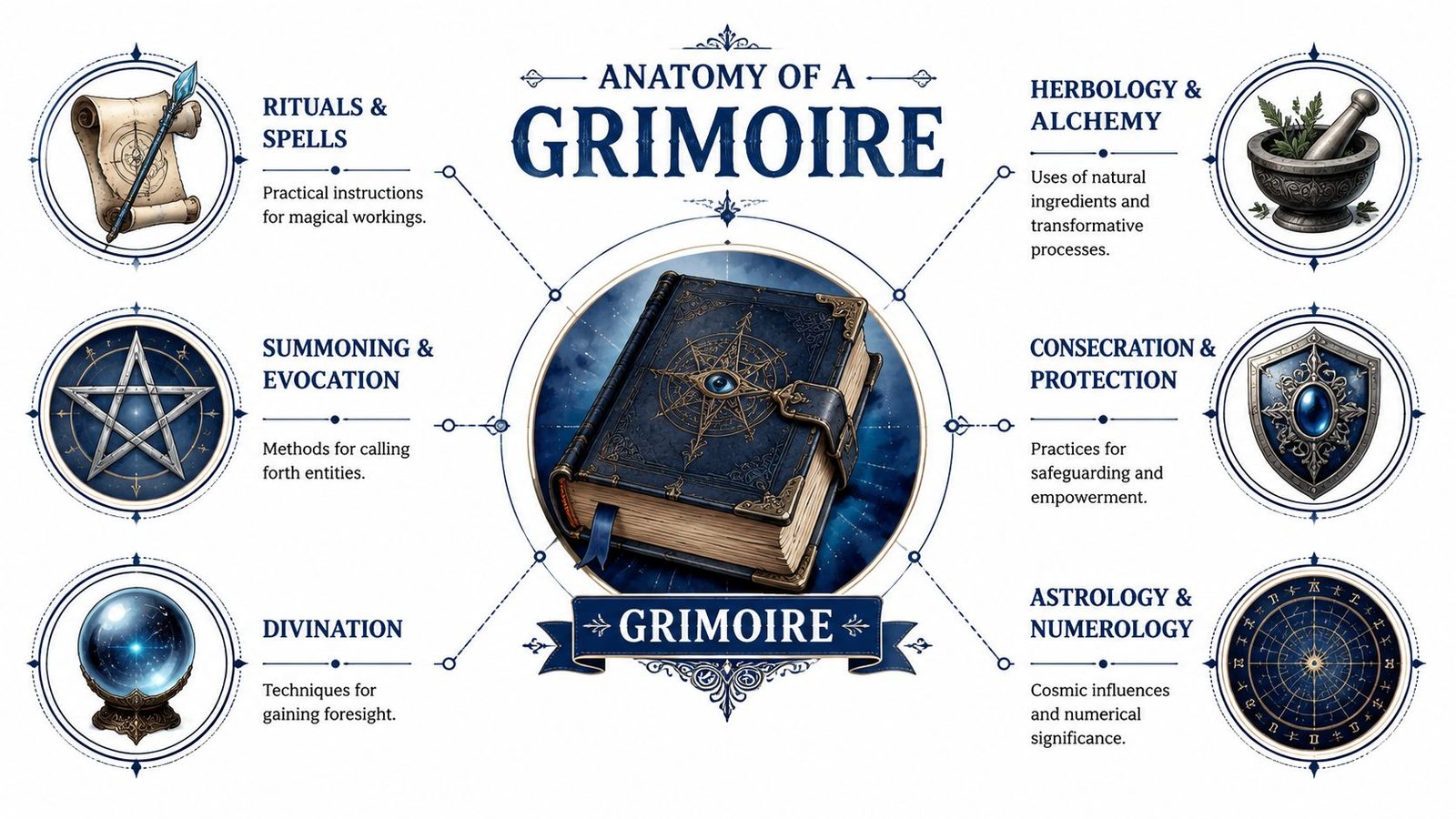
A historical grimoire is academically defined as a text composed within a tradition of ritual magic, providing operative guidance with procedural elements like ritual purification, planetary timing, and diagrammatic tools. Its purpose is to serve as a practical instruction manual for a solitary practitioner (scholarly guide to historical grimoires).
That definition cuts through the noise. The centre of the matter is operative guidance. The book is trying to tell an operator how to perform something, not how to feel about it.
A workable grimoire usually includes several layers of instruction:
- Preparation: fasting, purification, prayer, space-setting, or tool consecration.
- Timing: planetary hours, astrological conditions, or selected ritual windows.
- Formal structure: seals, pentacles, circles, names, invocations, dismissals.
- Material logic: which implements, inks, materia, or offerings belong to the operation.
- Closure: how the work is sealed, ended, stored, or repeated.
These are not decorative details. They are the mechanics. Remove enough of them and the text stops acting like a manual.
A manual built for use
This is why I compare a grimoire to a technical handbook rather than a visionary scrapbook. If someone is organising a serious magical text, it helps to think in terms of sequence, sections, dependencies, and reference usability. Even a general publishing resource like this roadmap for book composition is useful for understanding why structure matters when a book is supposed to be consulted rather than admired.
A practical student of spellwork also benefits from studying the basics of spellwork through procedural thinking instead of intuition alone. Instinct has a place. It should not replace architecture.
Here is the simplest test.
| If the text includes | It behaves more like |
|---|---|
| Ordered procedures, exact tools, timing, setup rules | A grimoire |
| Reflections, dream notes, emotional impressions, personal entries | A journal |
| Symbol lists with no method for use | A reference notebook |
| Myth, lore, and inspiration without application | Esoteric reading |
A grimoire should answer the same basic questions any craft manual answers: what is required, what is forbidden, what is the order, and what changes the outcome?
That’s the technical blueprint. The book records operations so they can be performed with discipline. Without that, the term becomes costume jewellery.
Grimoire vs Book of Shadows A Critical Distinction
This is the point where modern occult language usually becomes sloppy. People use both terms as if they are interchangeable. They aren’t, and treating them that way causes confusion for practitioners and clients alike.
Instruction manual versus personal record
A key distinction in occult literature is that a grimoire functions as an instruction manual or “codified collection of operative instructions,” whereas a “Book of Shadows” is a personal diary or magical record of one’s specific sessions and reflections (reference on the distinction).
That difference is not cosmetic. It changes what the text is for.
A grimoire preserves a system.
A Book of Shadows preserves a practitioner’s experience within or around a system.
One can certainly feed the other. A practitioner may test methods, record outcomes in a Book of Shadows, then formalise what proves reliable into grimoire material. But the categories remain different.
Here is the hard comparison.
| Attribute | Grimoire | Book of Shadows |
|---|---|---|
| Primary purpose | Instruction | Personal record |
| Core content | Procedures, seals, timings, formulas | Notes, reflections, experiences |
| Intended user | Operator applying a system | Practitioner documenting practice |
| Structure | Codified and repeatable | Flexible and personal |
| Authority style | Method-based | Experience-based |
| Best use | Performing or studying operations | Tracking development and observations |
Why clients should care about the difference
This distinction is not only academic. It has practical consequences when someone claims expertise.
If a practitioner says they work from a “grimoire,” the useful question is whether they mean:
- A real operational framework with procedures, constraints, and tested mechanics.
- A personal notebook filled with impressions, correspondences, and loosely assembled spell ideas.
Those are not equal. The first suggests systematisation. The second may still reflect sincere practice, but it does not automatically justify technical claims.
When a practitioner cannot explain the procedural basis of their work, the problem isn’t secrecy. The problem is often that there is no stable method to explain.
That is why clear language protects people. It helps practitioners stay honest about what kind of document they have built. It also helps clients distinguish between operational knowledge and personal spirituality. Both have value. Only one answers the grimoire definition properly.
The Grimoire in Modern Professional Practice
A grimoire is not frozen in the past. In advanced work, it becomes a living operational framework. Not a relic. Not a prop. A working system.
Why diagnosis comes before ritual
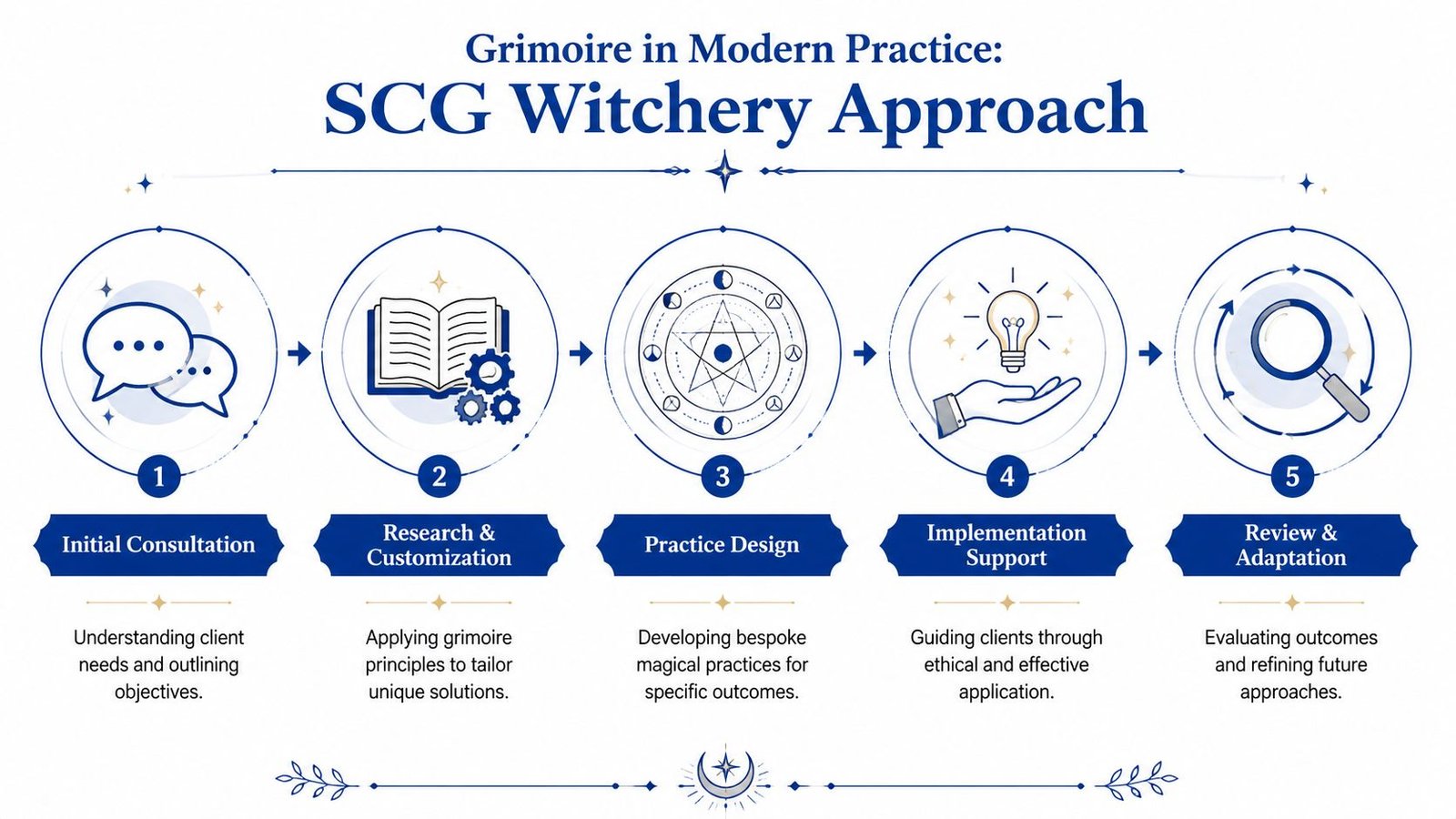
The strongest modern application of the grimoire model is diagnostic-first practice. That means ritual is not treated like a generic product pulled from a shelf. It is built in response to the mechanics of an actual situation.
The clearest concrete example in the provided data is the Telos spells framework, where a 40-minute initial consultation is mandatory before any ritual work is commissioned, so the operation rests on a mechanical assessment rather than blind enthusiasm (Telos consultation requirement).
That approach aligns with the older logic of grimoires far better than mass-market “spell kits” do. A real manual assumes conditions matter. It assumes variables matter. It assumes that timing, construction, and intent need alignment.
What does not work well in entrenched situations is random substitution. People often try to solve layered problems with template candles, copied wording, or jar spells stripped from context. That can feel active without being precise. Diagnostic work forces a practitioner to ask tougher questions.
- What is the active problem? Not the story told about it, but the operative obstruction.
- What is driving it? Recurrence, outside interference, internal conflict, timing, or mixed intent.
- What kind of build fits it? Protection, separation, pressure, attraction, revelation, or no work at all.
Modern grimoire development
In contemporary high-level practice, grimoire development means systematising knowledge so future work is not improvised from memory every time. The practitioner records not just what was done, but how decisions are made, what prerequisites govern the work, and where a method fails.
That’s the modern continuation of the same discipline that defined historical manuals. The language is different, but the craft principle is the same. Codify what can be repeated. Isolate what depends on conditions. Refuse to treat all cases as identical.
A mature grimoire in professional practice often functions as:
| Function | Why it matters |
|---|---|
| Operational archive | Prevents vague repetition and memory errors |
| Design framework | Supports custom ritual construction |
| Decision filter | Helps identify when not to work |
| Technical record | Tracks method, conditions, and rationale |
This is also where fantasy language becomes an obstacle. The more theatrical the framing, the easier it is to hide weak method behind mystique. Serious practice goes in the other direction. It makes the logic clearer, even when parts of the work remain private.
How to Identify Legitimate Practitioners and Services
If you understand the grimoire as a technical manual, you can use that understanding to vet practitioners. Through this process, the definition shifts from an academic concept to a practical tool for protecting people from poor work and outright fraud.
A practical vetting checklist
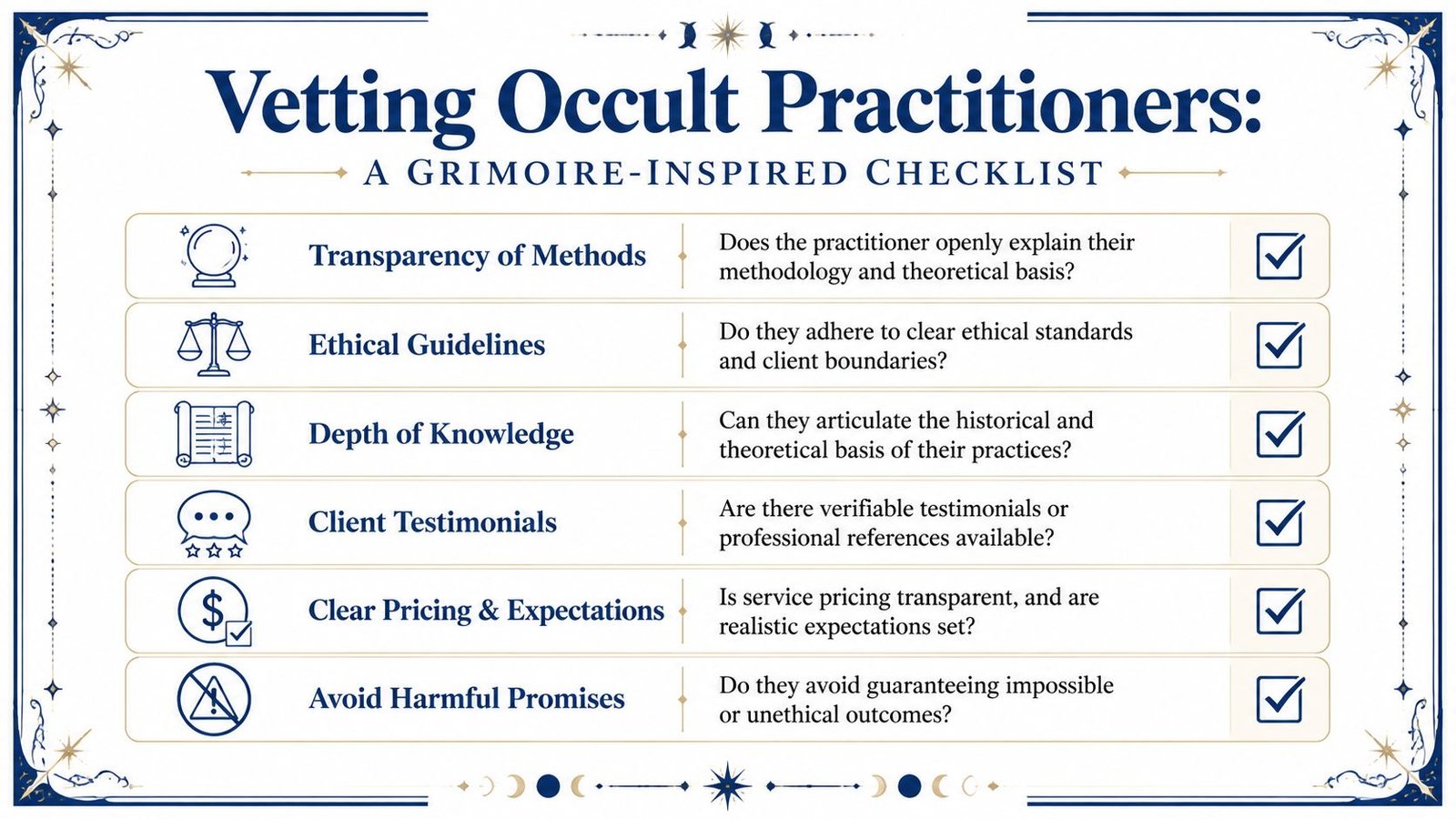
A legitimate practitioner doesn’t need to reveal every ritual detail publicly. They do need to show that their work is organised, bounded, and ethically framed.
Use this checklist:
- Method before mystique: Can they explain how they assess a case before recommending work?
- Clear service boundaries: Do they state what the service is and what it is not?
- Verifiable business identity: Can you confirm they operate as a real enterprise where registration applies?
- Transparent pricing: Are fees stated plainly instead of changing according to pressure or panic?
- No impossible promises: Do they avoid guarantees, instant-result claims, or emotional coercion?
- Fraud awareness: Do they help clients recognise template-selling and manipulative behaviour?
For readers in Quebec, one concrete marker is especially important. Registered enterprises like SCG Witchery operate under transparency standards, and services are legally required to be sold for “entertainment, spiritual, and educational purposes only” (Quebec terms and compliance standard).
That single rule tells you a lot. Ethical practitioners in that framework cannot promise guaranteed manifestation. They cannot sell certainty. They cannot responsibly claim that anything works instantly.
What ethical compliance looks like
Practical trust is built from specifics.
The verified business details in this case include a public NEQ 2279950598, with operation under Charmes De Sorcellerie Du Québec. The verified price structure is also concrete: diagnostic consultations start at $90 and premium custom ritual work peaks at $850. Those details matter because vague billing and identity opacity are common warning signs in spiritual services.
You should also pay attention to process. If a practitioner claims custom work but offers it without prior assessment, the contradiction is obvious. Custom work requires diagnosis. Otherwise it is only branding.
A useful screening step is to review a dedicated spellcaster verification service or an equivalent fraud-checking process before paying anyone. That won’t replace judgement, but it improves it.
Ethical occult work looks less glamorous than fantasy. It usually involves paperwork, limits, consultation, documented policies, and the willingness to say no.
If a service is all urgency, secrecy, and miracle language, walk away. A practitioner grounded in real method may still be occult, esoteric, or highly specialised. They should not be impossible to verify.
If you want help from a practice that treats occult work with procedural discipline instead of theatrical promises, SCG Witchery offers diagnostic consultations, custom ritual design, divination, and verification services grounded in a documented, Quebec-registered framework.