
Lilith in Biblical Texts: Uncovering Ancient Truths
The name Lilith has become one of the most recognizable — and most misunderstood — figures in the history of religious mythology. She appears on tattoos and tarot cards, in feminist manifestos and horror films, in occult ritual and academic scholarship. But what do the actual ancient texts say about her? Where does Lilith appear in the biblical record, and where does mythology end and documented history begin?
The answer is far more complex, more fascinating, and more contested than most popular accounts suggest.
Lilith’s presence in the textual traditions of Judaism spans nearly three thousand years — from a single, cryptic mention in the Book of Isaiah, through fragmentary references in the Dead Sea Scrolls, into the elaborate demonological discussions of the Babylonian Talmud, and finally into the rich mythological world of medieval Kabbalah and the Zohar. Each layer adds new dimensions to her character, transforming an obscure Hebrew word into one of the most potent supernatural figures in Western religious imagination.
This article provides a comprehensive, scholarly examination of every major textual source in which Lilith appears within the biblical and Jewish literary tradition — separating what the texts actually say from the centuries of interpretation that have accumulated around them. For readers seeking Lilith’s pre-biblical origins in Mesopotamian civilization, see our companion article: The Mesopotamian Origins of Lilith: Separating Fact from Fiction.
The Isaiah 34:14 Reference: Lilith’s Only Biblical Appearance
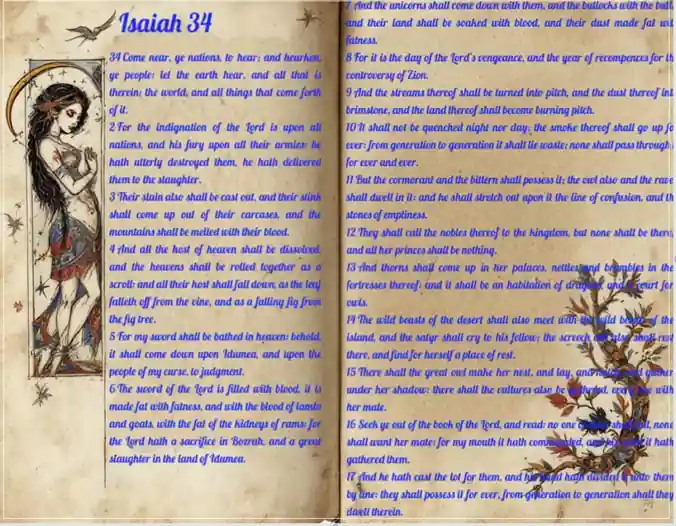
The first — and only — verifiable mention of Lilith in the Hebrew Bible appears in Isaiah 34:14. This single verse constitutes the entire foundation upon which all subsequent biblical interpretations of Lilith rest. Understanding it requires close attention to the original Hebrew, the prophetic context, and the fierce scholarly debate that continues to surround it.
The Hebrew Text
The relevant portion of Isaiah 34:14 reads in Hebrew:
אַךְ־שָׁם הִרְגִּיעָה לִּילִית וּמָצְאָה לָהּ מָנוֹחַ
akh-sham hirgi’ah lilit u-matza’ah lah manoach
“There too the lilit shall repose and find herself a resting place.”
The word lilit (לִילִית) occurs only this one time in the entire Hebrew Bible — making it what biblical scholars call a hapax legomenon, a word that appears once in a corpus. This singularity makes definitive translation extraordinarily difficult, because there are no other biblical usages to establish context or confirm meaning.
The Prophetic Context: The Desolation of Edom
Isaiah 34 is a powerful apocalyptic poem describing the total devastation of Edom, the perennial enemy of ancient Israel lying to Judah’s southeast. The chapter belongs to a literary unit (chapters 34-35) that most scholars consider distinct from the writings of the historical prophet Isaiah, son of Amoz (who lived approximately 742-701 BCE). These chapters were likely authored later — possibly during or after the Babylonian exile (6th century BCE) — and address themes of divine vengeance, cosmic judgment, and the ultimate desolation of Israel’s enemies.
The full context of the passage describes a landscape so thoroughly cursed by divine judgment that only the most ominous and marginal creatures will inhabit it:
“Wildcats shall meet hyenas,
Goat-demons shall greet each other;
There too the lilit shall repose
And find herself a resting place.”
The creatures mentioned alongside lilit are themselves subjects of scholarly debate. The Hebrew tsiyyim (צִיִּים) refers to desert animals — possibly wildcats or jackals. The iyyim (אִיִּים) are hyenas or howling creatures. Most significantly, the sa’ir (שָׂעִיר) — literally “hairy one” — is translated variously as “wild goat,” “satyr,” or “goat-demon.” The same word appears in Leviticus 17:7 and 2 Chronicles 11:15, where it clearly refers to demonic entities that the Israelites were worshipping — suggesting that Isaiah 34 may deliberately populate Edom with supernatural beings, not merely wild animals.
This contextual detail is critically important: if the sa’ir in verse 14 is understood as a demonic goat-figure (as the King James Version’s “satyr” and the Jewish Publication Society’s “goat-demon” suggest), then the lilit in the same verse is very likely also a supernatural entity rather than an ordinary nocturnal bird. The two are paired in the text — one calling to the other — and it would be inconsistent for one to be a demon and the other a mere owl.
As the scholarly analysis at the REV Bible Commentary notes, “Lilith would not need to be described in detail or said to be a demon if the common understanding in the culture at the time was that she was a demon.” Her appearance in the text without explanation or introduction indicates that Isaiah’s audience already knew what a lilit was — suggesting a pre-existing cultural understanding inherited from Mesopotamian tradition. (For the full background on this Mesopotamian heritage, see The Mesopotamian Origins of Lilith, where we trace the lilītu spirits through 3,000 years of cuneiform texts.)
The Significance of Lilith’s Placement
Lilith appears in Isaiah’s oracle not as a random detail but as a marker of ultimate desolation. The prophet is making a theological argument: Edom will become so thoroughly cursed that it will be fit only for the habitation of demons and wild beasts. Lilith’s presence signals that the land has been abandoned by God and by civilization.
This literary function connects directly to the Mesopotamian tradition, where Lilith-type spirits (lilītu) were associated with ruins, uninhabited places, and the desert — liminal zones between the ordered human world and the chaos beyond it. The biblical author’s deployment of lilit in a desolation prophecy perfectly mirrors the Mesopotamian understanding of where such spirits were believed to dwell.
The Translation Debate: Screech Owl, Night Creature, or Demon?
No aspect of Lilith’s biblical presence has generated more controversy than the translation of the single word lilit in Isaiah 34:14. The range of translations across English Bible versions reveals the deep uncertainty — and occasional theological bias — that surrounds this enigmatic term.
Major Translation Variants
| Translation | Rendering | Implication |
|---|---|---|
| King James Version (1611) | “screech owl” | Naturalistic — ordinary nocturnal bird |
| New King James Version | “night creature” | Ambiguous — could be animal or supernatural |
| Revised Standard Version | “night hag” | Supernatural — explicitly demonological |
| New Revised Standard Version | “Lilith” (capitalized) | Proper name — specific mythological figure |
| English Standard Version | “night bird” | Naturalistic — nocturnal avian |
| New International Version | “night creatures” (plural) | Ambiguous — plural, non-specific |
| Amplified Bible | “Lilith (night demon)” | Both name and gloss provided |
| Darby Bible | “the lilith” | Transliteration — leaves meaning open |
| American Standard Version | “night-monster” | Supernatural — monstrous entity |
| Latin Vulgate | “lamia“ | Identification with Greek/Roman child-stealing demon |
| Septuagint (LXX) | “onokentauroi” (donkey-centaurs) | Mythological creature — no direct Lilith equivalent |
Three Schools of Interpretation
The scholarly debate over this translation falls broadly into three camps:
The Zoological Interpretation: Some scholars, following the KJV tradition, argue that lilit simply refers to a type of nocturnal bird — a screech owl or night owl. This reading is supported by the surrounding context of wild animals, the derivation from laylah (“night”), and Strong’s Concordance, which lists “screech owl” as the primary meaning. The argument holds that nothing in the text requires a supernatural reading and that inserting a Mesopotamian demon into Hebrew prophecy represents eisegesis (reading meaning into the text) rather than exegesis (drawing meaning from the text).
The Demonological Interpretation: Other scholars argue that lilit is indeed a reference to the Mesopotamian lilītu demon class. This interpretation draws strength from the phonetic near-identity between Hebrew lilit and Akkadian lilītu, the pairing of lilit with the sa’ir (which is used elsewhere in the Bible as a demonic figure), and the broader ancient Near Eastern cultural context in which Isaiah was composed. Eberhard Schrader (1875) and Moritz Abraham Levy (1855) both argued that lilit was a demon of the night known to the Jewish exiles in Babylon.
The Agnostic Position: A third group of scholars acknowledges the ambiguity and argues that definitive resolution is impossible given the hapax legomenon status of the word. Judit M. Blair has argued that the context most naturally indicates an unclean animal, while acknowledging that the Mesopotamian demonological connection cannot be entirely dismissed.
The Septuagint and Vulgate Evidence
The earliest translations of the Hebrew Bible into other languages provide important clues about how ancient translators understood lilit:
The Septuagint (Greek translation, 3rd-2nd century BCE) renders the broader passage with daimonia (“demons”) and onokentauroi (“donkey-centaurs” — mythological hybrid creatures), but notably does not include a direct equivalent for lilit. This suggests either that the translators did not recognize lilit as a distinct named entity, or that they subsumed her into the broader category of daimonia.
The Latin Vulgate (Jerome, 4th century CE) translates lilit as lamia — a direct identification with the Greco-Roman child-stealing demon. Jerome, who was one of the most accomplished biblical translators in history and had access to Jewish scholarly tradition, clearly understood lilit as a supernatural entity. His choice of lamia (rather than any word for “owl” or “bird”) demonstrates that as late as the 4th century, the demonological interpretation was considered authoritative by at least some learned Christian scholars.
The Great Isaiah Scroll: A Crucial Variant
An extraordinary piece of evidence comes from the Great Isaiah Scroll (1QIsaᵃ), one of the original seven Dead Sea Scrolls discovered at Qumran in 1947. This scroll, dating to approximately 125 BCE, is the oldest complete copy of the Book of Isaiah — roughly 1,000 years older than the medieval Masoretic manuscripts that form the basis of most modern translations.
In this ancient manuscript, scholars have noted that the word appears in what may be a plural form (liliyyôt), suggesting that the original understanding was of a category of night spirits rather than a single named entity. This aligns with the Mesopotamian tradition, where lilītu was a class of demons rather than an individual. If the plural reading is correct, it strengthens the demonological interpretation and undermines the zoological reading (one would not pluralize a specific bird species in this context).
What the Translation Choices Reveal
The choice of translation is never neutral. Each rendering reflects a set of theological and scholarly assumptions:
- Translators who render lilit as “screech owl” or “night bird” are domesticating the text — removing its supernatural elements to produce a reading compatible with rationalist theology.
- Translators who render it as “Lilith” (capitalized) are importing later Jewish mythology back into the prophetic text — potentially anachronistic but arguably faithful to the cultural context.
- Translators who render it as “night creature” or “night monster” are attempting a middle path — acknowledging the nocturnal association while leaving the supernatural question open.
The most intellectually honest approach acknowledges that Isaiah’s original audience almost certainly understood lilit as a known supernatural entity — a wind spirit or night demon familiar from the broader ancient Near Eastern cultural milieu — and that the word’s meaning was progressively obscured, secularized, and debated as that cultural context receded from memory.
The Dead Sea Scrolls: Lilith Among the Demons of Qumran
The Dead Sea Scrolls, discovered at Qumran beginning in 1947, provide the oldest clear Hebrew-language usage of lilith as an explicitly supernatural term — outside the ambiguous Isaiah passage. This evidence is crucial because it establishes beyond reasonable doubt that by the 2nd-1st century BCE, Jewish communities in the Land of Israel recognized Lilith as a named demonic entity.
Songs of the Sage (4Q510-511)
The most important Qumran text for Lilith studies is the fragmentary manuscript known as the Songs of the Sage (also called Songs of the Maskil), catalogued as 4Q510 and 4Q511. This Hebrew-language composition is a text of incantation and exorcism — a liturgical work designed to protect the community from demonic forces.
The text reads:
“And I, the Instructor, proclaim His glorious splendor so as to frighten and to te[rrify] all the spirits of the destroying angels, spirits of the bastards, demons, Lilith, howlers, and [desert dwellers]… and those which fall upon men without warning to lead them astray from a spirit of understanding.”
Several aspects of this passage demand attention:
Lilith is named alongside other supernatural beings, not animals. She appears in a catalog that includes “destroying angels,” “spirits of the bastards” (the offspring of the Watchers described in 1 Enoch), and “demons.” This context makes it impossible to interpret lilith here as a type of bird.
The text is liturgical and practical, not mythological. The Songs of the Sage were recited by the Maskil (instructor/sage) of the Qumran community as part of regular ritual practice. This means Lilith was not a theoretical theological concept but an active threat that required ongoing ritual defense — exactly as the Mesopotamian lilītu spirits were treated in Akkadian exorcism texts (detailed in our article on The Mesopotamian Origins of Lilith).
The composition’s purpose is apotropaic (protective/warding). The academic analysis of this text, published in the Dead Sea Discoveries journal, argues that “the protection from the demons offered by the Songs is not so much the result of ‘magic’ as it is a natural outcome of the perceived attainment” of purity and supernal knowledge. In other words, the community believed that spiritual perfection created an inherent shield against entities like Lilith.
Connections to Other Qumran Texts
The Songs of the Sage is comparable to two other Qumran exorcistic compositions: the Aramaic incantation 4Q560 and the Hebrew text 11Q11. Together, these texts demonstrate that the Qumran community maintained an extensive and sophisticated demonological worldview in which Lilith occupied a recognized position among the forces of darkness aligned under Belial (the Qumran equivalent of Satan).
The text assumes a cosmology in which “the world is populated with evil angels under the dominion of Belial, a figure of ultimate personified evil.” Within this framework, Lilith is one of many demonic agents working to “lead men astray from a spirit of understanding” — an explicitly spiritual and moral threat, not merely a physical one.
Lilith in the Babylonian Talmud: From Spirit to Succubus
The Babylonian Talmud (finalized circa 500-600 CE) represents the next major stratum of Lilith’s textual history. While the Talmud does not develop Lilith into the fully formed mythological character she would later become, its scattered references reveal how rabbinical scholars of late antiquity understood her — and how their views shaped centuries of Jewish belief and practice.
The Four Key Talmudic Passages
Lilith is mentioned by name in four passages of the Babylonian Talmud. Each contributes a different facet to her emerging character:
Eruvin 100b — This passage discusses the cursed characteristics that were imposed upon Eve after the Fall. In the course of this discussion, Lilith’s name appears in connection with female sexuality and its consequences. The passage implies that certain physical or behavioral traits of women are linked to Lilith’s influence — establishing an early association between Lilith, female sexuality, and divine punishment.
Niddah 24b — This passage contains one of the most vivid Talmudic descriptions of Lilith. Rabbi Yehuda, quoting Shmuel, states: “In the case of a woman who discharges a fetus that has the form of a lilith — a female demon with wings and a human face — the mother is considered ritually impure.” This passage is significant for two reasons: first, it provides a physical description of Lilith (winged, with a human face); second, it places her within the legal framework of ritual purity (tahara/tumah), demonstrating that the rabbis considered Lilith relevant to practical halakhic (legal) decision-making, not merely folklore.
Shabbat 151b — This passage contains the Talmud’s most famous warning about Lilith: “It is forbidden for a man to sleep alone in a house, lest Lilith get hold of him.” (Rabbi Hanina’s statement.) This prohibition reveals several things about the rabbinical understanding of Lilith: she is an active threat, she specifically targets men who are alone, and she operates at night (presumably during sleep). The warning establishes Lilith as a succubus — a demonic entity that engages in sexual predation against sleeping men. The rabbis treated this as a genuine danger requiring practical behavioral countermeasures, not as a quaint superstition.
Bava Batra 73a-b — This passage contains one of the most extraordinary Talmudic references to Lilith — not to Lilith herself, but to her offspring. The sage Rabba reports seeing a supernatural being called “Hurmin bar Lilith” (Hurmin, son of Lilith) — a demon who could outrun horses while leaping across the ramparts of the city of Mekhoza and juggling cups of wine without spilling a drop. The passage states that this demonic figure was eventually killed by royal order. This reference is significant because it establishes that the rabbis conceived of Lilith not merely as an individual demon but as a progenitor — a mother of demons whose offspring were active in the physical world.
The Talmudic Lilith: An Emerging Profile
Taken together, the four Talmudic passages construct a composite portrait of Lilith that is more developed than anything in the biblical or Qumran texts, yet still far less elaborate than the medieval traditions that would follow:
- She has a physical form: winged, with a human face (Niddah 24b)
- She has long hair (Eruvin 100b)
- She is sexually predatory, targeting men who sleep alone (Shabbat 151b)
- She is a mother of demons, whose offspring are named and identified (Bava Batra 73a)
- She is relevant to questions of ritual purity, not merely folklore (Niddah 24b)
- She is taken seriously as a practical danger requiring behavioral precautions (Shabbat 151b)
What the Talmud does not do is identify Lilith as Adam’s first wife. That identification would not appear for several more centuries. In the Talmudic period, Lilith remains what she was in Isaiah and the Dead Sea Scrolls — a dangerous demonic entity — now significantly elaborated with physical characteristics and specific behavioral patterns, but not yet integrated into the Genesis creation narrative.
The Genesis Problem: Two Creation Accounts and a Missing Wife
To understand how Lilith eventually became identified as Adam’s first wife, we must first understand the textual puzzle that motivated the identification: the apparent contradiction between the two creation narratives in Genesis.
Genesis 1:27 — Simultaneous Creation
“So God created man in His own image, in the image of God He created him; male and female He created them.”
In this account (attributed by scholars to the “Priestly” source, or P), man and woman are created simultaneously, from the same material, and apparently as equals. The text uses the Hebrew hā’ādām (האדם) — “the human” or “humankind” — rather than a personal name, and states that both male and female were created together.
Genesis 2:7, 21-22 — Sequential Creation
“Then the LORD God formed man of the dust of the ground, and breathed into his nostrils the breath of life; and man became a living soul.” (2:7)
“And the LORD God caused a deep sleep to fall upon the man, and he slept; and He took one of his ribs, and closed up the place with flesh instead thereof. And the rib, which the LORD God had taken from the man, made He a woman, and brought her unto the man.” (2:21-22)
In this second account (attributed to the “Yahwist” source, or J), Adam is created first, alone. Only later, after God determines that “it is not good for the man to be alone” (Genesis 2:18) and after the creation and naming of all the animals, does God create a woman — not from the earth, but from Adam’s rib.
The Rabbinical Reconciliation
For rabbinical scholars who considered every word of Torah to be divinely inspired and therefore accurate, this apparent contradiction demanded explanation. If Genesis 1:27 describes the simultaneous creation of a man and woman, and Genesis 2 describes the separate creation of Adam followed by Eve — then who was the woman created in Genesis 1?
The Talmud itself offers one answer that does not involve Lilith. In Eruvin 18a, the rabbis suggest that the first human being was a single androgynous creature — “At first it was the intention that two [male and female] should be created, but ultimately only one was created” — which was later divided into male and female halves. This interpretation explains Genesis 1:27 without requiring a “first wife.”
But another tradition, one that would prove far more culturally powerful, offered a different answer: the woman of Genesis 1 was Lilith. The woman of Genesis 2 was Eve. And the reason Lilith does not appear in the subsequent narrative is that she fled Eden before the story continued.
The Alphabet of Ben Sira: Where Lilith Becomes Adam’s First Wife
The identification of Lilith as Adam’s first wife appears for the first time in a medieval Jewish text known as the Alphabet of Ben Sira (Alphabetum Siracidis), an anonymous work composed sometime between the 8th and 10th centuries CE — likely in Abbasid Baghdad.
The Nature of the Text
The Alphabet of Ben Sira is not scripture, not Talmud, and not formal midrash. It is classified by modern scholars as a satirical work — one of the earliest and most sophisticated Hebrew narrative satires of the Middle Ages. The Jewish Virtual Library describes it as having “a special, satirical, and even heretical character.” The Ancient Jew Review notes that “the contents of the Alphabet are wild” and that “David Stern has named the Alphabet of Ben Sira the first example of parody in classical rabbinic literature.”
The text contains pornographic elements, derogatory descriptions of biblical heroes (including Solomon and Jeremiah), and “serious” discussions of vulgar matters including masturbation, flatulence, and animal copulation. Prominent authorities, including Maimonides, attacked the work vigorously. Understanding this satirical context is essential to evaluating the Lilith narrative it contains — this is not a solemn theological treatise but a work of irreverent, boundary-pushing medieval Jewish storytelling.
The Lilith Narrative
The Alphabet frames its Lilith story within a tale of King Nebuchadnezzar of Babylon, whose young son has fallen ill. A sage named Ben Sira is commanded to cure the boy and inscribes a protective amulet bearing the names of three healing angels: Senoy, Sansenoy, and Semangelof. He then explains the backstory:
“When God created Adam and saw that he was alone, He created a woman from dust, like him, and named her Lilith. But when God brought her to Adam, they immediately began to fight. Adam wanted her to lie beneath him, but Lilith insisted that he lie below her. She said, ‘I will not lie beneath you, for we were both created equal, both from the earth.'”
Unable to resolve the dispute, Lilith “uttered God’s Name and flew into the air and fled from Adam.” God sent three angels — Senoy, Sansenoy, and Semangelof — to retrieve her. They found her living in a cave by the Red Sea (the same Red Sea where Pharaoh’s army would later drown), mating with demons and producing “more than one hundred demons a day.”
The angels threatened to drown her if she refused to return. Lilith responded:
“Leave me! I was created only to cause sickness to infants. If the infant is male, I have dominion over him for eight days after his birth, and if female, for twenty days.”
A bargain was struck: Lilith swore that whenever she saw the three angels’ names on an amulet, she would have no power over that infant. In exchange, she accepted that one hundred of her demon offspring would perish daily.
Why This Narrative Matters
The Alphabet of Ben Sira‘s Lilith story accomplished several things simultaneously:
- It explained the Genesis contradiction — providing a narrative identity for the simultaneously-created woman of Genesis 1:27
- It incorporated existing demonological traditions — drawing on centuries of Talmudic and folk beliefs about Lilith as a child-threatening demon
- It provided an etiological myth for protective amulets — explaining why Jewish families inscribed the names of Senoy, Sansenoy, and Semangelof on amulets to protect newborns (a practice that was already widespread)
- It offered a subversive commentary on gender and power — whether satirically or seriously, presenting a woman who demands equality and is punished with demonization
Whether the anonymous author intended the story as genuine mythology or as biting satire of rabbinical attitudes toward women remains debated. What is undeniable is that the narrative “quickly spread throughout Jewish life” and became the dominant cultural understanding of Lilith — eclipsing all earlier, more restrained textual traditions.
Lilith in the Zohar and Kabbalistic Tradition: Cosmic Power
The final major development in Lilith’s textual history occurs in the Zohar (Sefer ha-Zohar, “The Book of Radiance”), the central work of Kabbalah, composed in 13th-century Spain (most likely by Moses de Leon, though traditionally attributed to the 2nd-century Rabbi Shimon bar Yochai).
The Zohar contains 48 references to Lilith, making it by far the most extensive single source on the figure. In Kabbalistic cosmology, Lilith is transformed from a troublesome demon into a cosmic force of genuine metaphysical significance.
Lilith’s Kabbalistic Origins
The Zohar offers its own account of Lilith’s creation. Drawing on the Talmudic interpretation of Genesis 1:27 (that the first human was androgynous), the Zohar elaborates that the male and female halves were eventually separated — and that “the original Lilith, who was with him [Adam] and who conceived from him” was the detached female portion (Zohar 34b). When Eve was subsequently created, “Lilith sees her rival clinging to Adam” and flies away in jealous rage.
Another Zohar passage states that Lilith was created on the fifth day of creation — even before Adam — because the “living creatures” with which God filled the waters on that day included Lilith among their number.
The Marriage to Samael
In the Zohar and in the earlier treatise On the Emanation on the Left by Rabbi Isaac ben Jacob ha-Cohen (mid-13th century), Lilith is established as the consort of Samael — the archangel of evil, also called “the Great Serpent,” “the Angel of Death,” and “the Prince of this World.” Their union was arranged by the Blind Dragon (Tanin’iver), who serves as an intermediary between them.
Rabbi Isaac describes the relationship:
“And this is Lilith, who is called ‘the mother of the children of whoredom,’ for she is the mother of all the demons and all the evil spirits that fly about in the world.”
The Cambridge University Press journal AJS Review has analyzed this text, noting that “the literary development which brought forth this formula began with the myth of Lilith as presented in the satirical Pseudo-Ben Sira and later revisions… both Lilith and Samael in these stories are not principles of evil; this transformation probably occurred only in the work of Rabbi Isaac.”
Lilith’s Dual Nature in the Zohar
The Zohar attributes to Lilith two primary and terrible functions:
As Succubus: “She roams at night, and goes all about the world and makes sport with men and causes them to emit seed. In every place where a man sleeps alone in a house, she visits him and grabs him and attaches herself to him and has her desire from him, and bears from him. And she also afflicts him with sickness, and he knows it not.”
As Infanticide: Lilith “clings to children” — particularly newborns — “feeding on them” and threatening their lives. This aspect connects directly back to the Alphabet of Ben Sira’s depiction of Lilith as a child-killer and to the even older Mesopotamian traditions of the lilītu and Lamashtu demons who threatened mothers and infants.
Lurianic Kabbalah: The Triad of Evil
In the 16th century, Rabbi Isaac Luria (the Ari, 1534-1572) and his student Rabbi Hayyim Vital further systematized Lilith’s cosmic role within a comprehensive framework of evil known as the kelipot (“shells” or “husks” that trap divine light). In Lurianic Kabbalah, Lilith forms part of a triad of evil alongside Samael and Asmodeus:
- Lilith corresponds to sexual desire (Yesod) and the world of action (Assiyah)
- Samael corresponds to intellect (Da’at) and the world of formation (Yetzirah)
- Asmodeus corresponds to will (Ratzon) and the world of creation (Beriah)
The Arizal summarized Lilith’s nature and purpose as “the ruination of the world” — a far cry from the ambiguous lilit of Isaiah 34:14.
The Incantation Bowl Tradition: Everyday Protection Against Lilith
While the Talmud tells us what scholars thought about Lilith, and the Zohar reveals what mystics envisioned, the incantation bowls show us what ordinary people actually believed and feared. (For a detailed examination of the physical archaeology, see our companion article on The Mesopotamian Origins of Lilith.)
The Practice
During the Sassanian period (approximately 3rd-7th centuries CE), Jewish, Christian, and Mandaean communities in Mesopotamia — particularly in Nippur, Babylon’s ancient urban center — produced thousands of ceramic bowls inscribed with protective spells in Aramaic. These bowls were buried upside-down beneath the floors of homes to trap and neutralize demons.
The first critical academic study of these bowls, James Montgomery’s Aramaic Incantation Texts from Nippur (1913), was based on bowls excavated by the University of Pennsylvania’s archaeological expedition beginning in 1888. As Penn researcher Yael Elitzur-Leiman has noted, the Penn bowls “were a watershed in the study of ancient Jewish magic and amulets” and remain the only major group from a documented archaeological excavation.
Lilith in the Bowls
Lilith is one of the most frequently invoked demonic threats in the incantation bowl corpus. A representative inscription from the Nippur collection reads:
“Removed and chased are the curses and incantations from Quqai son of Gushnai, and Abi daughter of Nanai and from their children.”
Bowls depicting Lilith show her as a shackled figure with raised arms, spotted skin (“like a leopard’s”), and hairy bird feet — iconographic details that echo both the Mesopotamian lilītu tradition and the Talmud’s description of Lilith as winged and long-haired.
Some bowls use legal formulas of “divorce” from demons — language that parallels the Talmudic legal framework for dissolving marriages (Gittin 85b). This extraordinary detail suggests that the relationship between a demon and its victim was understood in quasi-legal terms, requiring a formal decree of separation to become effective.
Cross-Community Practice
One of the most significant findings from the incantation bowl evidence is that protection against Lilith transcended religious boundaries. Archaeological evidence shows that bowls produced by different faith communities — Jewish, Christian, and Mandaean — were sometimes found in the same house. Clients crossed religious lines to acquire bowls from practitioners of other traditions, suggesting that the fear of Lilith was a shared cultural reality that unified these otherwise distinct communities.
Lilith’s Roots and Evolution: From Isaiah to the Modern World
A Timeline of Textual Development
| Period | Source | Lilith’s Character |
|---|---|---|
| c. 742-500 BCE | Isaiah 34:14 | Ambiguous lilit — night creature or demon in a desolation prophecy |
| c. 200-100 BCE | Dead Sea Scrolls (4Q510-511) | Named demon in exorcistic liturgy — one of many destructive spirits |
| c. 125 BCE | Great Isaiah Scroll (1QIsaᵃ) | Possible plural form (liliyyôt) — class of night spirits |
| c. 500-600 CE | Babylonian Talmud | Winged succubus with long hair — targets men sleeping alone — mother of demons |
| c. 300-700 CE | Incantation Bowls | Named demonic threat requiring ritual containment — shared across religious communities |
| c. 700-1000 CE | Alphabet of Ben Sira | Adam’s first wife — created equal, demanded equality, fled Eden, became child-killer |
| c. 1280 CE | Zohar | Cosmic force of evil — consort of Samael — 48 references — created before Adam |
| c. 1260 CE | Isaac ben Jacob ha-Cohen | Central power in the “Emanation on the Left” — mother of all demons |
| c. 1534-1572 CE | Lurianic Kabbalah (Arizal) | Part of evil triad (Lilith, Samael, Asmodeus) — corresponds to sexual desire |
The Cultural Transmission Pattern
The evolution of Lilith in biblical and Jewish texts follows a recognizable pattern of mythological development:
- Borrowed concept: The Hebrew lilit enters the biblical vocabulary from Mesopotamian lilītu, likely during the Babylonian exile period (6th century BCE)
- Minimal biblical presence: A single, ambiguous mention in Isaiah, lacking elaboration or narrative context
- Demonic standardization: The Dead Sea Scrolls and Talmud establish Lilith as a recognized category of demon with specific characteristics and behaviors
- Narrative invention: The Alphabet of Ben Sira creates an origin story that integrates Lilith into the Genesis framework
- Cosmic elaboration: The Zohar and Kabbalistic tradition elevate Lilith to a metaphysical force within a comprehensive system of evil
- Modern reclamation: Feminist and neo-pagan movements reinterpret Lilith as a symbol of female autonomy and resistance
Each layer of interpretation is built upon the previous ones, but none can be simply read back into the earlier sources. The Kabbalistic Lilith is not the Talmudic Lilith; the Talmudic Lilith is not the Isaiah lilit; and the Isaiah lilit is not identical to the Mesopotamian lilītu. Understanding Lilith requires tracking these distinctions with precision.
Frequently Asked Questions About Lilith in Biblical Texts
Is Lilith mentioned in the Bible?
The Hebrew word lilit (לִילִית) appears once in the Bible, in Isaiah 34:14. However, the meaning of the word is debated — it has been translated as “screech owl,” “night creature,” “night hag,” “night bird,” and “Lilith” depending on the version. The New Revised Standard Version is the only major English translation that renders it as the proper name “Lilith.”
Was Lilith Adam’s first wife according to the Bible?
No. The Bible does not identify Lilith as Adam’s first wife. That narrative originates in the Alphabet of Ben Sira, an anonymous medieval Jewish satirical text composed between the 8th and 10th centuries CE — thousands of years after Genesis was written. The story was created to reconcile the two different creation accounts in Genesis 1 and Genesis 2.
What does the Talmud say about Lilith?
The Babylonian Talmud mentions Lilith in four passages (Eruvin 100b, Niddah 24b, Shabbat 151b, and Bava Batra 73a). It describes her as a winged female demon with a human face and long hair who preys on men sleeping alone and is a mother of other demons. The Talmud treats her as a genuine threat requiring practical precautions, including the prohibition against sleeping alone.
What do the Dead Sea Scrolls say about Lilith?
The Songs of the Sage (4Q510-511), a Hebrew exorcistic text from Qumran, lists Lilith among “the spirits of the destroying angels, spirits of the bastards, demons, Lilith, howlers, and desert dwellers.” This is considered the oldest clear Hebrew usage of lilith as a supernatural term.
How is Lilith depicted in Kabbalah?
In the Zohar and later Kabbalistic tradition, Lilith is a cosmic force of evil — the consort of Samael (the angel of death), the mother of all demons, and a figure with 48 references across the Zohar’s text. Lurianic Kabbalah places her within a triad of evil alongside Samael and Asmodeus, corresponding to sexual desire and the world of action.
What is the Alphabet of Ben Sira?
The Alphabet of Ben Sira is an anonymous medieval Jewish text composed between the 8th and 10th centuries CE, likely in Abbasid Baghdad. It is classified by scholars as a satirical work — “the first example of parody in classical rabbinic literature” — that contains the earliest known narrative identifying Lilith as Adam’s first wife. Despite its satirical nature, the story became widely accepted in Jewish folk tradition.
Why are there protective amulets against Lilith?
The tradition of inscribing the names of the angels Senoy, Sansenoy, and Semangelof on protective amulets derives from the Alphabet of Ben Sira, where Lilith swears that these names will render her powerless over infants. The practice, however, predates the written story — archaeological evidence of incantation bowls and protective amulets against Lilith-type demons extends back to the Sassanian period (3rd-7th centuries CE) and earlier.
Conclusion: What the Texts Actually Tell Us
The textual history of Lilith in biblical and Jewish tradition is a story of progressive elaboration built upon an extraordinarily slender foundation. A single ambiguous word in a desolation prophecy — lilit, appearing once in Isaiah 34:14 — became the seed from which grew one of the most complex and culturally powerful mythological figures in Western religious history.
Each textual layer added something new: the Dead Sea Scrolls confirmed her demonic identity; the Talmud gave her physical form and predatory behavior; the Alphabet of Ben Sira invented her origin story as Adam’s rebellious first wife; the Zohar elevated her to cosmic significance within Kabbalistic cosmology.
But the responsible scholar — and the serious practitioner of occult history — must always remember that these layers are not equivalent. The medieval Lilith is not the biblical lilit. The Kabbalistic Lilith is not the Talmudic Lilith. And none of them are identical to the Mesopotamian lilītu from which the name and earliest characteristics derive. To understand Lilith is to understand the process of mythological evolution itself — the way a single word, passed from culture to culture and century to century, can accumulate the fears, desires, and theological imaginations of entire civilizations.
The texts are clear. The interpretation is where the complexity — and the power — resides.
This analysis is based on direct translation of ancient texts, peer-reviewed scholarly research, and archaeological evidence. It separates historical fact from later religious interpretations and distinguishes between the textual appearance of “lilit” in Isaiah and the much more elaborate narratives concerning Lilith that developed in post-biblical Jewish literature.