
The Mesopotamian Origins of Lilith: Separating Fact from Fiction
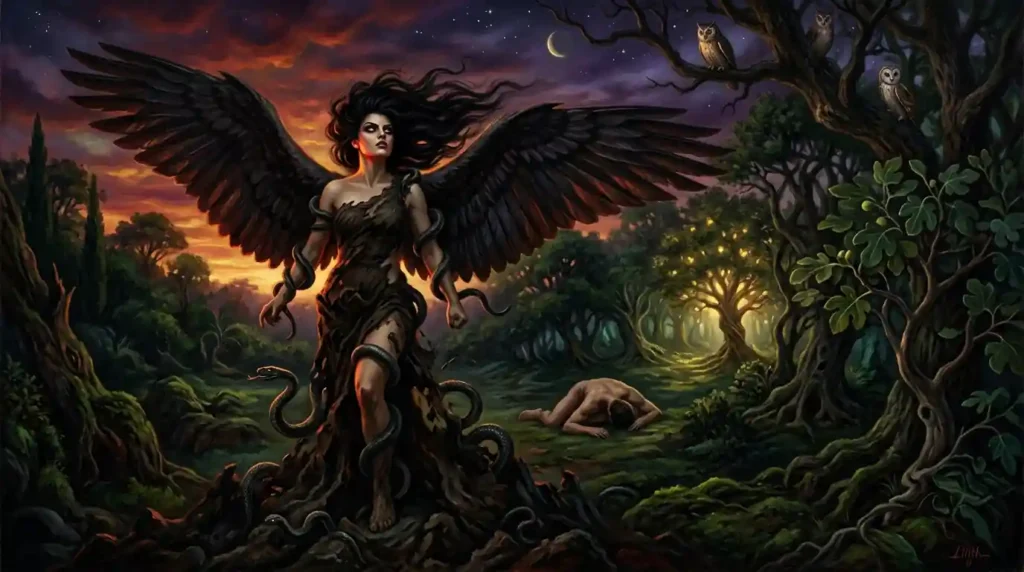
For over 4,000 years, the name Lilith has echoed through the mythology, theology, and folklore of civilizations spanning from ancient Sumer to the modern world. Yet the figure most people associate with Lilith — the rebellious first wife of Adam, the winged seductress of Kabbalistic lore, the feminist icon of contemporary spirituality — is a relatively recent construction, assembled centuries after her earliest appearances in the written record.
The real origins of Lilith lie not in the pages of the Hebrew Bible or medieval Jewish mysticism, but in the clay tablets and incantation bowls of ancient Mesopotamia. To truly understand who — or what — Lilith was before later traditions reshaped her, we must return to the cuneiform scripts of Sumer, Akkad, and Babylon, and examine the evidence with the precision it demands.
This article represents a comprehensive, scholarly analysis of the Mesopotamian origins of Lilith, drawing on verifiable archaeological evidence, primary textual sources, and decades of academic research. Here, we separate what can be historically confirmed from what has been embellished, misattributed, or invented by later traditions.
Etymological Origins: Tracking Lilith in Ancient Language
Understanding the Mesopotamian origins of Lilith begins with her name. The Hebrew word lilith (לִילִית) derives from the Akkadian lilītu, which is itself a feminine Nisba adjective built from the Proto-Semitic root LYL, meaning “night.” The literal translation of lilītu is “female night being” or “of the night” — a designation that immediately places Lilith within the domain of nocturnal phenomena and spirit activity.
The Líl- Class of Demons
In Akkadian demonology, lilītu was not a unique individual but part of a broader class of demonic spirits identified by the líl- element in their names. This class included:
- Lilû — a male demonic spirit
- Lilītu — a female demonic spirit (the direct ancestor of the Hebrew Lilith)
- Ardat lilî — literally “young woman of the lilû-type,” a particularly dangerous female spirit associated with sexual predation
- Eṭel lilî — a rarer male variant
As the Assyriologist Martin Worthington notes in his analysis published in the Journal des Médecines Cunéiformes, these líl-type demons were “among the many types of demons which plagued ancient Mesopotamians,” and their names were consistently written with the Sumerographic element LÍL, linking them etymologically to the concept of wind or air spirits.
A Critical Distinction: Lilītu vs. “Lilith”
One of the most important facts that separates scholarly analysis from popular mythology is this: the Akkadian lilītu and the Jewish Lilith are not identical figures.
While the name and certain demonic characteristics were transmitted from Mesopotamian to Hebrew culture, the fully developed character of Lilith as Adam’s first wife, as a child-killing succubus, as a consort of Samael was constructed over centuries by Jewish scribes, Talmudic scholars, and Kabbalistic mystics. The Mesopotamian lilītu was a class of spirit, not a singular mythological personality.
Some scholars, including the prominent Eberhard Schrader (1875) and Moritz Abraham Levy (1855), have argued that Lilith was a demon of the night known to the Jewish exiles in Babylon, suggesting a direct cultural transmission during the Neo-Babylonian period (6th century BCE).
This would place the Jewish adoption of the lilītu concept precisely during the period of Babylonian captivity, when Judean intellectuals were immersed in Mesopotamian literary and religious traditions.
However, this view has been challenged by scholars like Judit M. Blair, who argues that many of the biblical references attributed to Lilith actually describe unclean animals rather than supernatural beings, urging caution against reading Mesopotamian demonology directly into the Hebrew text.
Early Textual Evidence: Cuneiform Records from the Third Millennium BCE
The Akkadian lilītu appears in cuneiform texts dating back to approximately 3000 BCE, found in both religious and medical contexts across Mesopotamian civilization. These early references consistently associate the entity with wind spirits, nocturnal phenomena, and disease-bearing supernatural agents.
Medical and Exorcism Texts
Among the earliest attestations of líl-type spirits are Mesopotamian medical tablets, where illness was frequently attributed to demonic possession or spiritual affliction. The Utukku Lemnūtu (“Evil Demons”) incantation series — one of the most important Akkadian exorcism texts, with manuscripts preserved from multiple periods and cities — explicitly names líl-type demons among the malevolent forces requiring ritual expulsion.
A cuneiform tablet catalogued at the Metropolitan Museum of Art (MMA 86.11.367) preserves Tablet 12 of the Utukku Lemnūtu series, complete with the description of a scapegoat ritual designed to transfer demonic affliction from a human victim to an animal substitute. These rituals demonstrate the seriousness with which Mesopotamian practitioners regarded líl-type spirits — they were not abstract theological concepts but active threats requiring concrete ritual countermeasures.
Disease-Bearing Wind Spirits
Charles Fossey’s 1902 analysis of cuneiform inscriptions from Mesopotamia found that līlītu referred specifically to “disease-bearing wind spirits” — entities that traveled on nocturnal winds to afflict human victims with illness. This association between wind, night, and disease is one of the most consistent features of the lilītu across all periods of Mesopotamian literature, and it provides the oldest verifiable layer of the Lilith tradition.
The Sumerians called the equivalent spirit ki-sikil-líl-lá (sometimes transcribed as ki-sikil-lil-la-ke), which the Assyriologist Douglas Frayne has translated as “Young Woman Spirit.” In Semitic Akkadian, this became (w)ardat-lillā or ardat-lilî — both phrases carrying the same essential meaning.
The Sumerian Connection: Inanna and the Huluppu Tree
Sumerian sources provide some of our most vivid — and most debated — early references to the Lilith figure. The central text is the composition known as Gilgamesh, Enkidu, and the Netherworld (sometimes called Inanna and the Huluppu Tree), preserved on a tablet discovered at Ur and dating to approximately 2000 BCE.
The Story
According to Samuel Noah Kramer’s landmark study for the University of Chicago’s Oriental Institute (Assyriological Studies No. 10), the story describes a huluppu tree (most likely a willow) that had been planted on the bank of the Euphrates and nourished by its waters.
Uprooted by the South Wind and carried away by the Euphrates, the tree was retrieved by a goddess wandering along the riverbank. At the command of the gods Anu and Enlil, she brought it to the sacred garden of Inanna (Ishtar) in Uruk.
Inanna planned to use the mature wood to fashion a throne and a bed — objects of both practical and sacred significance. But after ten years of growth, when she came to harvest the tree, she found three supernatural squatters had taken up residence:
- In the roots: a serpent “which fears no spell”
- In the trunk: the ki-sikil-líl-lá-ke (the spirit that would later be identified with Lilith)
- In the branches: the Anzu bird (Zu bird), which had placed its young there
Inanna, distressed and unable to remove these creatures, called upon her brother Gilgamesh for help. The hero made light of his heavy armor, slew the serpent in the roots, and thereby caused the Anzu bird to flee with its young to the mountains and the ki-sikil-líl-lá-ke to fearfully destroy her dwelling and escape into the wilderness.
The Translation Controversy
The identification of ki-sikil-líl-lá-ke with “Lilith” in this Sumerian text has generated significant scholarly debate. Early translators, including Kramer himself (1967) and Diane Wolkstein and Kramer (1983), rendered the term directly as “Lilith,” creating an immediate and powerful connection between the Sumerian text and the later Jewish demoness. Cyril J. Gadd’s preliminary translation of 1933 went even further, describing the figure as “the shrieking maid, the joyful, the bright queen of Heaven.”
However, modern translations have revised this reading significantly. Contemporary scholars now translate the passage as: “In its trunk, the phantom maid built herself a dwelling, the maid who laughs with a joyful heart. But holy Inanna cried.” The difference is substantial — the modern translation neither implies an association with owls (as Gadd’s version did) nor asserts the god-like nature of the figure.
Indeed, Gadd himself acknowledged in 1933 that “ardat-lilî (kisikil-lil) is never associated with owls in Babylonian mythology” and that “the Jewish traditions concerning Lilith in this form seem to be late and of no great authority.” This honest assessment from the very first translator of the text underscores how much of the popular Lilith narrative was constructed after the fact.
As the scholar Lowell K. Handy has argued, while the Hebrew Lilith likely derives from Mesopotamian demonology, the evidence for the specific figure of Lilith being present in the sources most frequently cited — including the Sumerian Gilgamesh fragment — is “scant, if present at all.”
Inanna’s Temple and Feminine Power
Despite the scholarly caution around direct identification, the Huluppu Tree narrative reveals something genuinely important about the líl-type spirits in Sumerian thought: their association with Inanna’s sacred space.
Older Sumerian accounts describe lilītu as the “handmaiden of Inanna” or the “hand of Inanna.” The Sumerian texts state that “Inanna has sent the beautiful, unmarried, and seductive prostitute Lilitu out into the fields and streets in order to lead men astray.” Babylonian texts similarly depict Lilith as “the prostitute of the goddess Ishtar (Inanna).”
This connection to Inanna — the Sumerian goddess of love, war, fertility, and sexuality — is one of the most underappreciated aspects of Lilith’s Mesopotamian origins. Rather than being purely malevolent, the lilītu spirits functioned within a religious framework that recognized feminine sexual power as both sacred and dangerous.
They were agents of Inanna’s domain, embodying the untamed, boundary-crossing aspects of female sexuality that Mesopotamian society simultaneously venerated and feared.
Archaeological Findings: Physical Evidence from the Ancient World
Beyond textual sources, the Mesopotamian origins of Lilith are supported by a substantial body of physical archaeological evidence — clay tablets, protective amulets, incantation bowls, and architectural reliefs discovered across the ancient Near East.
Clay Tablets from Ur and Babylon
The primary textual evidence for líl-type spirits comes from cuneiform clay tablets excavated at major Mesopotamian archaeological sites, including Ur, Babylon, Nippur, and Uruk. These tablets, now preserved in museums around the world (including the British Museum, the Metropolitan Museum of Art, the University of Pennsylvania Museum, and the Oriental Institute of the University of Chicago), record exorcism rituals, medical diagnoses, temple hymns, and mythological narratives that collectively document the lilītu tradition across nearly three millennia.
The Utukku Lemnūtu tablets, the Maqlû (“Burning”) incantation series, and the Šurpu (“Incineration”) ritual texts all contain references to líl-type demons and the rituals designed to combat them. These are not marginal or obscure texts — they represent some of the core liturgical and therapeutic literature of Mesopotamian civilization.
The Arslan Tash Amulets
Among the most controversial — and potentially significant — archaeological objects linked to the Lilith tradition are the Arslan Tash amulets. These limestone plaques were discovered in 1933 at Arslan Tash (ancient Hadattu) in northern Syria and bear Phoenician incantations inscribed in Aramaic script, dated on paleographic grounds to the 7th century BCE.
The first amulet depicts a carved figure — described by scholars as having the body and tail of a lion and a human face — accompanied by an incantation text that includes apparent references to night demons (llyn in Aramaic, interpreted by Frank Moore Cross and Richard Saley as “night demons”). The amulet is perforated at the top, suggesting it was suspended by a cord over a door or within a house as a protective talisman. Cross and Saley (1970) even argued that the Arslan Tash plaque may have been “a pagan prototype of the mĕzūzāh, the Israelite portal inscription.”
The authenticity of the Arslan Tash amulets has been debated since the 1980s. Challenges were raised by Javier Teixidor (1983), Pierre Amiet (1983), Matthias Köckert (2003), and Gregorio del Olmo Lete (2004). However, the amulets’ authenticity has been defended by scholars including Frank Moore Cross, Richard Saley (2003), José-Ángel Zamora (2003), and Rüdiger Schmitt (2004). As Jacobus van Dijk noted in his 1992 analysis, “any discussion of the texts and depictions on the Arslan Tash amulets must now begin with the question as to whether the tablets are indeed modern forgeries or not.”
If authentic, the amulets represent pre-Jewish evidence that the name and concept of Lilith-type demons had spread beyond Mesopotamia proper into the broader Semitic world by the 7th century BCE — a date that would predate the Babylonian exile and complicate the standard narrative of Jewish cultural borrowing.
Incantation Bowls from Nippur and Beyond
Perhaps the most abundant and vivid archaeological evidence for the Lilith tradition comes from Aramaic incantation bowls — ceramic vessels inscribed with protective spells and buried upside-down beneath the floors of homes throughout Mesopotamia during the Sasanian period (approximately 3rd–7th centuries CE).
The first major scholarly study of these bowls was James Montgomery’s Aramaic Incantation Texts from Nippur (1913), based on bowls excavated from the Jewish settlement at Nippur by the University of Pennsylvania’s archaeological expedition beginning in 1888. As researcher Yael Elitzur-Leiman has noted, the Penn incantation bowls “were a watershed in the study of ancient Jewish magic and amulets” and remain “the first and the only major group of such items that emerged from a documented archaeological excavation.”
To date, at least 2,000 incantation bowls have been registered as archaeological finds, though scholars estimate tens of thousands more may exist in private collections and among antiquities traders. Key characteristics of these bowls include:
- Inscriptions in spiral patterns, beginning at the rim or center and spiraling outward, written in Jewish Babylonian Aramaic, Mandaic, or Syriac
- Depictions of shackled demons, often featuring a figure with hairy bird feet reminiscent of ancient Mesopotamian goddesses and demons (like Pazuzu)
- Explicit invocations against Lilith, naming her as a primary demonic threat requiring ritual containment
- Legal formulas of “divorce” from demons, paralleling Talmudic legal language found in tractate Gittin 85b
- Client names, revealing that virtually every house excavated in the Jewish settlement at Nippur had such bowls buried in them
The bowls were used to protect against evil influences including the evil eye, Lilith, and Bagdana (another demon). The inscription on one well-known bowl at Harvard University’s Semitic Museum reads: “Removed and chased are the curses and incantations from Quqai son of Gushnai, and Abi daughter of Nanai and from their children.” Though Lilith’s name does not appear on this particular bowl, she is identified by comparison with images on other bowls where she is depicted with raised arms and skin “spotted like a leopard’s.”
A particularly noteworthy detail from the archaeological record is that bowls produced by different faith communities — Jewish, Christian, Mandaean — were sometimes found in the same house, and there is evidence that clients crossed religious lines to acquire bowls from practitioners of other traditions. This suggests that the fear of Lilith transcended the boundaries of any single religious community in late antique Mesopotamia.
The Burney Relief: “The Queen of the Night”
No discussion of Lilith’s archaeological footprint is complete without addressing the Burney Relief (also known as “The Queen of the Night”), a Mesopotamian terracotta plaque in high relief dating to the Old Babylonian period (approximately 1800–1750 BCE).
Now housed in the British Museum, the relief depicts a curvaceous, nude, winged female figure with bird talons for feet, standing upon two reclining lions and flanked by owls. She wears a horned headdress — the characteristic marker of Mesopotamian divinity — and holds the ring-and-rod of justice, a symbol of divine authority.
The relief’s identification has been one of the most hotly contested questions in ancient Near Eastern art history:
The Lilith Identification: Henri Frankfort and Emil Kraeling first proposed in 1937 that the figure represented Lilith, drawing on Kramer’s translation of the Gilgamesh fragment. Raphael Patai (1990) later championed this identification, calling the relief potentially “the only existent depiction of a Sumerian female demon called a lilitu” and describing the figure as: “She is slender, well-shaped, beautiful and nude, with wings and owl-feet. She stands erect on two reclining lions which are turned away from each other and are flanked by owls.
On her head she wears a cap embellished by several pairs of horns. In her hands she holds a ring-and-rod combination. Evidently, this is no longer a lowly she-demon, but a goddess who tames wild beasts and, as shown by the owls on the reliefs, rules by night.”
The Inanna/Ishtar Identification: Thorkild Jacobsen later identified the figure as Inanna, based on symbols and attributes commonly associated with the goddess, including the rod-and-ring, the nudity (associated with Ishtar’s role as goddess of sexual love), and the lions (Ishtar’s sacred animals). He noted that the owls could be linked to Ishtar through a “cluster of metaphors linking prostitute and owl and the goddess Inanna/Ishtar,” and even suggested the relief may have originally served as “the house-altar of a bordello.”
The Ereshkigal Identification: The British Museum itself currently favors a third identification: Ereshkigal, Ishtar’s sister and rival, the goddess of the Underworld. This interpretation is supported by the downward-pointing wings (indicating an Underworld deity) and the originally black background (suggesting night or the underworld).
Modern scholarly consensus has moved away from the Lilith identification, though it remains popular in non-academic writing. Thermoluminescence testing has confirmed the relief’s authenticity, dating it between 1765 and 45 BCE — establishing it as a genuine artifact of Old Babylonian artistic production, whatever figure it ultimately represents.
The Lamashtu Connection: Distinguishing Lilith from Her Demonic Counterpart
Any thorough examination of Lilith’s Mesopotamian origins must address her relationship to another fearsome female demon of Mesopotamian mythology: Lamashtu (Akkadian: Lamaštû). While Lilith and Lamashtu are frequently conflated in popular writing, they are distinct figures in the Mesopotamian textual and archaeological record — though their traditions likely influenced each other over time.
Who Was Lamashtu?
Lamashtu was depicted as a terrifying hybrid creature with the head of a lioness (or lion-griffin), the ears of a donkey, the body of a woman, and fingers or toes ending in sharp claws or talons. She was shown standing or kneeling atop a donkey, clutching snakes, and surrounded by scorpions. In some depictions, reptiles hung from her pendulous breasts rather than nursing infants — a horrific inversion of the maternal role.
Unlike most Mesopotamian demons, who acted under the direction of higher gods, Lamashtu was uniquely autonomous — she acted according to her own malevolent will. This made her unpredictable and especially terrifying. Her primary targets were pregnant women, mothers in labor, and newborn infants, whom she was believed to snatch and devour. She was also associated with nightmares, stillbirths, and the poisoning of breast milk.
Key Differences from Lilītu
While both Lamashtu and lilītu were feared female supernatural entities, they occupied different positions in the Mesopotamian demonic hierarchy:
| Feature | Lilītu | Lamashtu |
|---|---|---|
| Nature | Wind/night spirit class | Individual goddess-demon |
| Autonomy | Acted as part of a spirit class | Uniquely autonomous, self-directed |
| Appearance | Associated with wind, night | Hybrid lion-donkey-human form |
| Primary threat | Sexual predation, disease | Infant death, maternal illness |
| Protective counter | Incantations, amulet bowls | Pazuzu amulets, Lamashtu plaques |
| Association | Handmaiden of Inanna | No divine patron |
The scholar who authored The Transformations of a Goddess: Lillake, Lamashtu, and Lilith (Academia.edu, 2018) proposed that the Jewish Lilith may be a syncretization of multiple Mesopotamian figures — including Lillake (ki-sikil-líl-lá), lilītu, ardat lilî, and Lamashtu — whose distinct traditions merged and blended as they were transmitted across cultures and centuries. The child-killing and infant-threatening aspects of the later Jewish Lilith, for example, align more closely with Lamashtu than with the Akkadian lilītu, suggesting that Lamashtu’s mythology was absorbed into the Lilith tradition at some point during the transmission process.
The Dead Sea Scrolls: The Oldest Hebrew Reference
The oldest verifiable Hebrew-language reference to Lilith as a supernatural entity — as distinct from a common noun meaning “night creature” — appears not in the biblical text of Isaiah, but in the Dead Sea Scrolls.
Songs of the Sage (4Q510-511)
The fragmentary manuscripts known as Songs of the Sage (also called Songs of the Maskil), catalogued as 4Q510 and 4Q511, are Hebrew-language texts of incantation and exorcism found among the Qumran scrolls. These manuscripts are notable for containing what scholars consider “the first clear usage of the Hebrew (or Aramaic) term lilith in relation to a supernatural creature.”
The text lists Lilith among a catalog of demonic entities — including “spirits of the bastards, demons, Lilith, howlers, and desert dwellers” — against which the Maskil (a community instructor or sage) recites protective incantations. The composition is comparable to the Aramaic incantation text 4Q560 and also to 11Q11, another exorcistic composition from Qumran.
The Dead Sea Scrolls reference is significant because it establishes that by the 2nd–1st century BCE, Jewish communities in the Land of Israel had already adopted lilith as a demonic category — not merely a word for a nocturnal animal, but a named supernatural threat requiring formal ritual protection.
Isaiah 34:14: The Biblical Question
The sole potential biblical reference to Lilith appears in Isaiah 34:14, within a passage describing the desolation of Edom:
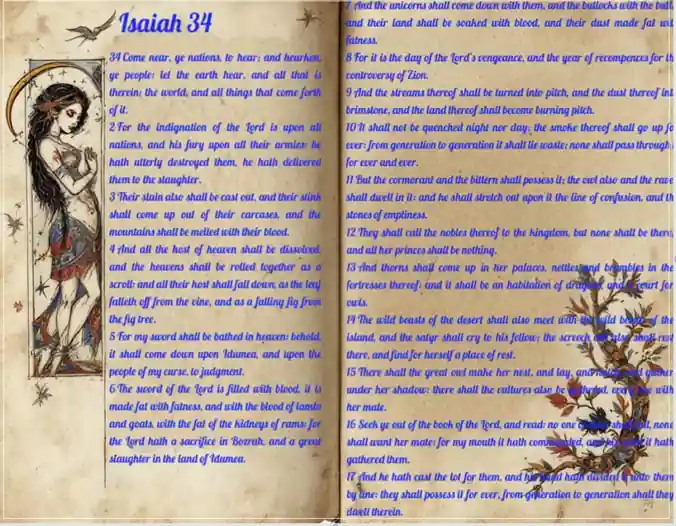
“The wild beasts of the desert shall also meet with the wild beasts of the island, and the satyr shall cry to his fellow; the screech owl also shall rest there, and find for herself a place of rest.” (King James Version)
The Hebrew word translated here as “screech owl” is lilith (לִילִית). Translations vary dramatically:
- KJV: “screech owl”
- NKJV: “the night creature”
- NRSV: “Lilith” (capitalized, treating it as a proper name)
- NIV: “the night creatures”
The word occurs only once in the entire Hebrew Bible, making its precise meaning inherently difficult to determine from context alone. Strong’s Concordance suggests “screech owl,” and the surrounding context of wild animals in abandoned places supports a zoological rather than demonological reading.
However, the phonetic similarity between Hebrew lilith and Akkadian lilītu has led many scholars to perceive an overlap with the Mesopotamian demonological tradition. The scholarly debate remains unresolved, with Judit M. Blair arguing that the context indicates an unclean animal, while others maintain that the Isaiah passage reflects a genuine encounter between the Hebrew prophetic tradition and Mesopotamian demonology — particularly if Deutero-Isaiah is dated to the 6th century BCE during the Babylonian exile, when Judean scribes would have been thoroughly exposed to Mesopotamian lilītu beliefs.
Historical Evolution: From Wind Spirit to Feminist Icon
The concept of Lilith evolved through distinct phases, each adding new layers of meaning while progressively distancing the figure from her Mesopotamian origins.
Early Phase (c. 3000–2000 BCE): The Wind Spirit
In the earliest Sumerian and Akkadian texts, lilītu spirits are nature spirits associated with wind, night, disease, and sexual transgression. They are not individual personalities but a class of demonic beings — comparable to how “vampire” or “ghost” functions as a category in English rather than a personal name. Their primary characteristics included:
- Association with nocturnal wind and storms
- Causing illness and disease in human victims
- Sexual predation (especially the ardat lilî variant, who preyed on sleeping men)
- Connection to Inanna’s temple and sacred prostitution
- Inhabiting liminal spaces (deserts, ruins, wild places)
Middle Phase (c. 2000–500 BCE): Ritual and Protection
During this period, the Mesopotamian response to líl-type demons became increasingly formalized. The major exorcism series (Utukku Lemnūtu, Maqlû, Šurpu) were compiled and standardized. Protective amulets and rituals proliferated. The Arslan Tash amulets (if authentic) suggest the tradition had spread to Syria and the broader Levant by the 7th century BCE.
The Huluppu Tree narrative (c. 2000 BCE) places the ki-sikil-líl-lá in a specific mythological context for the first time — as a squatter in Inanna’s sacred tree, driven out by Gilgamesh. This is the earliest narrative (as opposed to purely ritual or medical) treatment of a Lilith-type figure.
By the 6th century BCE, the Jewish exile in Babylon created conditions for the direct transmission of lilītu beliefs into Hebrew religious culture. The Isaiah reference (if demonological rather than zoological) may date to this period, as may the earliest Jewish adoption of lilith as a named demonic category.
Late Antiquity (c. 500 BCE–700 CE): The Incantation Bowl Period
The incantation bowls from Nippur and other Mesopotamian sites (approximately 3rd–7th centuries CE) document the most extensive evidence of everyday belief in Lilith. During this period, the Sasanian Persian empire ruled Mesopotamia, and its diverse population of Jews, Christians, Mandaeans, Manichaeans, and Zoroastrians all participated in a shared magical culture that included Lilith as a recognized threat.
The bowls show Lilith transitioning from a class of spirit to something closer to a named individual — the shackled demoness depicted on the bowls has specific iconographic features (raised arms, spotted skin, bird feet) that suggest a standardized visual identity. The Babylonian Talmud (finalized c. 500–600 CE) mentions Lilith in several passages (Eruvin 100b, Niddah 24b, Shabbat 151b, Bava Batra 73a), describing her as having long hair, wings, and the characteristics of a succubus.
Medieval Phase (c. 700–1500 CE): Adam’s First Wife
The transformation of Lilith from a Mesopotamian wind demon into Adam’s rebellious first wife occurred in the anonymous medieval Jewish text known as The Alphabet of Ben Sira (c. 700–1000 CE). This satirical work introduced the narrative that Lilith was created from the same dust as Adam, refused to “lie beneath” him because they were equals, uttered the ineffable Name of God to gain wings, and fled to the Red Sea where she mated with demons and birthed one hundred demon-children daily.
This medieval narrative has no basis in Mesopotamian sources — it is a Jewish literary invention, likely crafted to reconcile the two different creation accounts in Genesis (1:27 and 2:22). However, it drew upon the accumulated centuries of Lilith-related demonology to create a figure that was simultaneously terrifying and sympathetic — a powerful woman punished for demanding equality.
The Zohar (13th century) and Kabbalistic tradition further developed Lilith’s mythology, establishing her as the consort of Samael (the angel of death), the queen of demons, and a cosmic force of darkness. These traditions contain 48 references to Lilith and describe her creation as preceding Adam’s, on the fifth day of creation.
Modern Phase (1800s–Present): The Feminist Reclamation
In the 19th and 20th centuries, Lilith underwent yet another transformation — this time from demonic threat to feminist symbol. The Pre-Raphaelite poet Dante Gabriel Rossetti (1828–1882) reimagined Lilith as a figure of dangerous allure, while 20th-century feminist theologians and writers reclaimed her as an archetype of female autonomy, sexual liberation, and resistance to patriarchal authority.
In some contemporary spiritual traditions, Lilith is viewed as the embodiment of the Goddess — a designation shared with what these traditions believe to be her counterparts: Inanna, Ishtar, Asherah, Anath, Anahita, and Isis. Whether or not this identification is historically supportable, it represents the latest chapter in a 4,000-year process of mythological evolution.
Scholarly Debate: What Modern Academia Confirms and Disputes
The academic study of Lilith’s Mesopotamian origins has produced both areas of firm consensus and ongoing scholarly dispute. Here is what modern research can and cannot confirm:
Confirmed by Academic Evidence
- The existence of lilītu in Akkadian cuneiform texts dating to the third millennium BCE
- Multiple Sumerian literary references to líl-type spirits, including the ki-sikil-líl-lá in the Huluppu Tree narrative
- Archaeological evidence of protective rituals against líl-type demons, including incantation bowls, amulets, and exorcism tablets
- Consistent associations with night, wind, and disease across all periods of Mesopotamian literature
- The etymological derivation of Hebrew lilith from Akkadian lilītu via Proto-Semitic LYL (“night”)
- The existence of the Dead Sea Scrolls reference (4Q510-511) as the oldest clear Hebrew-language usage of lilith as a supernatural term
- The authenticity of the incantation bowls from Nippur and other Sasanian-period sites
- Cross-cultural transmission of lilītu beliefs from Mesopotamian to Hebrew religious culture
Disputed or Unresolved
- Whether ki-sikil-líl-lá-ke in the Huluppu Tree should be translated as “Lilith” or simply as a generic phantom/spirit
- The identity of the Burney Relief figure (Lilith, Inanna/Ishtar, or Ereshkigal)
- The authenticity of the Arslan Tash amulets and their implications for the pre-exilic spread of Lilith beliefs
- Whether Isaiah 34:14 refers to a demon, a screech owl, or a generic night creature
- The precise mechanism of cultural transmission from Mesopotamian lilītu to Jewish lilith
- Whether Lilith was originally a class of spirits or a singular entity in the earliest Mesopotamian sources
- The degree to which Lamashtu’s characteristics were absorbed into the later Lilith tradition
Frequently Asked Questions About Lilith’s Mesopotamian Origins
Was Lilith a real Mesopotamian goddess?
Not exactly. In the earliest Mesopotamian sources, u003cemu003elilītuu003c/emu003e was not a goddess but a class of wind and night spirits associated with disease and sexual predation. Over time, certain depictions (particularly the Burney Relief, if it represents u003cemu003elilītuu003c/emu003e) suggest the figure may have acquired divine status in some traditions. Some scholars propose that the Canaanites called her u003cemu003eBaalatu003c/emu003e (u0022Divine Ladyu0022), though this identification remains debated.
Is Lilith mentioned in the Bible?
The Hebrew word u003cemu003elilithu003c/emu003e appears once in the Bible, in Isaiah 34:14. However, there is no scholarly consensus on whether this refers to the Mesopotamian demoness, a nocturnal animal (such as a screech owl), or a generic u0022night creature.u0022 The fully developed mythological Lilith — Adam’s first wife — does not appear in any biblical text.
What is the oldest text that mentions Lilith?
The oldest narrative reference is the Sumerian composition u003cemu003eGilgamesh, Enkidu, and the Netherworldu003c/emu003e (c. 2000 BCE), which mentions u003cemu003eki-sikil-líl-lá-keu003c/emu003e dwelling in Inanna’s Huluppu Tree. The oldest medical/ritual references to u003cemu003elíl-u003c/emu003etype spirits in cuneiform texts date to approximately 3000 BCE.
Were Lilith and Lamashtu the same demon?
No. Lilith (u003cemu003elilītuu003c/emu003e) and Lamashtu (u003cemu003eLamaštûu003c/emu003e) were distinct figures in Mesopotamian demonology. Lamashtu was a specific, autonomous demon-goddess who preyed on mothers and infants, while u003cemu003elilītuu003c/emu003e was a class of wind/night spirits associated with disease and sexual predation. However, their traditions may have merged over time as they were transmitted into Jewish folklore.
What were incantation bowls used for?
Incantation bowls were ceramic vessels inscribed with protective spells in Aramaic and buried upside-down beneath the floors of homes in Mesopotamia during the Sasanian period (c. 3rd–7th centuries CE). They were used to trap and neutralize demons — including Lilith — and protect households from supernatural threats. Over 2,000 bowls have been registered as archaeological finds, with estimates of tens of thousands more in private collections.
Did the Sumerians worship Lilith?
There is no evidence that the Sumerians worshipped u003cemu003elilītuu003c/emu003e spirits. These entities were feared and ritually expelled, not venerated. However, their connection to Inanna’s temple suggests they operated within the broader religious framework of the goddess’s cult, serving as agents of her wild and untamed aspects.
Conclusion: The Weight of Evidence
The Mesopotamian origins of Lilith are not a matter of speculation — they are documented in clay, inscribed in cuneiform, and preserved in the archaeological record of one of humanity’s oldest civilizations. The lilītu of ancient Sumer and Akkad was a wind spirit, a night demon, a class of supernatural beings that afflicted the living with disease and unwanted desire. She was feared, contained, and ritually expelled for over three thousand years before she ever became Adam’s first wife, a Kabbalistic queen of darkness, or a modern symbol of feminine liberation.
What separates the Mesopotamian lilītu from the Lilith of later tradition is not merely chronology but fundamental character. The wind spirits of ancient Mesopotamia were not individuals with personal narratives — they were forces of nature, as impersonal as a plague wind or a fever dream. The rich mythology that surrounds Lilith today — her defiance, her exile, her dangerous sexuality, her maternal vengeance — was constructed over millennia by successive cultures, each projecting its own anxieties and ideals onto an ancient name.
To understand Lilith, then, is to understand something profound about the human relationship with darkness, feminine power, and the stories we tell to make sense of both. The clay tablets of Mesopotamia do not give us the whole story — but they give us the foundation upon which everything else was built.
This historical analysis is based on three decades of studying ancient texts, peer-reviewed scholarly research, and verified archaeological findings. It separates confirmed historical facts from later interpretations and popular mythology.