
Table of Contents
God Bael Before the Fall: The Forgotten Origins of a “Demon King”
What emerges is no demon at all. Instead, you encounter a god.
God Bael Before the Fall: The name Bael evolved from Baal, an ancient Semitic term translating to “lord,” “master,” or “owner.” This distinction matters greatly. Baal originally served as a title, not a lone entity. Across the ancient Near East, it honored mighty deities, with each area claiming its own Baals—local lords overseeing key life elements like nature and survival. Eventually, one stood out above the rest: Baal Hadad, Canaan’s mighty storm god.
In ancient Canaanite religion, Baal stood as no minor spirit. He ranked among the pantheon’s central gods, linked to storms, thunder, rain, fertility, agriculture, and battles against chaos like sea god Yam and death god Mot.
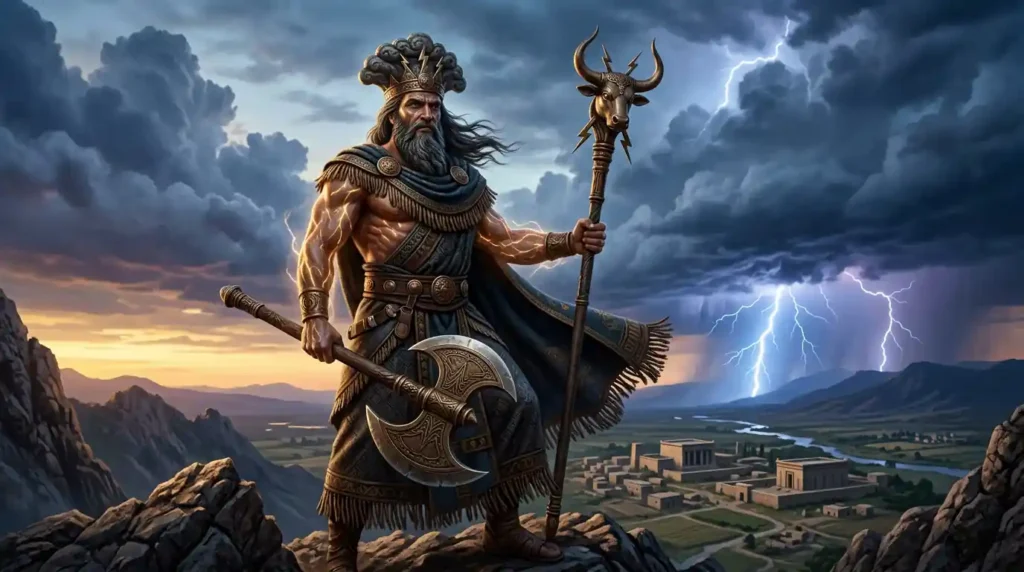
To agrarian communities, Baal proved vital: rain brought crops, crops ensured survival, and survival depended on Baal. Depictions showed him as a lightning-wielding warrior atop mountains, ruling the skies—not hell. His realm was the heavens.
The Baal Cycle: Myth Before Demonization
Ugaritic texts preserve Baal’s key mythology, especially the Baal Cycle, among the Near East’s earliest epic tales. These tales portray Baal not as evil, but as a heroic power upholding order and life.
His Enemies:
Yam (sea and chaos)
Mot (death and sterility)
Baal vanquishes Yam to tame chaos, then battles Mot, experiencing death and resurrection that reflect drought and renewal cycles. This differs from demonic lore. Rather, it forms cosmic mythology, illuminating life, death, and rebirth via godly conflicts.
Baal as Life-Giver
Worship practices linked Baal closely to fertility:
Rain and dew for crops
Seven-year abundance cycles
Rituals with bull sacrifices
Societies erected temples, offered gifts, and relied entirely on his blessings. Followers saw Baal not as a danger. He embodied necessity.
The Turning Point: Rival Gods and Cultural Conflict
God Bael Before the Fall, as Baal’s shift to demon status unfolded gradually, sparked by religious rivalries. Early Israelite faith focused on one god, Yahweh, turning the once-dominant Baal into a rival. This rivalry appears clearly in biblical narratives, where Baal worship is condemned as false or corrupt. From a historical perspective, this reflects:
Theological consolidation under Yahweh
Cultural clashes in the region
Baal held no innate evil; opponents of his worship branded him as such.
From God to Idol to Enemy
Linguistic and symbolic changes marked the next phase. Hebrew texts redefined Baal from “lord” to:
False idol
Corrupt influence
Here, views solidified. Labeling a deity false leads inevitably to the next phase. It turns hostile.
Beelzebub: The First Corruption
before the fall Bael’s key evolution involves Beelzebub, stemming from Baal-zebub. It first named a Philistine god honored in Ekron. Yet the name likely served as intentional mockery. Rather than “lord of the high dwelling,” it became: “Lord of the flies.” Experts view it as a derisive twist, linking Baal to decay, filth, and corruption. This was deliberate. It represents linguistic ideological combat.
The New Testament Shift: From Rival to Demon
Early Christianity finalized the change. Beelzebub transcended mere rivalry. He is explicitly identified as:
Prince of demons
Satan himself
This signals a pivotal change:
Full demonization
Integration into infernal hierarchy
It forms the basis of Christian demonology.
The Birth of Bael in Demonology
In medieval and early modern eras, grimoires organized demons into structured hierarchies. Here, Bael emerges in his known guise. In texts like:
The Lesser Key of Solomon
Pseudomonarchia Daemonum
Bael appears as:
King of Hell
Three-headed (man, toad, cat)
Invisibility granter, with fiery presence
Yet it is no fresh entity. It reimagines the original. The old storm god now fits a structured hellish hierarchy.
Why Baal Became Bael
Baal to Bael traces a historical pattern:
Rival god labeled false
Mocked via wordplay
Absorbed into enemy lore
Baal’s fate was not singular; numerous pre-Christian gods met similar demonization. Baal’s stature amplified the drama of his decline. He went from:
Storm lord and life-bringer
To feared demon king
Fragmentation of Identity
Baal was never a solitary deity. Multiple Baals existed:
Baal Hadad (storm)
Baal Peor (local variants)
Baal Zaphon (mountain)
Demonology later fused, warped, or divided these identities into new forms. They seem linked yet distinct. These are shards of a former broad divine title.
The Psychological Reversal
A profound layer underlies this shift. Baal embodied:
Storms, rain, raw nature
Such forces prove unpredictable, overpowering, and hard to master. Monotheism’s focus on order, submission, and sole rule cast these ancient powers as threats. So they were reframed as:
Chaotic evils
Infernal temptations
This transcends mere theology. It reshapes human-power dynamics.
Bael as a Memory of Power
Baal’s primal essence lingers in demonology. Bael grants:
Invisibility
Legions command
These traits hold purpose. They reflect primeval Baal:
Storm command (hidden strikes)
Kingship over forces
The demon retains the god’s shadow.
Conclusion: The Demon That Was a God
Bael originated not as a demon. He started as a power title. He grew into a storm and fertility god, pivotal in humanity’s ancient mythologies. Cultural clashes, faith rivalries, and doctrinal shifts later recast him otherwise. Something shadowy. Something dreaded. Bael’s tale exceeds a mere demon. It reveals how power is redefined. How gods become enemies. And how, over time, reverence can be rewritten into fear.
if you enjoyed reading This check out the sequel: bael in the goetia
Pingback: Understanding Bael In The Goetia Vs Baal The God
Pingback: Bael Before Demonization: The God Behind The Name
intriguing, scary, badass, insightful, thought provoking