
Bael Before Demonization: The God Behind the Name
Bael Before Demonization was a period when the being later recorded in demonology was known as Baal, and specifically Baal Hadad. This entity was neither a demon nor a dark spirit, but a central deity of the ancient Canaanite and Northwest Semitic world who was worshipped thousands of years before the existence of Christianity.
The word Baal itself did not originally refer to a single entity. It meant “lord” or “master.” It was a title, much like “king” or “sovereign.” Over time, one specific Baal rose above the others in prominence. That was Baal Hadad.
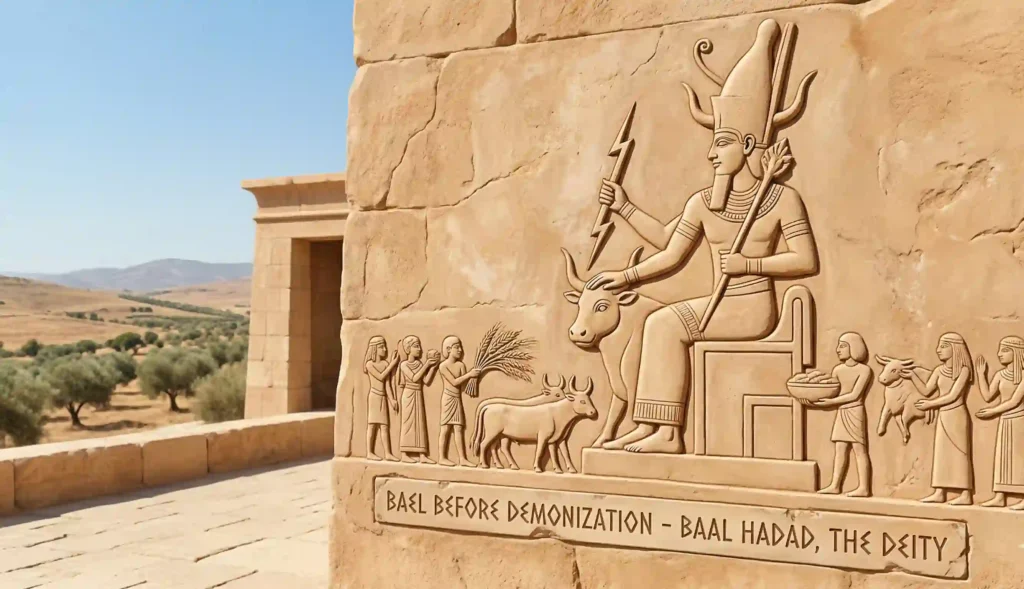
Baal Hadad: The Storm and Fertility God
Baal Hadad was a storm god, and in ancient societies, that meant power over life itself.
His domains included:
- Rain and thunderstorms
- Fertility of the land
- Agricultural cycles
- Seasonal renewal
In a world dependent on crops and rainfall, this made him one of the most important gods in the region.
He was often depicted:
- Holding a lightning bolt
- Standing atop mountains
- In a warrior stance, symbolizing dominance over nature
He was not feared as evil. He was respected as necessary.
Without Baal, there was drought. Without drought, there was survival.
The Mythological Role: Order Against Chaos
The oldest known stories about Baal come from the Ugaritic texts (around 1400–1200 BCE), especially what is now called the Baal Cycle.
In these myths, Baal is not destructive for the sake of destruction. He is a force of order and life.
He battles two major figures:
- Yam, the sea, representing chaos and uncontrolled forces
- Mot, death, representing drought and sterility
Baal defeats Yam and temporarily overcomes Mot. His struggle with Mot reflects the seasonal cycle:
- Baal’s “death” = dry season
- Baal’s return = rains and fertility
This is not demonic behavior.
This is cosmic balance mythology, explaining how life continues.
His Place in the Pantheon
Baal was not alone. He existed within a structured divine system.
Key figures included:
- El – the high god, father figure of the pantheon
- Asherah – a mother goddess associated with fertility
- Anat – Baal’s sister and ally, a fierce warrior goddess
Baal’s role was not to rule everything, but to control the active forces of the world, especially weather and growth.
He was the god people prayed to when they needed results.
Worship and Cultural Importance
Baal’s worship was widespread across:
- Canaan
- Phoenicia
- Parts of Syria and the Levant
Rituals and offerings were tied directly to survival:
- Prayers for rain
- Agricultural rites
- Seasonal ceremonies
To his followers, Baal was not optional.
He was the difference between famine and abundance.
Why His Image Changed
The shift away from Baal being seen as a god began with religious conflict, not inherent evil.
As early Israelite religion developed, it moved toward exclusive worship of one god. Baal, being one of the most popular competing deities, became a direct rival.
From that point:
- Baal worship was condemned
- His followers were portrayed negatively
- His identity was reframed as false or corrupt
Over generations, this reframing intensified.
A rival god became a false god.
A false god became something dangerous.
Eventually, something dangerous became demonic.
The Transition Into Bael
By the time medieval grimoires were written, the original Baal had already been transformed through centuries of reinterpretation.
The name shifted slightly:
And the identity changed completely:
- Storm god → King of demons
But the structure of authority remained:
- He is still called a king
- He still commands legions
- He still embodies power
This is not coincidence.
It is a distorted echo of his original divine status.
The Truth of His Origin
Bael did not begin as something dark or infernal.
He began as:
- A title meaning “lord”
- A god of storms and fertility
- A central figure in ancient myth and survival
The demon came later.